
Let’s Talk About Ms.

You do not know if Ms. Marvel is married from her title

You do not know if Ms. Marvel is married from her title

We’ve already addressed honorifics, but for some reason I keep seeing people confused about Ms.! So now you all get a primer.

To understand Ms., let’s think about Mr. If someone is introduced to you as “Mr. Gary Noodlebaker,” what do you know about them? You know they identify as male, and…that’s pretty much it. You don’t know if he’s married or single, if that’s his birth name, or anything about his profession. You just know he’s male. Ms. operates similarly, and can be used by any woman. As “Ms. Jaya Saxena,” you know I identify as a woman, and that’s it. I could be married, I could be single, but that’s not revealed by my title. This is great.

However, there are a few other options for women, since marital status is something that’s been treated as more important for women than for men. Miss is the honorific generally used for young, unmarried women. (Master is sometimes used for young boys in the UK, but it’s not as common as Miss.) Mrs. is used when a woman is married and has taken her husband’s last name, but even then she can still use Ms., it just becomes a matter of preference. Some people think it’s a generational thing, but I’ve met many younger married women who have taken their husbands last names and prefer Mrs. However, you do not have to use Mrs. once you are married., so I do believe that when in doubt you should use Ms.

Also, if a woman has married and hasn’t taken her husband’s last name, you use Ms. This seems to confuse a lot of people, who think that something has to change about the way you address a woman when she gets married. But considering nothing has to change about a man’s name, the same goes for women!

So what’s so confusing? According to Wikipedia, “Mrs originated as a contraction of the honorific Mistress, the feminine of Mister, or Master, which was originally applied to both married and unmarried women. The split into Mrs for married women from Ms and Miss began during the 17th century.”  Ms. fell out of use as an honorific, but in 1901 an article in The Sunday Republican suggested reviving the title to avoid the etiquette faux-pas of calling a woman by the wrong title. By having a “more comprehensive term which does homage to the sex without expressing any views as to their domestic situation,” we avoid calling a 16-year-old girl Mrs., or a married lady Miss. Ms. didn’t really get going until the mid 20th-century, but clearly it fills a void. The usages of Miss, Mrs. and Ms. have been the norm for quite some time, and if you insist on going by archaic, 16th-century usages of everything then you have other issues you need to deal with.

On a different note, I’m curious to see if and how this will change as same-sex marriage becomes more common. For instance, if two men get married and want to change their titles to something that indicates it, or if two women marry and don’t want to use Mrs. but still want to show they’re married. Or if gender-nonconforming people come up with titles that are completely different (performance artist Justin Vivian Bond uses “Mx” and I love it). Traditions and usage are fluid, and our job as polite people is to make the best effort we can to use everyone’s preferred titles without driving ourselves crazy. And remember, if you’re not sure JUST ASK. It’s always polite to ask.

The Etiquette of Weed Pt. 3: A Rebuttal

I'm sorry this is your neighbor

I’m sorry this is your neighbor

Last week, author Jennifer Garam’s XO Jane article, I Don’t Want to Smell Your Pot Smoke and I Don’t Think It Should Be Legalized, was picked up by Time Magazine. Obviously the title is a bit sensational, but I expected to be a bit more sympathetic than your average Millennial. As someone who doesn’t smoke pot, I can relate to a lot of Garam’s complaints: the constant pressure to do it because it’s “cool,” the frustration of being the only not-high person in a room, and most of all the smell. The smell of pot is something that’s always bothered me, and the prospect of legalization and the increase in that smell being acceptable gives me a minor panic attack.

However, the crux of Garam’s complaints is really an issue of etiquette, not of legalization.

Garam illustrates her complaint with her downstairs neighbor, an apparently avid pot smoker.  She explains, “I live in an old building with cracks and crevices so there were a lot of places for the smoke to seep through. It smelled like it was coming up through the radiator, through the crack between the floorboards and the wall at the head of my bed, by the kitchen, and in the closet. Also, I live on the top floor, so the smoke would float up to my apartment and get trapped there with nowhere further to go.” She complained to her landlord (though seemingly not to her neighbor) to middling success, and received no relief until her neighbor moved out.

We’ve discussed both pot smoking etiquette and apartment etiquette here, and this issue lives at that intersection. I’ve lived in apartment buildings my whole life, and I’ve been subject to pot smoking neighbors, but also cigarette and cigar smoking neighbors, and none of these are pleasant.  For two years my pantry (which shared a wall with another apartment) smelled like cigarettes, and when I was a kid my neighbor down the hall smoked so many cigars I swear the lobby was hazy. I’ve never particularly minded cooking smells, but if someone hasn’t taken out their garbage for weeks, believe me the whole building knows. Even if you’re a smoker (of anything), it’s not a stretch to understand that not everybody is okay with, or can handle, the smell of your smoke.

This is all to say that if you live in an apartment building, you have to come to terms with your space not being entirely your own, and that goes both ways. If you’re going to smoke pot, you have to do everything in your power to contain the smell to your own apartment (smoke through a vaporizer, with lots of windows open, or with one of those things with a dryer sheet tied to the end of a paper towel roll). If you are bothered by the smell or smoke from your neighbors, ask them yourself first instead of running through your landlord. Make it clear that their actions are directly affecting you. It’s easy enough to shut the door to our apartments and forget that the outside world exists, and yes I’m all for having sex as loudly as you want, but if you’re going to live in an apartment, you have to remember there are people on the other side of that wall.

Issues like these are good reminders that we are never entirely alone. Whether you lived in a crowded apartment building or in an open field, miles from your neighbor, your actions and decisions affect others. It seems inevitable that pot will be legalized in the US, and despite the issues that will arise (can we talk about how black people bore the brunt of pot arrests and white people are most likely to reap the benefits of legalization?), it will probably be a good thing. We still deal with the issues of alcohol being legal, but you’d be hard pressed to find many advocating for a complete return to prohibition. So no, having an annoying pothead neighbor does not mean pot shouldn’t be legal. I’m sure this woman has had many a pothead neighbor who’ve been able to keep their habits to themselves, and thus she’s never known about it. What it does mean is that we’ll all need to rethink our habits and adjust them accordingly, so that nobody is forcing their hobby on an unsuspecting tenant.

Musings On Religion, Holidays, and the In Laws

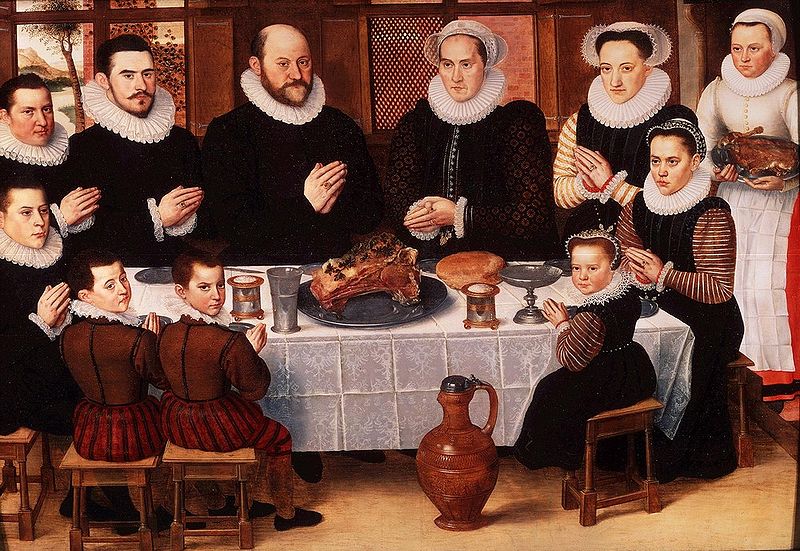
Family Saying Grace, 1585

Family Saying Grace, 1585 [Via]

We’ve spoken a bit about etiquette in places of worship already, though the idea is pretty simple. Be respectful, dress conservatively to be on the safe side, and ask if there’s anything you’re unsure about. However, most of us aren’t just popping into random religious services all the time. What’s more likely is that you’re invited to participate in a service or tradition by your close friends and family, especially your In Laws, and with 45% of marriages in the US between people of different faiths, this probably happens a lot!

While my relationship is not interfaith, our families are. My husband’s family is Jewish, and mine is a combination of vaguely Christian, Hindu, and “have you read the new Sam Harris book?” As such, there are occasions where we’ll be asked to participate in services and traditions we don’t believe in, which can be difficult depending on your view of religion.

Here’s my thing: I have a hard time participating in a religious ceremony or tradition if I know I don’t believe it, no matter how welcome my hosts have made me feel. To me, it feels dishonest to fake it while everyone around me earnestly believes what’s being said. I’ve been told many times throughout my life that I just need to go with the flow, and there are times where I have been able to ignore it  and have a good time. But usually I feel like it’s not my place to be there and participate, even if I’ve been explicitly invited. I am a crazy person and maybe you shouldn’t be turning to me for etiquette advice. Oops.

There’s also a difference between a ceremony taking place in a place of worship, or in a more private setting. In a church I can stand and sit along with everyone else, and no on will notice if I don’t say “amen.” However, there are certain rituals that take place in the home, and it’s a lot more obvious if I’m not participating.

Okay, so what does this mean in terms of practical etiquette? Well, if you get the sense that someone is not comfortable practicing your religion, do not ask them to “go with the flow.” That’s like telling an anxious person to “just calm down,” like really, you don’t think they tried that already? Also, be up front about what’s expected, and be gracious if they cannot meet those expectations, even if they seem minimal to you. If you’re the one being asked to participate, ask questions and participate where you can, and if anyone asks why you’re not participating in a certain ritual, explain that you don’t feel comfortable doing so. If they try to pressure you, they’re the rude ones. Also, see if there are other places you can help out, such as cooking some of a meal or helping set things up. It’ll show you’re grateful for being invited and included, even if you don’t feel like fully participating.

A Plea: Be Clear With Your Name Use

Even if your name is very popular you should be clear about it. [Via]

Even if your name is very popular you should be clear about it. [Via]

We’ve already discussed the problems some people face when changing their names after marriage (or divorce, or just because they feel like changing their names because you’re an adult and can do that whenever you damn well please). But one issue we keep running across is people who go by one name in some places and a different name in others. This can get really confusing.

There are many legitimate reasons why someone would want to use an alias in public, and you should be allowed to do that! Perhaps you’re a writer who uses a pen name, or a public figure who doesn’t want people to find your personal Facebook page, or are trying to hide from an abuser or stalker, or maybe you just go by a nickname. These are all fine and entirely understandable. What gets frustrating is when, for instance, you have someone who has kept one name in public spheres and uses another “officially,” but expects you to know this without them telling you. I mostly see this with people who have changed their name after getting married, continue to go by their original names on Facebook, email, and other areas, and then are frustrated when you address an invitation or a check to their maiden name.

Okay, so nothing is actually stopping you from doing this. You can do this. Go by 10 different names on 50 different platforms, whatever. But at this point we don’t use at-home cards, and we certainly don’t assume anything about someone’s name unless we’ve been told. So, if every correspondence is telling us your name is “Janet Smith”…we’re gonna go with that. And if it turns out you changed your name when you got married and you can’t cash a check unless it’s make out to “Janet White,” it’s on you to let everyone know about that.

I am perhaps speaking too much from experience, thinking back on  sending out wedding invitations and figuring out who was named what. Most of my friends emailed me their preferred titles when they sent their addresses, but others I just went off what was on Facebook and other platforms. I mean, why wouldn’t I? Maybe I’m just self conscious and coming to terms with living in a world where I do not actually know my friends’ “real” names, and rely on a website to tell me what they are. Where asking someone if the name attached to their Gmail is accurate is a thing. Where you can know someone so well and intimately, well enough to invite them to your wedding, and not know this extremely basic thing about them. And maybe I can just remember that names don’t hold that much importance for everyone, and that knowing the person is more important than knowing their name.

You should still be clear with your name use though.

How To Throw A Polite Wedding On The Cheap, Pt. 2

Get all your drinkware at Party City! Plastic is not rude!

Get all your drinkware at Party City! Plastic is not rude! [Via]

Alright, we already discussed that Daily Mail article and some of the crazier ways people are saving money…sometimes by being really rude to their guests. But what can you actually do to save money on your wedding day while ensuring you’re not offending anyone? Here we are to break it down for you! (By the way, there are a lot of amazing guides about how to save money on your wedding in general. We’re just going to focus on parts that deal with etiquette.)

Guest List

Hosting a party means treating guests to anything they may enjoy within the party–meaning if you’re offering it, it should be free. That goes for food, drink, entertainment, knick-knacks, etc. [Uncommon Courtesy is split on the concept of pot-luck weddings. Jaya thinks they’re okay as long as you make it clear and are ready to field questions and concerns, Victoria thinks they’re terrible.] Yes, there are areas where cash bars and things of the sort are more accepted, so YMMV, but really we’re going to take a firm stance on this. Don’t invite 200 people if you can’t provide for 200 people. Don’t invite 5 if you can’t provide for 5 either. This might take some hard negotiating, but sometimes that’s what wedding planning is about.

Food & Drink

Most people think that the only way to have a “proper” wedding is to do a sit-down dinner (and then pass the costs onto your guests if you can’t afford it) but that’s just not true! You can host a brunch reception, or do cake & punch, or passed hors d’oeuvres. You can just do beer and wine instead of a full bar, or do a taco buffet. If you eschew a full sit-down meal, you can also often accommodate more guests. Just make sure that there are actually places to sit for the elderly/easily tired, or surfaces on which to place food. It’s never easy to drink with one hand and balance a plate of appetizers with another.

Timing

This is slightly related to food and drink, because the time of day you have your reception will influence what you serve. It’s generally considered polite to provide a meal if your reception is taking place during an assumed meal time, and since lots of people have receptions that take place from roughly 6-10, that means an actual dinner will need to be served. You do not have to do this, but if you  hold your reception during dinner time, you should make it extremely clear that a full dinner will not be served, and be ready for some people to bail so they can find pizza.

However, if your reception is from 3-6, that frees you up to serve some light snacks and drinks, and many venues will give you a discount for not using the space during “peak” times!

Decor

Similarly to the idea that you need a sit-down dinner, a lot of people assume you need fine china and flatware. Yes, it feels nice, and you don’t want someone trying to cut a steak with a flimsy plastic knife, but there are a lot of great looking plastic/paper utensils out there. As long as everyone has functional enough tools to eat, the rest is just a matter of taste.

Invitations

Etiquette doesn’t care if you have a hand-inked suite with individual, foil-lined envelopes and tissue paper between each page. It used to, but it doesn’t anymore, because we’re all sane people who understand that paper costs money. Instead of an RSVP card, ask your guests to email RSVP. Instead of a separate card telling your guests about accommodations and directions, set up a wedding website and ask them to get the details there. Also, there are plenty of websites that offer gorgeous, customizable invitations without having to pay for a calligrapher.

Favors

Favors are not necessary! I will repeat this until it shines through everyone’s skulls like sunlight through a magnifying glass, condensing on the brain of that one aunt who is nagging you about jordan almonds. The reception is the favor–paying for food and drinks and entertainment for your guests is the thanks you are giving them for bearing witness to your marriage. They do not need to take home a jar of jam or a keychain with your names on it after that, and even Emily Post agrees that it’s not any sort of breach of etiquette not to provide them. Similarly, you don’t have to provide gift bags for guests in from out of town. Unfortunately, I think these customs have become so popular that people assume they will happen, and that you’re a bad host if they don’t. So please, help me in breaking the trend and saving yourself some cash.