Leprechaun and Other Wee Folk Etiquette

Happy St. Patrick’s Day! Or lá fhéile Pádraig sona dhaoibh if you speak Gaelic, which I do not.

When you think of St. Patrick’s Day, you often think of how crazy it was that your kindergarten teacher made you create leprechaun traps out of construction paper that magically had chocolate coins in them the next morning. In Ireland, they traditional take leprechauns and the other wee folk a bit more seriously.

If you are walking along and hear a gentle tapping, there might just be a leprechaun nearby cobbling some shoes. It is perfectly approved by etiquette to try to catch a leprechaun if you can, but once you catch him, there are three important things to remember:

  1. Always look a leprechaun in the eye, it is polite and it forces him to tell you the truth about where his gold is.
  2. Never take your eyes off of him: leprechauns are extremely fast and if you look away for one second, he will escape.
  3. Don’t be too greedy: if you catch a leprechaun, you can ask for a pot of gold, but just the one.

If you live in a place where there are elves and fairies and such, it is polite to leave some bread and milk outside for them each night.

It is also impolite to build your house on a fairy path- if you do, your whole family will get sick.

For real though, it’s not okay to pinch someone, even if they DO forget to wear green on St. Patrick’s Day. The holiday is no excuse for being drunk and obnoxious in public either, so cut it out and have a happy and safe day!

Victoria Pratt was a competitive Irish dancer back in the day and will dance a reel for you if you ask nicely.

Thank Goodness We Don’t Have to Do That Anymore: Paying Calls

Not this kind of call. [Via FreeDigitalPhotos.net]

Not this kind of call. [Via FreeDigitalPhotos.net]

Jaya has already written a really great post about calling card etiquette that you should check out. But calling cards are only a small part of a larger social nightmare that was referred to as “paying calls.”

Paying calls as a formal social requirement was most popular in the Victorian Period (of COURSE) but was dying out when Emily Post wrote Etiquette in the 1920s. Oddly, my 1967 copy of Amy Vanderbilt still has a chapter on it, though she acknowledges that the practice died out after WWI.

The first thing you need to know is that calls were called morning calls even though they took place in the afternoon. This comes from an earlier practice where any time before dinner time was called morning.

The other thing to know is that paying calls was basically a full time job for society ladies. They would go around almost every day to their friends and acquaintances to keep up with what was going on with everyone and making sure your family was still in good standing. Basically, social networking before the internet. This was such serious business that women would keep ledger books of who they regularly called on, if those calls had been returned, and if they owed anyone a call. Then they would whip out these “calling lists” when it was time to host a party and boom, there is your invitation list.

Fortunately, you didn’t always have to actually talk to all of your friends. You could often just drive around to their houses and leave your card, thus getting your obligation out of the way (and your friends would keep everyone’s cards on a tray in their front hall so everyone could see how important they were!). This was especially important when you came to town after being away (or being at your country estate for a while). You would drive around and leave a card at the house of everyone in your social circle. That way they would know that you were around and they could invite you to parties and other social events. Then when you left town, you would do the exact same circle of friends and acquaintances, but this time you would write P.P.C. in small letters in a corner of your card. This is an abbreviation for pour prendre congé which, for those of you who have forgotten your high school French, means “to take leave” and would signal to everyone that you were leaving.

Aside from paying calls when you arrive in town, when you depart, and just the regular round, there were several situations that REQUIRED a call to be paid. Anytime you were invited to a ball or a dinner or any other kind of social function (whether you actually attended or not), you had to pay a call on the hostess within a week or so of the event. You also had to pay calls when a friend got engaged or when someone died. Men didn’t have to do the regular call paying, but they did have to pay calls after receiving invitations or attending parties. Anyone who didn’t pay these required calls would find themselves never invited to one of that hostess’s events again, so!

Interestingly, men also had a large number of calls to make after he got married. It was assumed that all the friendships of his bachelor days automatically ended when he got married. By paying a call on any or all of them after the wedding, it said that he found them respectable and wanted to remain friends.

When you actually wanted to see someone during a call and not just leave your card, there were additional rules to follow (of course!). You would enter the house and ask the butler or other servant if the lady of the house was at home. If she was out or busy, the butler would tell you straight away that she was “not at home” and you would leave your card and depart (however, if she heard your voice and wanted to see you, she might come out and say “I am at home to YOU, my friend!”). Some women would screen their callers by looking out the window and signaling to the butler whether they wanted to see them or not, but once the butler had taken the card and brought it to the lady of the house, she basically had to see the person. There was no pretending you weren’t home once your servants had acknowledged that you were.

So once you were in, you were brought into the drawing room, which is where guests were received. You would keep your hat on to signal that you weren’t staying long (men removed their hats but kept them in their hands). Conversation during calls was polite and mild. You would stay about 15 minutes and then you would leave. Refreshments were rarely served, but if they were, it was rude for a hostess to insist that her guests take something, as it was possible that they had had tea and cakes at the 6 houses they had previously called on and could not eat anymore.

A particular tradition around paying calls that was definitely common in New York City and likely in other places too, was the New Year’s Day call. This was a very regimented form of calling where all the women of the family would be at home all day with a spread of nice foods and all the men would go out and pay in person calls at the homes of practically everyone they knew. Since the men would be paying possibly 50-100 calls in the day, they would get started by 9 or 10 am, which meant that the women would have to be up, hair done, and in place in the parlor or drawing room by that time (so they would have to wake up by 5 or 6 am, or possibly earlier if their hairdresser was booked!). Then there would be a steady stream of men coming by all day long for just a few minutes at a time. A completely exhausting time for everyone. The practice died out when fashionable neighborhoods in Manhattan spread out and it wasn’t possible to visit all your friends in one day anymore.

Sources:

What Jane Austen Ate and Charles Dickens Knew: From Fox Hunting to Whist-the Facts of Daily Life in Nineteenth-Century England by Daniel Pool

Etiquette by Emily Post

The Gentleman’s Book of Etiquette and Manual of Politeness by Cecil B. Hartley

“New-Year’s Calls,” Harper’s Bazar Magazine January 1, 1870

Complete Etiquette by Marion Harland

Showers, Bachelor/ette Parties, and Rehearsal Dinners, oh my!

All your pre-wedding parties will be in beautiful soft focus. [Via Flickr user tmarsee530]

Despite weddings already being a huge big party that is going to stress you out for a year or more, people like to have other, smaller parties around weddings. Fun! As a soon-to-be-married person, you might have some expectations about these parties from things you have seen from wedding shows and movies. These expectations might be wrong, but we are here to help! You also might find yourself wanting to avoid these parties, in which case see this previous post about how to handle avoiding having a shower.

Showers

  • Showers shouldn’t be thrown by family members or (especially) the couple! However, family members can throw family-only showers. In this instance family members mean your mother, your significant other’s mother, your sibling, or your grandparents. It is okay for aunts/uncles/cousins. The reason for this is that a shower is defined by being all about showering the bride (or couple) with presents. Since, traditionally, the bride’s family was responsible for setting her up with her trousseau, her family requesting presents from other people for her was essentially like asking for presents for themselves to help defray the cost of setting up her home. Though this isn’t really true anymore, family thrown showers still have a tone of “greediness.” However, in many social circles it is completely fine and normal, so just be sure to check.
  • A shower shouldn’t be something that the bride requests or expects but once it is offered, the bride should be the one to provide the guest list and have final veto of activities. (Or veto of the event altogether.)
  • Shower invitations can include registry information as the whole purpose of the party is to give presents
  • You need to write thank you notes for all gifts given at the shower- make sure someone is writing down what came from who (it is not a cute shower game to have guests self address envelopes for their thank you notes, however.)
  • If you have multiple showers, the guests lists shouldn’t overlap (except, parents/siblings and wedding party), but if they do, guests are only expected to bring gifts to ONE shower. A kind bride will acknowledge that duplicate guests gave a gift at a previous party.
  • Often, someone will collect the ribbons from the gifts and create a “bouquet” for the bride to carry at the rehearsal.

Bachelor/ette Parties

  • Bachelor/ette parties are not gift giving occasions. Though some groups will decide to work a lingerie shower into the festivities (but this should not occur if the same group is already throwing a regular shower).
  • Bachelor/ette parties are optional and you must wait until someone offers to throw one. You can’t just assign it to the maid of honor/best man. However, you do get to have input and final say on the activities of the party.
  • You can throw your own bachelor/ette party if you are truly hosting ie paying for everything, such as having a “slumber party” at your house or something. If you expect everyone else to go out to something you plan and cover your dinner, drinks, strippers, whatever, you shouldn’t be the one planning it.

The Rehearsal

  • The rehearsal is important if you have a long or complicated ceremony. Most people opt to have one just so everyone will know where to stand and when. There are a lot of different arrangements of who walks down the aisle in which order and who stands where, so you don’t want to assume that you are all on the same page.
  • Everyone participating in the ceremony should be present at the rehearsal so they all know where to go and when during the ceremony.
  • Superstitious brides don’t participate in the rehearsal but watch from the side with a stand-in walking down the aisle.

Rehearsal Dinner

  • Rehearsal dinners are not a requirement, though they are a nice way to gather with your most important people and thank them for showing up for the rehearsal.
  • Traditionally (except this tradition really only goes back to the 1940s/50s), since the bride’s family was hosting and paying for the wedding, the groom’s family would pay for the rehearsal dinner. Now, you will have to all decide together who is going to pay for it.
  • Typically, you invite both sets of parents, the whole wedding party and their significant others (if applicable), any readers, and the officiant. Many people like to invite out of town guests and close relatives as well.
  • You want to make sure to actually invite your guests to this event, either with a formal paper invitation, evite, or a simple email or phone call. These invitations should be sent fairly soon after the wedding invitation
  • You don’t have to have a fancy sit down dinner; a pizza party or backyard barbeque sound like awesome rehearsal dinners!
  • It doesn’t even have to be a dinner, but can be a brunch or lunch immediately following the rehearsal.
  • People often give spontaneous toasts at the rehearsal, this is perfectly fine.
  • Many couples give gifts to their attendants during this time.

All parties

You can’t invite people to wedding parties who aren’t invited to the wedding itself. An exception would be a shower that your co-workers or other specific group (such as a sports team) throw you.

The Etiquette of Weed Pt. 2: Enjoyment

IMG_1181

Someone please stop smoking up that iguana

Welcome to Part II of your weed etiquette, a topic that, curiously, Emily Post didn’t touch with a ten-foot waterpipe. Part I was all about how to use your best manners in order to obtain marijuana (which is an illegal narcotic both nationally and in 48 states to varying degrees of criminality and neither I, the writer, or the two editors of this site, would ever endorse something that is such a malfeasance in the eyes of the law) and that’s great for you. Congratulations. This section will be about something far more tricky: putting it in to your body in a manner both polite an courteous.

It is again worth noting–beyond a strict legal distancing–that this is written from viewing the East Coast experience. The West Coast seems to have a great abundance of weed as one commentor on the last post noted, someone in Portland literally biked up to her in order to sell her a joint. What a world.

What Do I Bring?

When you’re young, weed is a social drug. Everyone can get in a group, smoke up, and do whatever activities follow (video games, watching Rob Dyrdek’s Fantasy Factory, reading Keats line by line in a group, the usual). When you get older this tends to change, mostly because you have the means to do it on your own, both in terms of buying for yourself and for having your own space (aka “not cohabitation with your parents”). This section is for the younger, communal smokers. Bless your hearts and don’t believe you’ll ever die.

My editors scoffed at the idea of this section, thinking there is some sort of “pot smoking party” like it’s a dinner party [ed note: WE KNOW WHAT A NORMAL PARTY WITH WEED IS LIKE, DUDE]. While I wouldn’t say that (I don’t even know how to begin to think about how many forks would be involved and where they would be placed) smoking pot does have lend itself to a very ritualistic experience. Everyone has to gather at once, or close to it, as the act itself is on an ever-burning clock. It’s a bit more lenient when you’re set up in glassware since you can smoke it, discard it, and pack it again, but when it comes to paper smoking (Dutch/Phillie blunt/joint/spliff) it’s an all-or-nothing proposition. You’re there or you’re not.

My friends back home after college had a sort of standing time to gather, though at rotating locations, to smoke and “make hang.” This involved a number of elements but the easiest, and certainly most pressing, is weed. If you’ve got some, toss it in to the mix. And the more you’re willing to share? The better. In this way it’s less of a dinner and more of a potluck: you gain entrance to the experience by bringing enough to share. Plus mixing different strains of weed can lead to all sorts of weird, chemical-imbalanced fun, so, again, sharing is caring. (And sorry for using “potluck.” Yeesh.)

If you don’t have weed, don’t worry. That happens to everyone. Usually pot fiends are a relatively laid back group, and not actually fiends (ed note: or are they?!?!). Some people I know never bought weed; their shining, fun personality was enough of an asset to a “cypher” that their very presence paid for the price of admission. However, if you’re kind of dull or your friends need some actual material goods, offer to stop by at the local convenience store or bodega for supplies that are essential or tangential to the group: a couple Philly blunts/a twofer package of sealed Dutchmasters, two Gatorades for $3 (thanks, 7-Eleven), some gummy worms. Whatever the person whose residence you’re smoking at would enjoy. A little goes a long way here. It’s like any party, really: don’t show up empty handed. Tastycakes are like $2. Do your share.

Where Do I Smoke?

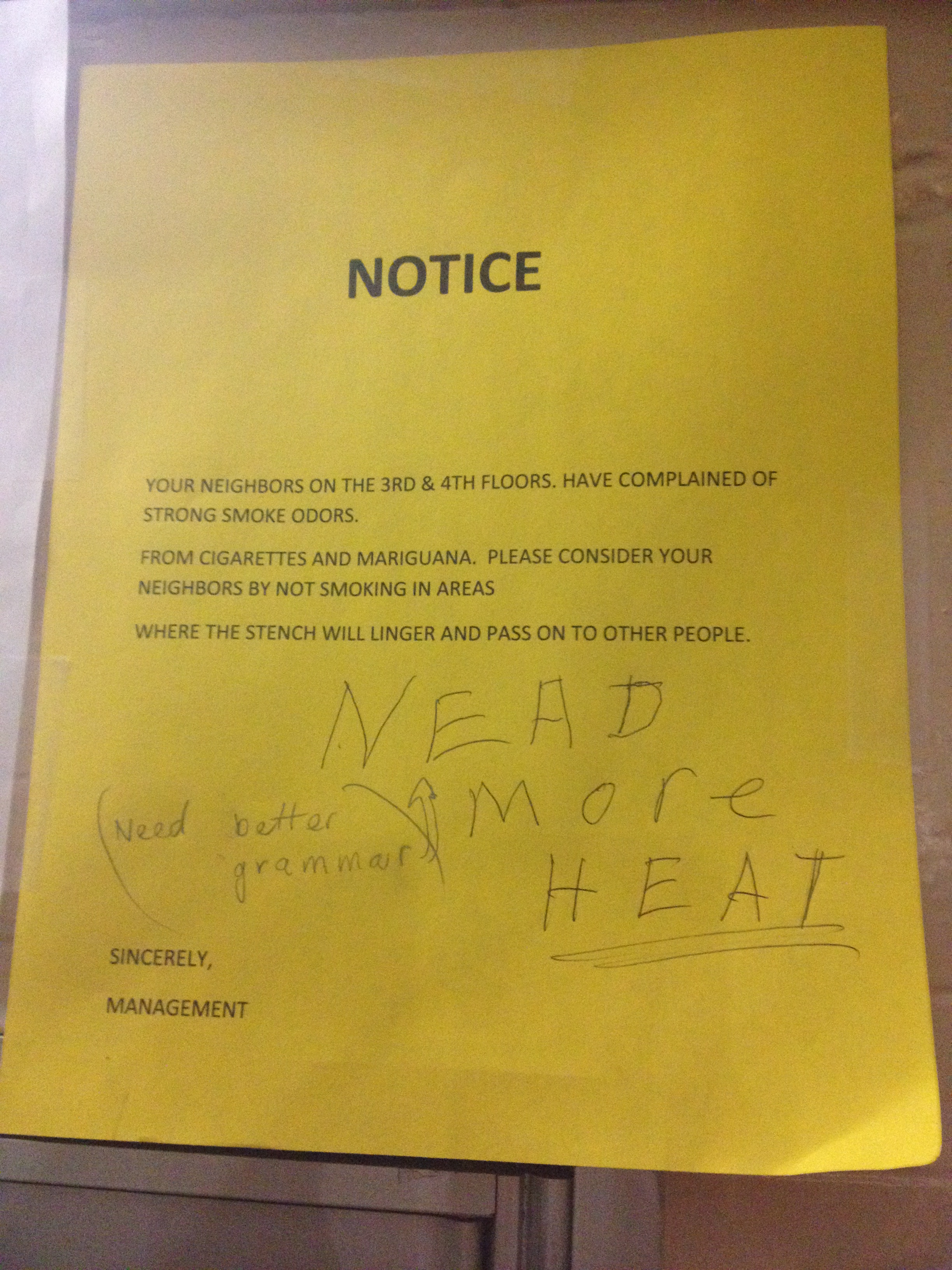
Marijuana brings with it a rather pungent smell. This is looked on favorably by people who smoke and incredibly unfavorably by everyone else in the world. If you live in your own home and the only things interacting with the smell are your nostrils then by all means, regulate your indoor smoking use like it’s New Hampshire.

The odds are you are not one of those people. If you’re smoking via flame (pipes, bongs, rolled paper of any kind) just go outside. Don’t try and rationalize this any other way. Just go outside.  If you insist on not leaning out the window, or taking the steps out on to the fire escape, or taking your one hitter on a nice walk around the block, then block all doors with towels or something akin, open up as many windows as your building allows, and throw on as many fans as possible. No one wants to knock on your door to tell you to cut that shit out. It makes them feel like a narc, or a buzzkill, or worse: a nagging parent. And Jesus, who wants to feel like that when talking to strangers? It’s an odd situation. So avoid it all, dear smoker, by being polite and going the fuck outside. This goes double for people with roommates who don’t smoke, triple for homes you share with your parents, and quadruple for places that you don’t live and the people there don’t smoke (I’ve seen it happen).

If you realize that it’s 2014 and you Want To Have It All, then purchase a vaporizer. There are many different variations from a stay-at-home model to the Volcano to sleek personal travel models that will make you among the 20 coolest ladies in Prospect Park on any given Spring day. If you Want To Have It All but are spending your money elsewhere, you’ll probably try to “mask” the smell by exhaling through a spoof (a toilet paper roll absolutely jam packed with dryer sheets) or lighting incense, but this “covers” the smell like using Axe body spray after gym class. Now you smell like something horrid mixed with another thing that smells horrid. Don’t.

How Do I Prepare?

Whenever you say something is “a process” it’s usually said with a big huff, as if you have to explain how the Model T is produced. So just get that idea of your mind. To smoke, there is a normalized process. First you collect the weed and look to remove any of the seeds or stems, colloquially known as “breaking up” and any probable hundred of other pet terms (people who smoke pot are usually creative, if we want to get out the Stereotype Stick to beat you over the head with). This involves taking the weed apart, bit by sticky bit. There is usually a designated place to do this: over a hard-bound high school yearbook, on a shitty Ikea coffee table, or some other non-essential piece of furniture. Do not break it up over a tablecloth or something of value as you’ll have green stains in there forever. Until Jolie Kerr tells us how to clean that, consider it impossible and move on.

When you’re rolling a Dutch or a Phillie the process involves the part that makes it a cigar in the first place. The “guts” are all of the low-end tobacco and who-the-shit-knows-what-else that comes within the crucial outer skin. This stuff is awful. I’d make a comment about why anyone would inhale it, but when you live in a glass house with stoners… Guts are the #1 way to get caught if you’re smoking in a place that you shouldn’t be, like a parental house or a car when pulled over by the cops. “I swear officer, someone just threw the inside of their cigar through my back window!”

The best way to dispose of these inessential parts is a bag within a bag. Take an odd paper bag (maybe the one that held all of the supplies you or your friend brought earlier?) and dispose of it in a trash bag, hopefully outside, My degenerate friends who would drive around and smoke when they didn’t have another location to do it would throw these bags in to storm drains and wait til summer until other friends worked for the town and would have to dredge them out. It’s the circle of manual labor.

How Do I Smoke Politely?

If your immediate reaction is “pass the dutchie to the left-hand side,” then you either don’t smoke, are 15, or just a total square. There is nothing that will make you lose cred faster than quoting that song. Please don’t.

The idea behind “pass it to the left” is just for a simple semblance of order. Its aim is to be polite. At parties in high school I’d see kids literally run to the left of the person who lights up like it was grade school kickball and coach was picking teams by the ol’ every-other selection system. People were pushed out of the way. It was ridiculous, and certainly not polite.

A cypher–the term of the order of the group of people to smoke which usually resembles a circle–is important soley so everyone can get an equal amount to smoke before it literally blows away. If there are four people and you have a decent amount then everyone should be able to traverse the room and still smoke in sequence. Putting everyone in a circle is one part natural inclination and another part failsafe. “Hey who’s–oh, yeah, here ya go” (easily turns to one side and passes). There have been cyphers I’ve witnessed that involve throwing lit dutches across a living room into waiting bare hands (only recommended by true professionals). Shit can get nuts but it’s all in the service of something polite: everyone gets their fair share.

How Do I Actually Smoke Politely?

This is actually a bit more complicated than you’d think.

First, how much to smoke? For paper products (Phillies/blunts/Dutches and joints) taking two hits (“puff, puff”) and passing is standard operating procedure. For glass products (pipes, bowls, bongs, one-hitters, chillems), take only one hit. This is by no means an iron-clad rule; it’s not written in the Constitution. Your friends might do differently. Treat it like beer pong: if you have any questions about house rules, simply ask before trampling forward and going “oh wait I thought.” Otherwise, go with the above.

If you have a large cypher (from about seven and up) and enough weed, think about rolling two and sending them opposite ways. This cuts down on time between smoking and, if everyone has weed, you’re going to do this again anyway. Just get there now and feel like you’re on Wheezy’s tour bus. If you live on the West Coast, it’s likely that everyone will pack “a personal” bowl or other product because seemingly 90% of all vegetative life out there is cannabis-based.

Regardless, the objective is that everyone gets their fair share. It’s a harsh world out there. It doesn’t have to be so rough and tumble within a cypher.

What About The Nature Of Smoking?

How you smoke requires etiquette as well. You don’t smoke glass, vaporizers and paper the same way as each method has their own methodology that does not translate well between mediums. Glass requires fuller, deep breathes to pull the smoke in to your lungs. It’s a much more forceful effort. The harsh nature also keeps you from smoking too much — you can only take so much.

Paper, however, is a delicate balance. The same way that a person takes in the smoke can also ruin the experience for others. If you pull too hard it’s possible that you can make the paper “canoe” which means that the outer paper burns faster than the marijuana inside which causes the structure to fall apart (think of a hot dog with a rapidly-decreasing bun). If you pull slowly and easily then you should have a fairly even burn. Some times this can’t be helped depending on the quality of the paper itself so don’t beat yourself up over it or anything.

The repairs should be done by the person who rolled the implement. The one who rolled the item is a crafts(wo)man after all, and deserve to have the opportunity to fix their work. If you’re cool with the person who rolled–or they trust your ability–then ask if it’s alright to mess with the paper and move forward. This also will occur if they’re simply too far away (pride in your work can’t always stretch across a long living room). Usually this just requires licking your finger and pressing it against the quickly-burning area to slow it down but still, give proprietary respect first.

How Do I Maintain My Piece?

There are two schools of thought here. The first is that there is sort of a dingy pride in not cleaning your pieces. Most glass bowls are explicitly built to pack resin (burned-out weed residue) inside, leading the designs to change colors the more you smoke. This is why a lot of higher-end head shops will display the pieces on black felt to give you an impression of what it will look like over time. While not always built for residue, there are a number of bongs that I’ve seen that have similar patterns.

Certain smokers will point to their pieces as a sign of how diligent they are about smoking (and how not diligent they are at cleaning). This is pretty fucking gross. I wouldn’t want to be reminded by the glass implement I’m smoking out of to give me a clear representation of all the awful shit I’m doing to my lungs by just by looking at it. And I’m sure that isn’t really adding to the cleanliness of the procedure, either.

Most high-end vaporizer users make it a priority to clean the system after every bit of use. Just because your way of smoking is more low rent doesn’t give you the license to treat it that way. I’ll put it like this: I clean my french press after every use because I’m worried that gook will collect and ruin my coffee. You’re inhaling that shit. Get out the pipe cleaners regularly. And if you’re using a pipe? It naturally keeps the passageways clean so you won’t get clogged. Win-Win (save, of course, for your lungs). (ed note: Check out My Boyfriend Barfed in My Handbag . . . and Other Things You Can’t Ask Martha by Jolie Kerr for instructions on how to clean all of your smoking paraphernalia.)

What If I’m At A Concert?

The modern identity of “grass” started with those damn blues players. Music and marijuana have been linked ever since. If you’re at a concert and someone next to you is smoking, you might want to get in on it. You can always ask, as that doesn’t hurt, but know who you’re asking. If the kid is college aged or younger, he or she will more than likely rebuff you because of the “supply and demand” principle mentioned earlier, and because most kids are selfish assholes. The older people you ask, the more likely they’ll want to share, either because they have beaten the “supply and demand” and have a lot of supply because of their own personal demand or because they can’t really smoke all that much anymore. I have seen twice-hit joints simply given away. I have seen a man in his 50s pull out twelve (12) joints for a two-hour concert. Twelve!

Anything Else?

No. It’s smoking weed, not a fucking dinner party after a UN general assembly. Go! Have fun! Be considerate! Be safe!

Part III

M. Anton was recently contacted by a weed delivery service directly to his cell phone from a number he did not know the day that Part I of this article was posted. The NSA works in strange and mysterious ways.

How To Be A Good Host

I tend to just serve really alcoholic punch and every has a good time. [Via Smabs Sputzer]

I tend to just serve really alcoholic punch and every has a good time. [Via Smabs Sputzer]

I can’t believe it’s taken us this long to address this topic, but sure enough, most of our party etiquette advice has been on how to act when you’re a guest. However, hosting is an art! No one wants to go to a party where they feel unwelcome or uncared for.

The biggest difference I’ve noticed between gracious and ungracious hosts is in intention (and, well, grace)—good hosts seem to enjoy their company, bad hosts act like company is a burden. A good host will often enjoy hosting, even if spending all day cleaning the bathroom and cooking four dishes is stressful, because seeing their guests happy makes them happy. Do not make your guests feel guilty about enjoying themselves, or be constantly reminding them about how much of a hassle this was for you to put together.

So how do you make sure you stay gracious? Here are a few tips.

1. Have a plan, or at least make decisions. There is nothing worse than showing up for a party (let’s say more than one or two who does not live at the residence) and the host has no suggestions on what to do. No thoughts on where to order out for dinner, no ideas on movies to watch or other activities, nothing. This is ok when it’s maybe a group of really close friends who can just hang out on the couch and “do nothing” in comfort, but not when there are ten hungry people in your living room and you got nothing. Be bold. Say you’re getting a bunch of tacos unless anyone has strong objections, put on your favorite album,  just go. If someone really doesn’t want to do what you suggest, good, at least you’re getting opinions rather than an endless chorus of “I don’t care.”

2. Ask for help in advance. Often times when planning a party, guests will ask if they can bring/do anything. Utilize this! If it’s a potluck or something more casual, ask everyone to bring booze or snacks. If it’s a dinner party and you’re making or ordering everything, email or call these people back and say “You know, I think I have most of it under control, I may just need help setting up the table when dinner is served!” Most people will really be willing to do this, but it’s good to ask in advance, just in case no one can help. And if people do help, make sure to thank them. Also, do not decline help and then complain that you did everything by yourself. I have seen this happen way too often and it still confuses me.

3. Make sure there’s enough of everything for the duration of your party. Not every party needs to be a dinner-and-booze party, but what is served and available needs to be reasonable for people’s expectations. Did you invite people over for cocktails at 9pm and only have cheese, crackers, and chips out? That’s fine, since it’s past dinner time. But did you only serve cheese and crackers at an all-day backyard party? Bad idea. This doesn’t just involve food—that backyard party would also probably suck if there were no chairs or blankets for people to sit on, no music, and one game to play for 40 people.

4. If the party is going to deviate from accepted expectations, let people know, and then be understanding. I’m going to bring this to a common debate among people getting married, since a reception is just a giant party. It’s generally considered rude to throw a “full length” reception without serving dinner (i.e. cake and punch at a quick 3pm reception is fine, only cake and punch at a wedding that starts at 5pm and ends at 11 is not). While not ideal, I don’t think this is necessarily rude, as long as you set your and your guest’s expectations accordingly. Want to have a long, evening party and only serve dessert? Make that clear on the invitation, and don’t be surprised or offended if some guests leave early or arrive late to give themselves time to find some food.

5. Seating arrangements. Traditionally, at a seated meal, you will want to split up couples- they talk to each other enough! However, use your judgment here. Do the couple in question know other people at the party? Are they generally social? If so they’ll probably do fine apart, but if one of them is incredibly shy and only know his or her partner, being split up may cause anxiety.

6. Clean your bathroom. Seriously the rest of your apartment could be a total shithole, and  you could close all those doors and no one would notice. I can guarantee every guest will be in your bathroom, and they will notice if it’s disgusting. It doesn’t need to be spotless, but at least wipe down the toilet, provide clean hand towels, and light a candle.

7. Have options for everyone, within reason. If 8 out of your 10 guests love lasagna and the other 2 think it’s just ok, they can deal. However, if those two guests are gluten and lactose intolerant and there’s nothing else for them to eat, you have a problem. You can’t please everyone, but try to gauge if there are any dietary restrictions or other preferences, and serve a mix of vegetarian, non-dairy, gluten free, etc. options. The same thing applies for alcohol, to make sure you don’t have a group of wine drinkers and only supply vodka. Also, have more than just water for the non-drinkers. (For a more thorough explanation of how difficult that can be, consult John Mulaney’s “I know you don’t drink” bit).

8. Pay. Part of hosting means providing food and drink, which also means going out and purchasing it. Now of course, there are plenty of situations where you are “hosting” by providing a space for the party, or Christmas rotates through the relatives houses every year and everyone brings a dish, or a potluck, where you don’t have to provide all the food and drink. But if you invite people over and say you are having a dinner party, you should be prepared to buy everything for the party. This is going to VARY a lot within whatever your social circle usually does, but it’s a good baseline to start with.

9. Don’t overexert yourself. If a group of people is coming to your house for a party, chances are they actually want to see you. Sure, plentiful food, good drinks and fun music are all nice, but not if their host is absent most of the night. See if you can have everything ready by the time people get there, with refills on dips or drinks in an easy-to-get spot. If you’re cooking dinner, find recipes you can make the day before and work well reheated, or that you can assemble and throw in the oven as people arrive. Or use all that help you asked for before so you can socialize and prep at the same time. Then go enjoy your party!