
Musings On Religion, Holidays, and the In Laws

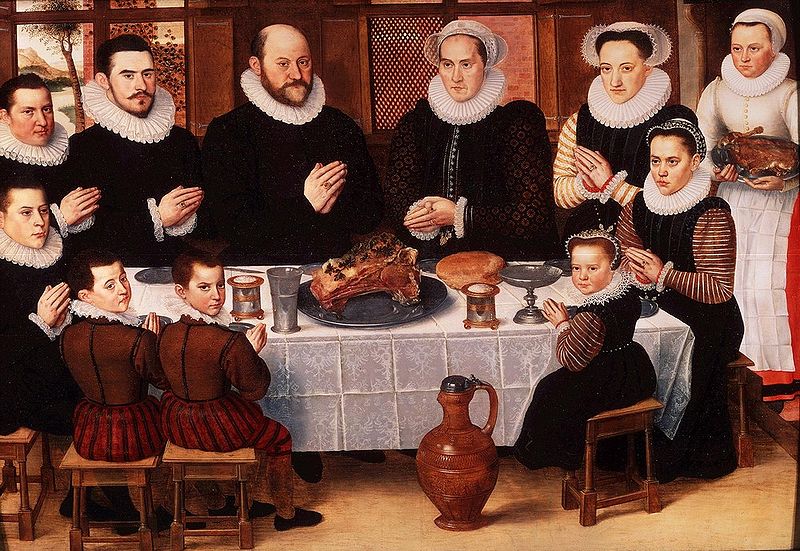
Family Saying Grace, 1585

Family Saying Grace, 1585 [Via]

We’ve spoken a bit about etiquette in places of worship already, though the idea is pretty simple. Be respectful, dress conservatively to be on the safe side, and ask if there’s anything you’re unsure about. However, most of us aren’t just popping into random religious services all the time. What’s more likely is that you’re invited to participate in a service or tradition by your close friends and family, especially your In Laws, and with 45% of marriages in the US between people of different faiths, this probably happens a lot!

While my relationship is not interfaith, our families are. My husband’s family is Jewish, and mine is a combination of vaguely Christian, Hindu, and “have you read the new Sam Harris book?” As such, there are occasions where we’ll be asked to participate in services and traditions we don’t believe in, which can be difficult depending on your view of religion.

Here’s my thing: I have a hard time participating in a religious ceremony or tradition if I know I don’t believe it, no matter how welcome my hosts have made me feel. To me, it feels dishonest to fake it while everyone around me earnestly believes what’s being said. I’ve been told many times throughout my life that I just need to go with the flow, and there are times where I have been able to ignore it  and have a good time. But usually I feel like it’s not my place to be there and participate, even if I’ve been explicitly invited. I am a crazy person and maybe you shouldn’t be turning to me for etiquette advice. Oops.

There’s also a difference between a ceremony taking place in a place of worship, or in a more private setting. In a church I can stand and sit along with everyone else, and no on will notice if I don’t say “amen.” However, there are certain rituals that take place in the home, and it’s a lot more obvious if I’m not participating.

Okay, so what does this mean in terms of practical etiquette? Well, if you get the sense that someone is not comfortable practicing your religion, do not ask them to “go with the flow.” That’s like telling an anxious person to “just calm down,” like really, you don’t think they tried that already? Also, be up front about what’s expected, and be gracious if they cannot meet those expectations, even if they seem minimal to you. If you’re the one being asked to participate, ask questions and participate where you can, and if anyone asks why you’re not participating in a certain ritual, explain that you don’t feel comfortable doing so. If they try to pressure you, they’re the rude ones. Also, see if there are other places you can help out, such as cooking some of a meal or helping set things up. It’ll show you’re grateful for being invited and included, even if you don’t feel like fully participating.


Regifting with Grace

Wrap your regifts in fetching zebra print wrapping paper. [via Wikimedia Commons]

Regifting is when someone gives you a gift, you decide you do not like it (or you already have it), and so you give it as a gift to someone else. It is not inherently rude, but, like so many other things in life, can be done rudely.

Things to remember when regifting:

  • When regifting, make sure that you are truly regifting- ie you have not used the item in question at all yourself and it is still in mint condition.
  • Make sure to remove all old tags. You want the recipient to think that you bought it especially for them. Obviously don’t regift anything that has been inscribed or engraved for you! While we are at it, remove any price tags if the original gifter hadn’t (you do all know to remove price tags before giving gifts, right??)
  • Avoid regifting extremely unique items when the original giver might see it.
  • Make sure the gift is something you think the recipient would like to receive, not just something you want to get rid of (save those for White Elephant exchanges!)
  • You should probably also not regift family heirlooms whose absence will be noticed.
  • Definitely do not present the regift in front of the person who gave it to you originally!

The key is to make sure that no one’s feelings get hurt in the regifting process- either the original giver or the recipient.

It’s Okay to Wear White After Labor Day

Personally, I think what colors you wear when is a matter of taste and fashion rather than etiquette, but some people think it’s actually rude, so here we are.

The traditional period for wearing white was Memorial Day through Labor Day (with some municipalities allowing a brief wearing of white for Easter and then packing it away again until Memorial Day.) The reason is is that Memorial Day through Labor Day marks the effective “summer” period. Back in the Victorian era where many of etiquette and social customs were formalized, rich people would leave their houses in the cities and go to the country homes for the summer months. In town, everyone wore very serious, dark, heavy clothes, but in the country they would wear nice, light, white clothing which was more comfortable during hot weather (and remember, there was no A/C back then!) When they returned to the city after Labor Day, they would put their summer clothing away and return to their more formal city clothes. Also, back then, city streets were full of mud and horse poop and garbage and the air was full of coal smoke and soot and all kinds of things that made wearing white extremely impractical. So it just kind of stuck and became codified into this “rule.” Also, as New York was kind of the center of the fashionable world, rules were made to follow the Northeastern climate where it didn’t really start to get hot until Memorial Day and it cooled down quickly after Labor Day.

Nowadays, it’s totally fine to wear white whenever you like, especially if you live in a climate where a sundress is perfectly comfortable in March. The fashion industry even has a thing called “winter white” which is white you can wear in the wintertime. Now of course, you might simply find it more practical and comfortable to put your more summery whites away in the winter, but nothing is stopping you from wearing white linen pants in January if you want.


Is Throwing Your Own Birthday Party Rude?

If people really thought throwing your own birthday was rude, they just wouldn’t come.

So here’s the thing. Technically, according to Miss Manners and other old school etiquette experts, throwing or organizing your own birthday celebration is rude. This is one of those rare areas where I fundamentally disagree (even though I see where they are coming from) and think it is one of those sections of etiquette that are changing due to different social norms.

The reason they consider it to be rude is that there is a traditional expectation that when you are invited to a birthday party, you will bring a birthday present and if you are throwing the party for yourself, then you are actually asking people to bring you gifts, which is not polite. In discussions of adult birthday parties, party poopers also like to bring up that it is all about honoring your ownself and being a bit “me me me,” rather than throwing a party in order to simply entertain guests. Miss Manners, herself, is firmly against adult birthday parties.  The general suggestion is that if a person is to have a birthday party, it must be thrown by a spouse, significant other, or other friend.

However, I find, at least among my social circle, that people are incredibly busy these days and while they might bow out of a “just because” party, most people try to prioritize birthday parties. There is also now the expectation that if you wish to celebrate your birthday, you will organize it in someway (spouses and significant others do often do this instead, but it would almost be weird if a friend said “oh let me throw you a birthday party this year”). Also, in my experience and region, birthday gifts for adults between friends are very rare (except maybe a gag gift?), and so there is no expectation that people will bring gifts. With our wide ranging social circles of friends and colleagues, you are also probably the only one who knows who you would want to invite to celebrate with you. So throwing your own thing is absolutely normal and polite.

There are some things that you can do, though, that will make your birthday party impolite:

  • Expecting birthday gifts, especially by making and distributing a registry. (Also don’t mention gifts anywhere in the invitation! Even to say no gifts).
  • With a dinner at a restaurant, you are going to mostly want to invite very close friends so it doesn’t seem like you are inviting people just so they will chip in for your dinner. If you want to invite a bunch of people, have a party at a bar or throw it at your house.
  • If it is your social circle’s custom to all split the birthday person’s dinner, then don’t argue too much when time comes to pay the check. Just say thank you graciously. That being said, always be prepared to pay your own way and don’t pick a restaurant out of the normal price range of restaurants your crowd frequents.
  • Be careful how you phrase invitations, “please join me for dinner at Bistro” sounds more like you are planning on paying for everyone than “I am celebrating my birthday at Bistro and I would love to see you if you can make it.”

I think what causes so much controversy over this issue is that it is something that really has evolved over the last decade or so. No one bats an eye at a Bride and Groom hosting their own wedding to celebrate their own marriage (which decades ago, was Not Done) and I see adult birthday parties as pretty much the same thing. The phrase “just because everyone does something doesn’t make it right” doesn’t actually apply to social customs. Social customs and etiquette are based on what everyone does, and if everyone starts doing something differently than the way it was done 100 years ago, then it becomes correct.

How To Throw A Polite Wedding On The Cheap, Pt. 2

Get all your drinkware at Party City! Plastic is not rude!

Get all your drinkware at Party City! Plastic is not rude! [Via]

Alright, we already discussed that Daily Mail article and some of the crazier ways people are saving money…sometimes by being really rude to their guests. But what can you actually do to save money on your wedding day while ensuring you’re not offending anyone? Here we are to break it down for you! (By the way, there are a lot of amazing guides about how to save money on your wedding in general. We’re just going to focus on parts that deal with etiquette.)

Guest List

Hosting a party means treating guests to anything they may enjoy within the party–meaning if you’re offering it, it should be free. That goes for food, drink, entertainment, knick-knacks, etc. [Uncommon Courtesy is split on the concept of pot-luck weddings. Jaya thinks they’re okay as long as you make it clear and are ready to field questions and concerns, Victoria thinks they’re terrible.] Yes, there are areas where cash bars and things of the sort are more accepted, so YMMV, but really we’re going to take a firm stance on this. Don’t invite 200 people if you can’t provide for 200 people. Don’t invite 5 if you can’t provide for 5 either. This might take some hard negotiating, but sometimes that’s what wedding planning is about.

Food & Drink

Most people think that the only way to have a “proper” wedding is to do a sit-down dinner (and then pass the costs onto your guests if you can’t afford it) but that’s just not true! You can host a brunch reception, or do cake & punch, or passed hors d’oeuvres. You can just do beer and wine instead of a full bar, or do a taco buffet. If you eschew a full sit-down meal, you can also often accommodate more guests. Just make sure that there are actually places to sit for the elderly/easily tired, or surfaces on which to place food. It’s never easy to drink with one hand and balance a plate of appetizers with another.

Timing

This is slightly related to food and drink, because the time of day you have your reception will influence what you serve. It’s generally considered polite to provide a meal if your reception is taking place during an assumed meal time, and since lots of people have receptions that take place from roughly 6-10, that means an actual dinner will need to be served. You do not have to do this, but if you  hold your reception during dinner time, you should make it extremely clear that a full dinner will not be served, and be ready for some people to bail so they can find pizza.

However, if your reception is from 3-6, that frees you up to serve some light snacks and drinks, and many venues will give you a discount for not using the space during “peak” times!

Decor

Similarly to the idea that you need a sit-down dinner, a lot of people assume you need fine china and flatware. Yes, it feels nice, and you don’t want someone trying to cut a steak with a flimsy plastic knife, but there are a lot of great looking plastic/paper utensils out there. As long as everyone has functional enough tools to eat, the rest is just a matter of taste.

Invitations

Etiquette doesn’t care if you have a hand-inked suite with individual, foil-lined envelopes and tissue paper between each page. It used to, but it doesn’t anymore, because we’re all sane people who understand that paper costs money. Instead of an RSVP card, ask your guests to email RSVP. Instead of a separate card telling your guests about accommodations and directions, set up a wedding website and ask them to get the details there. Also, there are plenty of websites that offer gorgeous, customizable invitations without having to pay for a calligrapher.

Favors

Favors are not necessary! I will repeat this until it shines through everyone’s skulls like sunlight through a magnifying glass, condensing on the brain of that one aunt who is nagging you about jordan almonds. The reception is the favor–paying for food and drinks and entertainment for your guests is the thanks you are giving them for bearing witness to your marriage. They do not need to take home a jar of jam or a keychain with your names on it after that, and even Emily Post agrees that it’s not any sort of breach of etiquette not to provide them. Similarly, you don’t have to provide gift bags for guests in from out of town. Unfortunately, I think these customs have become so popular that people assume they will happen, and that you’re a bad host if they don’t. So please, help me in breaking the trend and saving yourself some cash.