How to Read Social Cues

This is not the way to behave.

So by now I hope everyone has had a chance to see this excellent street harassment video which shows how many catcalls and looks a woman gets walking around New York City for 10 hours. While there has been much *ahem* debate over whether these were catcalls or just guys “being polite” (um no this is not polite), an interesting thing that cropped up (in my mind) was the complaint by many men that “what, we aren’t ever allowed to talk to a women in public?!?!?!?!” Congratulations, but no, of course you can talk to women (and men and whoever) in public, but only as long as you get social cues that they are also interested in talking to YOU!

The thing about people is that your desire to talk to me does not trump my desire to NOT talk to you (or anyone else). And okay, I get it, maybe that girl who is running to catch the train is clearly your soulmate, but honestly, that is just too bad and you really need to let it go. So here is a nice handy, fun primer on how to read social cues to tell if someone is interested in talking to you (also most people do this intuitively, by what? age 15? It’s not that hard).

Signs Someone is Not Interested in Talking to You:

  • They are reading (caveat, if they keep looking up over their book and making eye contact with you and only you and smiling, etc).
  • Walking fast- clearly on their way somewhere in a hurry.
  • It’s the morning commute (personally I think morning subways should be absolute quiet zones, but I certainly do not want to chat)
  • Sunglasses on, earbuds in.
  • They are actively avoiding making eye contact with you.
  • If you do speak to them and they give one word answers or mmhmms.
  • They shake their head at you (okay this is more for sidewalk canvassers than people wanting to make small talk, but hey, it applies)
  • They are crying (being able to cry in public without anyone questioning it is a New Yorker’s right)

Signs Someone is Interested in Talking to You:

  • They keep trying to make eye contact with you.
  • They smile at you a lot.
  • You say something benign and friendly (see below) and they are pretty chatty in their answers.

Things You Can Say to A Stranger in Public:

  • The train hasn’t come for 15 minutes= “The G train, amirite?”
  • “Excuse me, you dropped this.”
  • “Does this train stop at Canal street?” (I actually had a great chat on a subway with a guy once where the conductor was saying the wrong station name and we were trying to reassure each other that we were in fact on the right train.)
  • Compliments…cautiously- if they really are wearing a stunning dress or whatever, then that’s probably okay? As long as they aren’t exhibiting any of the “seriously, do NOT talk to me signs.”
  • “Hi” “Hello” “Good Morning” BUT and this is seriously important, if you are the friendly type of person who likes to say hi to people, make sure you say it to a WIDE range of people and not JUST people you are attacted to, that makes it more predatory than friendly. Suffice to say, “heeeeeey baby” is not the same thing as a chipper “hi.” And again, don’t do it if it’s pretty clear they aren’t interested in human interaction at the moment.

Things You Cannot Say to A Stranger in Public:

  • Honestly, it’s too long to list.

It’s also really important, especially if you are a man talking to a woman to not use words or talk in a tone that you wouldn’t use to speak to a man.

And please, just be realistic. If you are a kind of average slumpy joe, and you really, really want to talk to that amazing supermodel looking girl who is a good 10 years younger than you, do you REALLY think she is going to be that interested in talking to you? I mean, sure, maybe, but statistically it’s just not that likely

Thank Goodness Bicycle Etiquette Is Not This Sexist Anymore

Why we don't have bicycling cowboys I'll never know. [Etiquette and bicycling, for 1896]

Why we don’t have bicycling cowboys I’ll never know. [Etiquette and bicycling, for 1896]

“Every advanced step toward a more perfect civilization requires some modification of the laws of society. Social intercourse varies under different conditions, but when an entirely new order of affairs presents itself a new code of etiquette is necessary. The question is naturally asked: Who is the authority for the establishment of social laws, and in the absence of precedent why is not one way just as good as another.”

This quote is attributed to something called Bearings, “the recognized authority on cycling matters,” as quoted in Etiquette and Bicycling, for 1896. It is the best summation about etiquette I think I’ve ever seen. Please apply this as you want, but today this is applied to the emergence of bicycling culture. In 1896, it was a total gamechanger, allowing people to travel through surrounding areas instead of staying in their towns, and emancipating women from “slavish conventionality in both dress and conduct.” Well, maybe not. Women were still “ladies,” and despite the ability to cycle about town, there were still a lot of rules to adhere to.

An unmarried cycling woman had to be chaperoned by a married woman, and married women had to be accompanied by their groom or another woman. Occasionally, married women trained had a “servant trained in the art” in order to adhere to this convention. And though women were reminded that “modesty is becoming at all times,” bloomers were acceptable.

Things were much different for experienced “wheelmen,” though the book admits that one of the draws of cycling was it was something men and women could do it together. It was therefore customary that men hold the handles as a woman mounts her bike, from the left with her right foot on the pedal. The book argues, “Let the new woman prate as much as she please about her independence of man, but she is the first nevertheless to rise up in indignation if any of the same old time chivalry is omitted.” Therefore, the author concludes, the man will do everything in his power to make the woman comfortable. This would be hilarious if I hadn’t met men who still think this way.

Men were still supposed to be hyper-aware of their female biking companions once riding, and women were pretty much expected to be complete idiots about the whole endeavor (“it is difficult for a man and almost impossible for a woman to ride without an instructor”). A man shouldn’t dare go ahead of a woman on a narrow road, or he may “get a long way ahead of his companion without knowing she was in distress.” He should ride on the left side of a woman so he could give his right arm in assistance, and the author makes a special point to say that all women deserve assistance, “handsome or otherwise.”

Okay, this is getting exhausting. How about some general ideas for bicycle etiquette? Social Etiquette, Or, Manners and Customs of Polite Society by Maud C. Cooke says that bikes are welcome in houses of worship, so “don’t absent yourself from church to go wheeling.” Also “don’t leave your bicycle in the lower hallway of your flat house,” which is absolutely applicable today. Pass on the right, and don’t speed down hills with curves at the bottom. However, she does advise “sweaters worn like a Chinaman’s blouse are almost indecent.” Whatever that means.

Breaking up is hard to do- even among friends

If all else fails, hit them with a stick.

Dear Uncommon Courtesy,

I was friends with a person for a while, and during that time the person did not respect boundaries I tried to set clearly and added a lot of unnecessary drama to my life. At one point the person and I had an argument resulting in the person calling me a very offensive insult, and I told the person that the relationship was over and the insult was unforgivable to me. I thought this was a clear “break up.” Unfortunately the person did not interpret it as such and continues to invite me to events, seek me out at my workplace, ask other friends about me, etc.
What is the best way to explain I prefer no continued contact with this person without explicitly telling him that he’s a toxic drain on me?
Thank you so much!
Sincerely,
So Over This
Official Etiquette:
Miss Manners is actually a huge fan of the fade out, which she calls “being increasingly too busy to socialize.” But she says when the person is bothering you to the point of practically stalking, she says you have to tell the person that you are no longer interested in seeing them.
Our Take:

Jaya: This question has such perfect timing, I had just starting writing a post specifically about the friendship fade-out and I think a lot of my points will work here too.

Victoria: Hahah yes! Tell me your points.

Jaya: I have this working theory that social media totally makes it harder to gracefully  fade out of a friendship. I know you’ve made this point before, that fade outs for friends was really accepted and normal, because sometimes you just stopped being friends and it’s fine. Good lord if I had kept in touch with everyone at summer camp I thought was gonna be my BFFL there’s no way I’d even have time for a job. But now in order to stop being friends, it really takes effort. You do need to cut them out of your life in a more active way. (Also I think we could all take to heart the idea that not every friend is a forever friend, and that’s okay.)

Victoria: Yeah. I think Facebook, etc does make it feel like you are still friends because you see pretty big pieces of their life. And like, actually, I don’t think its that bad to keep up a FB connection with someone who you don’t really want to be active friends with. But obviously when you cross a line…then you have to be more proactive.

Jaya: Right. There is a difference between a Facebook friend and an IRL friend, for lack of better terms, and it’s easy to mistake the former for the latter. Social media is great for those friends you do live far away from. There are people I really liked that I probably would have faded out with if weren’t for Facebook, and I’m grateful for that. But right, then every person who sees your photos and reads the articles you post think they’re having a great personal interaction with you. That’s slightly besides the point here, where it sounds like this person is bordering on stalking.

Victoria: Hahah yeah!

Jaya: Like “seeks me out at my work place” raises HUGE red flags.

Victoria: I think in this case LW needs to say, “I am still angry and offended about our fight and you need to leave me alone.” The fight situation gives LW a good excuse that’s not making it about how toxic the person is.

Jaya: Absolutely. Sometimes people don’t get it after the first round, but keep the same message. And maybe tell your friends to do it too. Just like “I told you this relationships is over, so please stop contacting me”

Victoria: Yep yep.

Jaya: There may be a more polite way to say that but fuck it, we’re past that now.

Victoria: That’s pretty polite, you said please.

Jaya: It’s interesting to me how so much of our vocabulary about friendships is the same as romantic relationships, yet there’s this reluctance to treat them the same way. Like, in this letter, this guy does something offensive and unforgivable, and she says they can’t see each other anymore. That situation has gone down a million times in romantic relationships, and in those situations this guy would be considered a creepy ex. But here he’s just a person still trying to be friends.

Victoria: Yeah, I wonder if it’s because you CAN be kind of a casual friend but you can’t really be in a casual relationship? I mean, other than a FWB thing.

Jaya: Totally. Like, if someone said “even if we don’t talk for months, we can pick up right where we left off” about a spouse, that’d be a bad thing. So here, there was a firm “break up,” even if this person is not getting the message. And I think the letter writer just needs to repeat it until the ex-friend gets it, unfortunately. Not in detail, not “because you’re a toxic drain on my life,” but reminding him of what LW already said and standing by it. And then just blocking all email/Facebook/other contact points/

Victoria: Yep! Yeah, I think saying that he’s a toxic drain would make him defensive

Jaya: Right, that’s just inviting a conversation.

Victoria: No contact is just much easier and like, at a point, it goes beyond etiquette into safety. And safety always trumps etiquette.

Jaya: Absolutely. If he’s legitimately contacting you at work, talk to HR. Or the police. Or if you work at a “public” place like a bar, restaurant, retail, etc. makes this much more difficult. But ideally you can talk to your boss and something can be set up. Like, there’s a photo of him and everyone can recognize who it is and back you up if he comes in.

Victoria: That’s a great idea, but I mean, hopefully it doesn’t get to that point.

Jaya: I do think we can segue into the idea of the FRIENDSHIP FADEOUT that I’m clearly dying to talk about, because in most friendships, there is not a singular fight that marks an end point. Either there’s a pattern of behavior that turns you off, or you just realize you’ve grown apart and don’t feel like putting the effort in anymore.

Victoria: Yeah for sure. (I hope your wanting to talk about this so badly is not a hint =P)

Jaya: Hahaha omg are you kidding me??? Also I talk to you every day. So I’m doing a bad job if that’s my plan.

Victoria: Hahahahaha, good point.. Okay anyway, what would you like to say about fade outs?

Jaya: Basically, I’m a fan of the fade out, because I think it’s something that always occurred very naturally and it only seems unnatural now with Facebook and such. Like, people grow apart! This is not an offensive concept and friendships ebb and flow, certainly, but it seems to me the signs of a fade out are pretty clear. Someone minimally or flat out, not at all engaging in any contact with you, never initiating anything or wanting to hang out when you initiate, etc. And I guess if you can’t pick up those hints there are bigger problems. I’m sure people can be like “wahh we should all be straightforward” but I don’t know, lots of human interaction is based on hints and suggestions.

Victoria: Yeah! And it’s usually not like you hate the person.

Jaya: I actually think Kate Harding put it well in this article about affirmative consent. Like, constantly taking stock of someone else’s reactions to what you’re doing is part of sex/a relationship. And not just “yes” and “no.” You can tell when someone is into something and when they’re not, usually.

And right! It’s not about hating someone, you just stop being great friends. I don’t really see this as devastating. Like, it might hurt to see someone pulling away, but usually you can find that it’s mutual? I think the situation where one person is 100% on board and the other is 100% not is pretty rare.

Victoria: Yeah, I can’t even remember in my own life….I think it so often happens during a life change…or especially distance that you almost don’t even notice.

Jaya: Right. Every once in a while there might be a pang, like “oh I had a fun time with that person, I wonder where they went” but I’m not losing sleep over it.

Thank Goodness We Don’t Have to do that Anymore: Gift Giving

Rhett Butler shows he’s a cad by giving inappropriate gifts.

Obviously, people give each other gifts all the time, so this not truly “thank goodness we don’t have to do that anymore,” but there used to be a lot more RULES about these things that we don’t really have to follow anymore. These rules mainly pertain to gifts given by a man to an unmarried woman (because sexism! And maybe women weren’t really supposed to give gifts to men and this was so well known no one even had to write it down.)

Social Life (1896) by Maud Cook gives these rules about gifts to an unmarried woman:

  • The only acceptable gifts for a gentleman to give a lady are flowers, fruits, and candy (despite how expensive these items can be made to be). Since these are perishable items, they leave no obligation upon the lady.
  • However, if the lady and gentleman have been talking about a book or musical composition that she does not possess, he may offer to send her a copy and she may accept.
  • If inappropriate gifts are given, the lady may say “I thank you for the kindness but I never take expensive presents;” or, “Mamma never permits me to accept expensive presents.” Or her mother might discover the gift and send it back saying “I think my daughter rather young to accept such expensive gifts.”
  • After an engagement, the rules would slacken, but real, expensive, useful gifts were supposed to saved until after the wedding.

In the 1920 Etiquette, Emily Post gives a list of rules that an engaged couple must follow about gifts:

  • If the man is saving money so that they may get married, he shouldn’t waste his money sending flowers and other little gifts.
  • A woman may accept all presents except: wearing apparel, a car, a house, or furniture.
  • Basically, a man should not provide his future wife with any real useful objects until after they are married and it becomes his duty to take care of her. For example, a fur scarf would be a fine gift as it is a mere ornament, but a fur coat would not be because it is a useful piece of clothing.
  • If an engagement is broken, all gifts must be returned.

My 1954 copy of Etiquette For Young Moderns is unusual in that it has rules for the girl giving gifts to the boy:

  • For both genders, it is suggested that gifts not be too expensive or too personal.
  • Girls should be especially careful not to give a gift more expensive that what he is giving her AND she shouldn’t give the gift first.

In Sex and the Single Girl (1962), Helen Gurley Brown says: “Don’t give expensive presents to men. Madness!” And also highly encourages women to get expensive presents from men. She also thinks it’s fine to be someone’s mistress, so take all advice with a grain of salt.

In my 1967 copy of Amy Vanderbilt’s etiquette book her rules for unengaged people very strict:

  • A man’s gift to any girl (other than a relative) must be impersonal until an engagement is announced. The idea is to not imply intimacy or be so expensive that people talk about the girl.
  • Acceptable gifts: scarf, gloves, handkerchiefs, small things for the house such as a cocktail shaker or toaster (if she lives alone). Unacceptable gifts: dress, hat, underthings, stockings, or fur. Books are fine, but not a particularly expensive book or set of books.
  • A man who visits a woman’s home frequently might restock her liquor cabinet but would never insult her by trying to pay the grocery bill or anything.
  • If a girl receives an inappropriate gift she should return it to the giver and tell him “I know you didn’t realize it, but I couldn’t possibly accept such a gift from you, much as I appreciate your kindness in wanting to give it to me. A little present would be better.”
  • “To do anything that puts a girl in untenable position is to be less than a gentleman”


Death Becomes Her: Etiquette in the Museum!

IMG_0786It is only rarely that museums have exhibitions that directly reflect etiquette, so I was very excited to see the Metropolitan Museum of Art’s Death Becomes Her: A Century of Mourning Attire, the first fall show of the newly renamed Anna Wintour Costume Institute. We’ve discussed Victorian Mourning etiquette before, but it’s a subject worth revisiting in the context of this amazing exhibition (if you are in NYC, go see it before it closes February 1.)

This particular exhibition covers roughly the years 1815-1915 which spans the growth, peak, and decline of intense mourning clothing traditions in the United States (and a little bit of England). During this period, as the wall text reads: “With the growing circulation of women’s periodicals and advice manuals, along with technical advances that shaped the textile industry and fashion retail, modes of mourning that had been the preserve of the elite were made available to the burgeoning middle class.” With the end of World War I in 1918, formal mourning requirements drop off drastically. Interestingly, the massive casualties of the Civil War led almost to a peak of strict mourning rules whereas the even greater casualties of WWI made death so common and for such a “cause” that public mourning- the wearing of black and so forth was actually discouraged (especially in England). This led to the more current custom of only really wearing “mourning” clothes at the actual funeral services, if even then. The excellent review of the exhibition in the Wall Street Journal points out that the last public hurrah of this kind of “veiled widow” style of mourning was during the political assassinations of the 1960s.

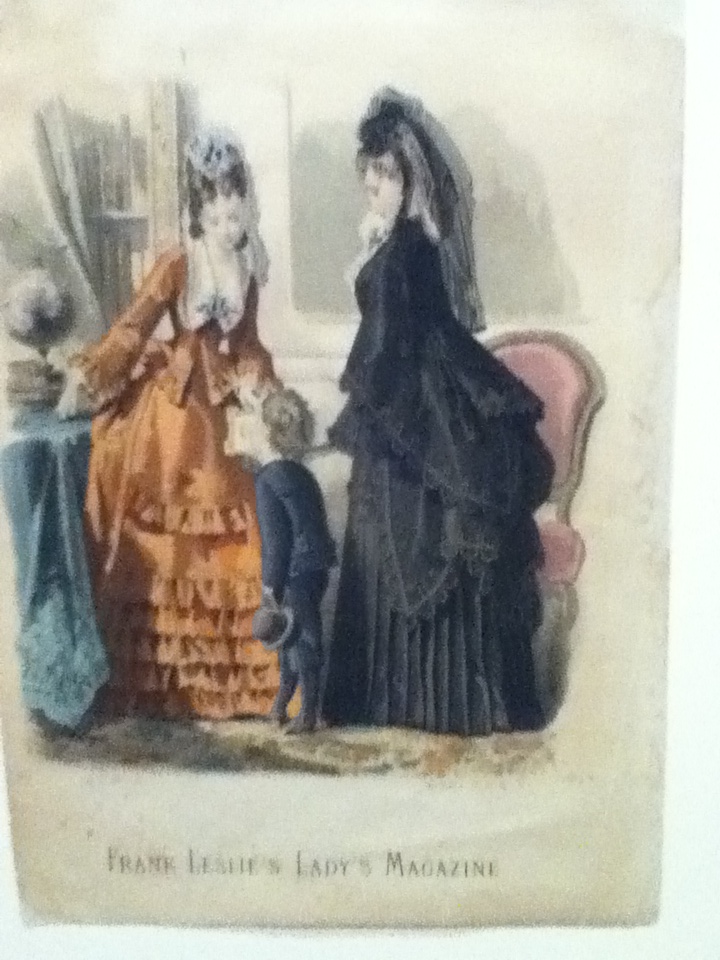
What I really loved about this exhibition was how clearly they linked the etiquette requirements of doing certain things during mourning: first wearing very matte black fabrics with little ornamentations, then getting shinier fabrics, and then introducing whites/greys/purples- and how women still fashioned their mourning attire after the most current styles of the day. There was a whole display of fashion plates which illustrated this, even down to two separate plates showing the same dress- one in “mourning” and one “regular”.

IMG_0761

Sorry for my blurry photos!!

The fashionableness of mourning clothes was quite important to these women, not only because hey, everyone likes to be fashionable, but because a young widow also probably wanted to get remarried as soon as her proscribed two years of mourning were over. There was a great series of illustrations by Charles Dana Gibson (of Gibson Girl fame) satirically illustrating the life cycle of a widow where she is first an object of sympathy, but then as she tries to rejoin society becomes an object of men’s leers and women’s derision. This particular widow ends up joining a convent but not being able to escape the gaze of the priest.

IMG_0767

There is quite a lot of focus on “the widow” as a specific form of female loveliness and object of desire. Some passages from books and etiquette manuals flash on the wall and this one in particular caught my attention: “Black is becoming; and young widows, fair, plump, and smiling, with their roguish eyes sparkling under their black veils are very seducing,”  from The Illustrated Manners Book by Robert De Valcourt 1855.

As with most fashion exhibitions, the show focused mostly on women’s clothing, and there are plennnnnty of beautiful gowns to drool over. Happily, there were a few men’s things as well, with a great text explaining that since men’s clothing during the period was already so somber, there wasn’t much they could do to show that they were mourning in the way women could. Instead, they would do things like wear a black band on their hat, or use black accessories such as cufflinks, gloves, and ties. Of course, men were a lot less likely to be commented on if they didn’t wear mourning properly so they also didn’t have the social pressure to conform in the same way women did.

The smaller gallery, including the works on paper mentioned above, also contains a small sample of mourning jewelry such as the famed Victorian hair jewelry and some jet things. Also a child’s post mortem photograph that is so fragile it must be covered with a black cloth- the image is so hard to see they shouldn’t have bothered. If these morbid-type things are more your cup of tea, it would be better to check out Brooklyn’s new Morbid Anatomy Museum’s nice little exhibit on the more gruesome side of Victorian mourning culture.

The exhibition was accompanied by a recording of Gabriel Faure’s “Requiem, Op. 48,” a nice touch for creating a haunting atmosphere to the underground galleries. It’s a small exhibit, but beautifully laid out and the starkness of the black dresses lended a beauty to the array and also let you really focus on the details and shapes of the designs. Totally worth the $1 you can pay at the Met, and for fashion/textile lovers, there is a bonus exhibition of GORGEOUS kimono in the Asian Art wing.