Would You Hire a Bridesmaid?

We recently read about this new service, Bridesmaid For Hire, who, as described, will fulfill many of the traditional duties of a bridesmaid: help with planning, keeping peace with your family and friends, and a shoulder to cry on. We thought this was an interesting concept, especially given the blowback brides have gotten from demanding too much from their real bridesmaids, and had a lot to say about it:

Jaya: So this is just a wedding coordinator? Can we talk about this? And also that a lot could be solved if you talked with your bridesmaids about expectations beforehand?

Victoria: Yeah, I mean I guess it is slightly different than a planner or coordinator, it’s almost more the old fashioned social secretary, except mixed with a therapist. I guess it’s a fine idea if people want to shell out for it. And super great if it means no one is expecting a bridesmaid to deal with every little issue.

Jaya: I’m weirded out that one of the packages involves her actually walking down the aisle as a bridesmaid.

Victoria: THAT is REALLY weird. Like you are showing your wedding pictures to your grandkids and “oh that lady is someone I hired to come.” You can definitely do all that stuff and not be IN the ceremony!!!

Jaya: And also I think it just frustrates me that we’ve gotten to the point where this is what’s expected as a bridesmaid.

Victoria: Yeah, omg the crazy expectations.

Jaya: It’s more the bigger picture that now you expect your best friend to be an expert party planner. So instead of lowering your expectations, you hire a better friend?

Victoria: Yeah, seriously. I mean the thing is, no one should be expecting their bridesmaids to do ANY of this. Bridesmaid expectations: show up, wear prescribed dress. Anything else is extra (not that there aren’t very heavy cultural expectations at play!)

Jaya: Yeah, and I mean, that’s why you talk about it! Don’t just throw all this stuff on somebody, because they might be busy with other things, or maybe they’re just not good at planning showers.

Victoria: The bachelorette party and stuff is generally expected, but honestly if your bridesmaids are too broke, spread out, or busy, then tough–you don’t get that. Or you take what they CAN give you.

Jaya: I just feel like most of it could be solved with like “this is what I’m hoping happens, is that something you think you could do?” and then everyone is just honest with each other.

Victoria: Yeah, for sure, and like also omg, it doesn’t HAVE to be the MOH who does it all. Like if MOH lives far away, and Bridesmaid A is interested and wants to plan, then duh she should. The whole thing is so bizarre.

Jaya: Yeah! When I was a bridesmaid, the maid of honor would start an email chain and then everyone figured it out together based on our budgets and schedules.

Victoria: I do like this Bridesmaid for Hire the more I think about it- if you need THAT level of service and hand holding, it’s definitely better to hire someone than force it on your friends. But don’t dress them up and march them down the aisle, that’s creepy and weird.

Jaya: I’m trying to figure out how I feel. To me, it’s more like, a wedding coordinator and a therapist would probably be more beneficial in the long run. You get the coordinator for planning, and you get your friends for emotional support. And with “forcing” it on your friends, obviously it depends by relationship, but I’d hope that my friends could take maybe a few late night freak out phone calls. I don’t wanna push the boundaries of what friends are for, but sometimes that’s what friends are for! OR YOUR SPOUSE MAYBE??? Like if you’re bonding yourself for the rest of your life to a person, maybe they can be an emotional/planning support??

Victoria: Yeah for sure, but if you need someone like…every day. I mean, I guess that maybe means you have bigger problems, lol.

Jaya: Anyway, yeah it does sound useful if your friends and spouse are gonna be no help and you’re prone to getting overwhelmed.

Victoria: Yeah, and if you were going to hire a wedding coordinator anyway, maybe you want that extra level of service.

Jaya: But if you take away the wedding coordinator duties, you’re sort of left with just needing the emotional support. and ideally you have friends that can provide that. I know bridesmaids are just supposed to show up in a dress, but I also think they’re supposed to be a bit happy for you and supportive when you need them, like friends are.

Victoria: Yeah, absolutely. But I guess looking at her packages she does do a lot of coordination type stuff, like between a full on wedding planner who deals with vendors and a “day of” coordinator who isn’t really there to help you make to-do lists and stuff.

Jaya: I feel like a lot of planners offer packages like that too. At least when I was researching there were lots of in between options.

Victoria: Do they? I have no idea.

Jaya: So I guess this girl is just good at branding/marketing. And sometimes wearing a dress and standing next to you.

Victoria: Not to mention the creepy thing of your MOH hiring this person secretly to plan your showers/bachelorettes.

Jaya: Yeah!!!!! That is weird. Like, if you’re a bridesmaid and you’re thinking of hiring help, please talk to the bride first.

Victoria: Seriously, omg that is so strange. Unless I guess you are super rich and would outsource all that kind of thing anyway.

Jaya: It’s just frustrating that it’s gone far enough to justify this, instead of people maybe trying to work together with their friends to make an enjoyable time.

Victoria: Haha yeah, but I do get, I guess, that weddings are more “stressful” now than maybe they used to be. And so maybe you do need to hire some form of planning help, in whichever iteration is more pleasing to you.

Jaya: Yeah. Though it still is about expectation. If you planned a 300 person wedding 100 years ago, you’d probably need a social secretary or assistants and such, but now, the expectation is that everyone will have a big wedding and know how to plan it by themselves.

Victoria: Yeah, plus your mom would be planning it and had probably planned dozens of parties for 300 people.

Jaya: Hahaha yeah. And yeah there’s the WIC (Wedding Industrial Complex) and all that, whatever. [ed. Jaya is not very into the term Wedding Industrial Complex] [other ed. IT’S A STRAWMAN]  I guess what bothers me is people tend to use that as an excuse for having no control over their weddings, like there are no other options. Hellooo you’re an adult, stand up to your parents’ expectations. And we have the internet, I can find you a white dress for under $100 like yesterday.

Victoria: Haha yeah, exactly, but I mean, it does seem like a lot of people go in with great expectations about keeping control on things and then it just spirals and they throw their hands up. So I can see getting in over your head.

Jaya: It is easy to be convinced things are necessary when they’re not, by family or by vendors. That’s definitely an issue. Why can’t everyone else just have a will of steel??

Victoria: Plus you have to have a pretty strong sense of self and what you want to do that. And that is just not easy for…probably most people. Especially if they hadn’t really thought much about their wedding besides, “it will be lovely and pretty and the happiest day of my life.” And not everyone spends as much time reading about weddings as us. For some reason.

Jaya: WHY NOT?! They have no excuse then. I say that as a joke but also kinda mean it???? Like, even if you haven’t read a lot about it, it’s not ridiculous to go in thinking it’ll take planning and decisions. So if you don’t research how to do that and then get overwhelmed, idk.

Victoria: Haha yeah for sure. I mean there are tons of resources.

Jaya: I certainly got overwhelmed, and it’s hard dealing with everyone’s opinions. But if it’s too hard for you then go to City Hall. If you agree to do a wedding, you sorta have to agree to planning, and making decisions, and saying no, and all this stuff. Or that you’ll pay someone to do it for you.

Victoria: Lol yeah for sure. Anyway, it’s certainly not rude to hire a bridesmaid, but maybe it would be best to talk to your actual bridesmaids about their expectations first. And, hey, if anyone wants to hire etiquette consultants to make sure you are doing everything above board, we are probably available!

Happy (Day After) Thanksgiving

We hope everyone had a tasty and restful Thanksgiving and we will be back on Monday!
In the meantime check out some Thanksgiving tips we’ve shared with:

Modern Farmer

Metro New York

Some Thanksgiving Tips

Last week, Victoria and I were interviewed for Metro New York about what to do if you’re a college student spending Thanksgiving with a friend’s family. However, a lot of the advice can be applied in many situations, like spending the holidays with your in-laws or your extended family. Here are a few more tips on how to get through it all without going crazy!

  • Offer to help out as much as you can, but make sure you can really do it: Jumping into the kitchen so Aunt Martha doesn’t have to make everything is fantastic, but don’t do it unless you actually know how to make green bean casserole. The only thing more stressful than having to cook five dishes is having to cook four while answering a million questions about the fifth. If that’s the case, see if there are other ways you can help, like running errands, watching the kids, or setting the table.
  • Don’t be a dick about dietary restrictions:  Some people refuse to believe gluten allergies exist. Others think anyone who isn’t a vegan is a murderer. Most of us can and should meet in the middle. My thought is that the host gets a heavy say in what’s served at their house, within reason. For instance, if you’re a guest in a Kosher household, don’t bring your bacon-wrapped scallop appetizer. However, if you’re the host but the only vegetarian, maybe request that most of the dishes remain vegetarian, but let someone bring a turkey. Also, speak up if you have a serious allergy, like if you’re so allergic to peanuts that the presence of them anywhere on the table will make you break out in hives. And if you have a lot of restrictions, bring a dish or two that you know you can eat.
  • Be flexible with traditions: I was slightly horrified the first time I went to a Thanksgiving dinner and everything was served on paper plates, because I’m a horrible snob and you should never invite me anywhere. But then I remembered that shrimp curry is often served alongside turkey at my family’s house. The holiday is about sharing traditions, not judging them.
  • Pick your battles: We got into this a little in Metro about balancing changing the subject gracefully with calling out someone’s racist uncle. Sometimes it’s not worth the effort to call someone out, and sometimes you can’t just let it slide. Everyone has their own personal thresholds.
  • Have an exit strategy: Most of us have probably felt stressed out at at least one Thanksgiving (or other holiday). It can be a perfect storm of stress, family tensions and loud little kids. Have a plan if you’re prone to getting overwhelmed by these things, like taking a walk or running an errand. Last year I got so overwhelmed at one holiday I excused myself to the bathroom and instead lay down in the guest room for ten minutes. No one will miss you for that period of time.
  • Don’t forget to use your good table manners: The basics- put your napkin on your lap, chew with your mouth closed, elbows off the table, and say please and thank you.

Death Becomes Her: Etiquette in the Museum!

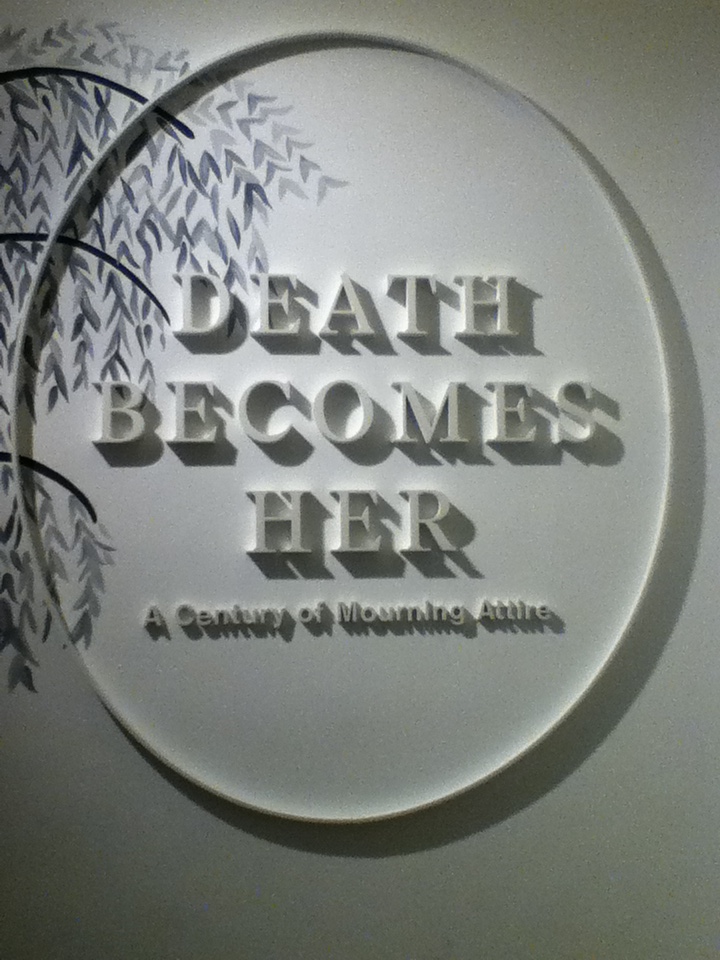
IMG_0786It is only rarely that museums have exhibitions that directly reflect etiquette, so I was very excited to see the Metropolitan Museum of Art’s Death Becomes Her: A Century of Mourning Attire, the first fall show of the newly renamed Anna Wintour Costume Institute. We’ve discussed Victorian Mourning etiquette before, but it’s a subject worth revisiting in the context of this amazing exhibition (if you are in NYC, go see it before it closes February 1.)

This particular exhibition covers roughly the years 1815-1915 which spans the growth, peak, and decline of intense mourning clothing traditions in the United States (and a little bit of England). During this period, as the wall text reads: “With the growing circulation of women’s periodicals and advice manuals, along with technical advances that shaped the textile industry and fashion retail, modes of mourning that had been the preserve of the elite were made available to the burgeoning middle class.” With the end of World War I in 1918, formal mourning requirements drop off drastically. Interestingly, the massive casualties of the Civil War led almost to a peak of strict mourning rules whereas the even greater casualties of WWI made death so common and for such a “cause” that public mourning- the wearing of black and so forth was actually discouraged (especially in England). This led to the more current custom of only really wearing “mourning” clothes at the actual funeral services, if even then. The excellent review of the exhibition in the Wall Street Journal points out that the last public hurrah of this kind of “veiled widow” style of mourning was during the political assassinations of the 1960s.

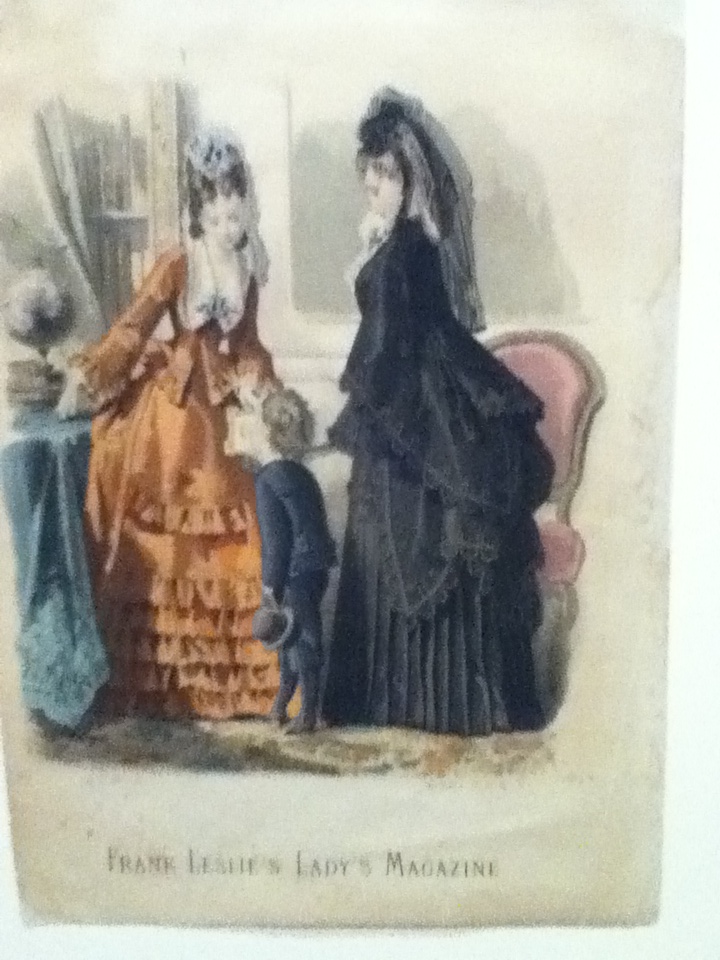
What I really loved about this exhibition was how clearly they linked the etiquette requirements of doing certain things during mourning: first wearing very matte black fabrics with little ornamentations, then getting shinier fabrics, and then introducing whites/greys/purples- and how women still fashioned their mourning attire after the most current styles of the day. There was a whole display of fashion plates which illustrated this, even down to two separate plates showing the same dress- one in “mourning” and one “regular”.

IMG_0761

Sorry for my blurry photos!!

The fashionableness of mourning clothes was quite important to these women, not only because hey, everyone likes to be fashionable, but because a young widow also probably wanted to get remarried as soon as her proscribed two years of mourning were over. There was a great series of illustrations by Charles Dana Gibson (of Gibson Girl fame) satirically illustrating the life cycle of a widow where she is first an object of sympathy, but then as she tries to rejoin society becomes an object of men’s leers and women’s derision. This particular widow ends up joining a convent but not being able to escape the gaze of the priest.

IMG_0767

There is quite a lot of focus on “the widow” as a specific form of female loveliness and object of desire. Some passages from books and etiquette manuals flash on the wall and this one in particular caught my attention: “Black is becoming; and young widows, fair, plump, and smiling, with their roguish eyes sparkling under their black veils are very seducing,”  from The Illustrated Manners Book by Robert De Valcourt 1855.

As with most fashion exhibitions, the show focused mostly on women’s clothing, and there are plennnnnty of beautiful gowns to drool over. Happily, there were a few men’s things as well, with a great text explaining that since men’s clothing during the period was already so somber, there wasn’t much they could do to show that they were mourning in the way women could. Instead, they would do things like wear a black band on their hat, or use black accessories such as cufflinks, gloves, and ties. Of course, men were a lot less likely to be commented on if they didn’t wear mourning properly so they also didn’t have the social pressure to conform in the same way women did.

The smaller gallery, including the works on paper mentioned above, also contains a small sample of mourning jewelry such as the famed Victorian hair jewelry and some jet things. Also a child’s post mortem photograph that is so fragile it must be covered with a black cloth- the image is so hard to see they shouldn’t have bothered. If these morbid-type things are more your cup of tea, it would be better to check out Brooklyn’s new Morbid Anatomy Museum’s nice little exhibit on the more gruesome side of Victorian mourning culture.

The exhibition was accompanied by a recording of Gabriel Faure’s “Requiem, Op. 48,” a nice touch for creating a haunting atmosphere to the underground galleries. It’s a small exhibit, but beautifully laid out and the starkness of the black dresses lended a beauty to the array and also let you really focus on the details and shapes of the designs. Totally worth the $1 you can pay at the Met, and for fashion/textile lovers, there is a bonus exhibition of GORGEOUS kimono in the Asian Art wing.

Trying To Separate Etiquette and Respectability Politics

In my time writing here, I’ve conducted a lot of fun research, from learning how to walk properly to how to take snuff. But it’s pretty obvious that the Western rules, no matter how arcane or relevant, have one thing in common: they were all dictated by rich white people.  In fact, I’m going to go ahead and guess that no matter where you are, most rules of social interaction come from those in power. Sure, etiquette is sold as a way for us all to navigate possibly confusing social situations, but let’s not pretend it wasn’t also used to weed out who wasn’t supposed to belong. It’s hard to make the rules fair when they’re being made by the winners.

Which brings us to respectability politics, or the idea of defining someone’s worth by how they present themselves to the world. Roxane Gay puts it excellently in her new book, Bad Feminist: “the idea that if black (or other marginalized) people simply behave in ‘culturally appropriate’ ways, if we mimic the dominant culture, it will be more difficult to suffer the effects of racism.”

If you squint, a lot of respectability politics can be mistaken for etiquette. We’re not rejecting people because of class or race or sex, we tell ourselves, but because they’re not being “respectable.” A girl who has sex on the first date surely can’t be worthy of a respectable relationship. A black guy can’t expect to get anywhere using slang all the time. Being gay is fine as long as you don’t flaunt it. Say the right things, dress the right way, don’t “act out.” Just adhere to the rules that you had no say in creating and you’ll be fine.

I remember times where I’ve fallen into this. Where I thought “it doesn’t matter who you are, as long as you’re like me,” and not noticing when it slipped into “No matter who you are, this is how you should be acting.” It’s letting personal preferences turn into value judgments. It’s mistaking a difference in culture for having no culture, or a difference in upbringing with rudeness, and expecting everyone to adapt to your standards.

I’ve said before that they core of etiquette is the balance between making room for others and keeping room for yourself. Literally this manifests itself through things like keeping to one side of a staircase so others can pass while you use it, hosting a party that’s fun for your guests and also fun for you, or making sure you and your roommate have equal living room time. But culturally, it’s about making sure we share the value of being considerate without imposing other value systems on each other. Etiquette is supposed to be about finding the good intentions in everyone, and that requires effort on all sides, especially if you’re on the side that’s been making the rules the whole time. In a perfect world, that’s all these rules are: shorthand to ensure your good intentions are clearly understood. But that doesn’t mean someone whose actions don’t look like yours doesn’t have those intentions.

You will not like everyone you meet in life. You will meet people who are downright rude to you, or who come from such different backgrounds that you cannot come to an understanding, despite your best efforts. This is fine for your personal life, but you should never mistake these personal differences for proof that somebody doesn’t deserve to be treated with basic humanity.