How To Be Considerate Of People Who Have Been Through Tragedies

Here’s a fun fact about your ol’ friend Jaya: I have either been present for or just barely missed many large-scale tragedies. On September 11, 2001, I was a high school sophomore in downtown Manhattan and vividly remember walking through the city with a dust mask for days. On August 28, 2005 I was set to fly to New Orleans to begin my sophomore year of college when I got word that a hurricane was approaching [ED: Victoria was also], and later had friends evacuate and sleep on my couch. The semester was cancelled. And in late November 2008 I was going to meet my grandparents in Mumbai and stay at the Oberoi hotel, owned by family friends, except my family wasn’t getting back to me about plans and I was being impatient and I booked a flight to Delhi instead and they changed their plans to meet me. I woke up my first day in Dehli to news of the bombings.

I’m not looking for pity. I’m lucky I wasn’t further downtown, or already in New Orleans, or that I didn’t wait a day and book my flight to Mumbai instead. But these things have a tendency to stay with you, even if you were on the outskirts. I can’t speak for everyone who has been through something like this. Even among friends who I experienced these things with, our reactions and traditions and the ways we remember are different. But there are ways to make sure you don’t cause more harm.

If it’s in the immediate aftermath and you’re trying to contact them, try to find one or two points of contact. In Delhi, it certainly helped to only have to email my mom and my boyfriend and have them relay that I was safe than answer 30 emails from concerned friends and relatives. If you can be that person, volunteer. Yes, now you’ll be the one answering all the emails and calls, but hey, it could be worse.

If you’re in a position to do so, offer help however makes sense, whether it’s a couch to sleep on, extra clothes, or legal expertise.

You may be tempted to let your friend know that they can talk to you. This can be good, but can quickly turn into a burden for the afflicted friend. It can either pressure them to talk if they don’t feel like talking (and don’t feel comfortable saying “I don’t want to talk right now”), or just subject them to an endless barrage of “How are you?” and “You must be going through a lot.” A simple “let me know if you need anything, I’m here for you,” just once, is effective.

As years pass your friend may still carry some trauma publicly, may be pained but prefer not to talk about it, or be honestly over the incident. It’s none of your business how that plays out.

Anniversaries can be a tough time, not just because it reminds the person of what transpired, but because it reminds everyone else of what transpired too. If it was a public tragedy there are going to be a million thinkpieces and news reels and conversations about it. Your friend may honestly not mind, but as a precaution, let them bring it up if they want to talk about it. Nothing is worse than having someone go “wow, what was 9/11 like?” when I’m not in the mood.

Similarly, if you know someone has been present for a tragedy, be careful about bringing up your own experiences. This is a tricky one, because in a lot of ways things like 9/11 or Hurricane Katrina are national tragedies. Everyone remembers where they were, and it’s natural to want to share what we were all doing when The Thing happened and commiserate together. But I’ve seen too many conversations turn into a pissing contest of who was the most traumatized?, and people talking over the person who perhaps witnessed or experienced it firsthand. And hey, they may still just not want to talk about it, and hearing what someone who wasn’t present feels about it won’t help. Yes, your feelings are valid, but they can also wait.

In a lot of ways it’s like helping a friend after a death. Let them know they have a support circle, be considerate and understanding if they need you, listen instead of talking over them, and let them handle it in their own way as long as they’re not causing themselves or others harm.


¯\_(ツ)_/¯

Etiquette at the DMV

c1dcf20a1201757bef3e6327688b2861I just had a lovely experience signing up for IDNYC (if you live in NYC you should get one!), and it had me thinking about all our stereotypes about the DMV and customer service in general. I wasn’t actually at the DMV, the signup took place at a local community college and I made the mistake of making my appointment on ORIENTATION DAY so oh god there were all these posters and helpful looking young people and ugh I just wanna find room E116 without making eye contact and accidentally signing up for the Gay-Straight Alliance. Aside from that it was actually quite painless and the woman who processed me was a delight.

But anyway, the DMV and similar places! They sort of suck, don’t they? There’s a lot of waiting, and forms, and people taking too long, and weird smells, and they just seem to bring out the crank in everyone. My theory is that paperwork and long wait times make everyone forget some basic etiquette that could smooth things over. No, etiquette will not make your wait shorter, nor will it make anyone less crabby to you, but it can help how you end up internalizing all your experiences.

Firstly, the practical stuff. If you can do it online, DO IT ONLINE, both to save you the hassle and to make one less body taking up space at the DMV. If you must do your business in person, research what forms you need to fill out and what you need to bring, and do them before you get there if possible. You probably already know this, but I was shocked when I got my learner’s permit renewed (a thing you can do, yes) a few years ago and saw the number of people who didn’t realize that a credit card isn’t a valid form of ID, or who had filled out completely the wrong forms, and held up things for anyone else. (A pass is given to anyone who doesn’t speak English well because they do NOT make those forms easy to read).

Next, the zen stuff. If there’s one humbling thing the DMV makes you remember it’s that you are not special. There is freedom in that. Use it. I think a lot of our etiquette faux-pas come from believing we alone are suffering the fools. We believe we are right and they are wrong, or we need something more than someone else, and no one understands us. That is rarely the case. At the DMV you are not suffering alone. Everyone around you is waiting, and probably has been waiting, and probably has places they have to be, or places they’d just rather be, or other stuff on their mind so they don’t hear their number called immediately. And the people who work there, yes it’s their job but they may also be tired or zoning out, like you are at your job sometimes. And maybe you think they shouldn’t be in customer service if they’re like that, but good jobs are hard to find. Nobody is always where they want to be.

It is satisfying in the short run to yell at someone for being unhelpful or rude or ignorant. On occasion it even works, and if someone has offended you or keeps giving you the wrong directions, by all means ask to speak to a manager. But returning rudeness with rudeness won’t make you feel better, really. You’ll stay resentful that you had to be rude. If you got an apology you’ll worry about if they meant it, and if they learned their lesson. If you didn’t, you’ll be wondering what you could have done to make them change. The rest of your day will be filled with the DMV. You don’t need that.

I don’t always like telling people to be nice. I think a lot of real issues get silenced under the pillow of “nice.” I don’t think niceness should come at the cost of human dignity. But people like to think places like the DMV are an affront to that dignity, and they just aren’t. They’re governmental processing buildings and they sorta suck. It’s not the worst thing you’ve had to endure.

This turned into being about a lot more than the DMV.

How To Not Talk To Someone About Their Name

4125yIn this country (the USA, where I’m writing from), I have what is considered an unusual name. It’s important to note that it’s unusual for this country; if you go to India there are plenty of Jayas and Saxenas all over the place, and you’ll be the one out of place with a name like Joseph Tabbert or whatever. What we consider “exotic” is extraordinarily objective, so before we get started, tattoo that into your brain. I do not assume most Americans will have heard my name before, or will know how to pronounce it. There are plenty of Western European names I cannot pronounce (and plenty of Indian names I can’t pronounce, for that matter), and nobody is expecting anyone to get everything right on the first go. What I get frustrated about, often, are follow up questions or inane, racially-coded commentary about my name that, I’m going to guess, the average Mackenzie is not subjected to. I know plenty of people with similarly “foreign” names that share my experiences, but also people with names just considered “unusual,” and thus, game for commentary. Here are a few things I think we’d all appreciate.

  1. Do not make name commentary the first thing you say to someone. Last week I wrote a humorous post about this for The Toast, and it got picked up on a MetaFilter board, where there were no shortage of people arguing about their free-speech right to talk about whatever they want, and PC culture, and how #millennials just need to lighten up, and how when they were kids they talked about their backgrounds and names all the time. NOBODY IS SAYING YOU CAN’T DO THAT. I too grew up in a diverse area and had lots of friends of different backgrounds, and I too spent many recesses talking about where my parents were from, where their parents were from, what our names meant, what other names our parents might have given us, and plenty more. You know why we talked about that? Because we were friends, and shared backgrounds and heritage are what friends talk about. What’s infuriating is when you introduce yourself to someone and the first thing they say is “Wow! What a strange name.” The explanation will probably come in time. Or it won’t, and you’ll live. (Or you can probably just Google it later.)
  2. If you see it written out, do ask how it’s pronounced. Again, nobody is expecting you to know every name in the world, and if you encounter a name you honestly don’t know how to pronounce, ask politely how, without any comment on how “it’s so long” or “you don’t see those letters together every day” or “seems foreign.” You can also try to give it your best shot, but follow up by saying “did I get that right?” That gives the name-haver (???) an opportunity to respond yes or no, rather than coldly having to interject and correct you. Similarly, if you need to know how a name is spelled, ask, and with no addition of “wow that’s easier than I thought.”
  3. Do not pre-emptively nickname someone. When my parents named me, they wanted something that reflected my heritage but that wouldn’t get nicknamed into something stupid. I love my name, but what sad reasoning! How unfortunate that we can’t trust each other to just call us what we want to be called, instead of seeing “Shivangi? I’m gonna call you Shishi.” And yes yes yes YOU may be very progressive and worldly and would never think to do this, but, people do. Again, if you’re friends for a while and a nickname naturally appears, go ahead, but if someone introduces you by their name, call them by that name.
  4. Do not inform someone where their name comes from. Go ahead and assume they know.
  5. Do not inform someone that their name is a burden to you. This comes in many forms. It could be by saying it’s complicated to pronounce, or doesn’t fit on their coffee cup. It could be in the form of a teacher that doesn’t study his new students name list, and on the first day rattles through the Amy Johnsons and Brian Smiths before pausing at yours. It could be the person balking when you introduce yourself, asking “what kind of a name is that?” or making an assumption about what your parents are like.

So, what should you do? My idea: Treat every name like it’s Sarah (or some similarly common name where you’re from). A common comment I get on my name that I’m sure lots of people think is innocuous, or even a compliment, is “wow, that’s so pretty!” And it is! I love my name and I think it’s very pretty. You know what are other pretty names? Jenna and Mary and Laura and Alexis, but they don’t get that commentary. You wouldn’t ask Sarah where her name is from, or where she is from. You wouldn’t ask her why her parents named her that. You wouldn’t tell Sarah she has such a pretty name, even though she does! Maybe start telling everyone they have pretty names and see how that feels. [Ed: I (Victoria) am told I have a pretty name allll the time. But the point still stands.] On a last note, somewhat related to this, I’d like to call for an end to the idea of “respectable” names, which is often just code for white, Western European names. You see this in lots of places, whether it’s the proof that resumes with black-sounding names get fewer callbacks than identical ones with white-sounding names, or people acting incredulous over the idea of a President Paisley. The worst, in my opinion, is saying “that name is made up.” Guess what? All names are made up! John was just made up a bit longer ago than Jaxon (maybe? I actually don’t know that.) So unless their parents have named them something like “Dick Johnson-Schlong” (please don’t do this), accept it and move on.

How Well Can You Do On This 1922 Etiquette Quiz?

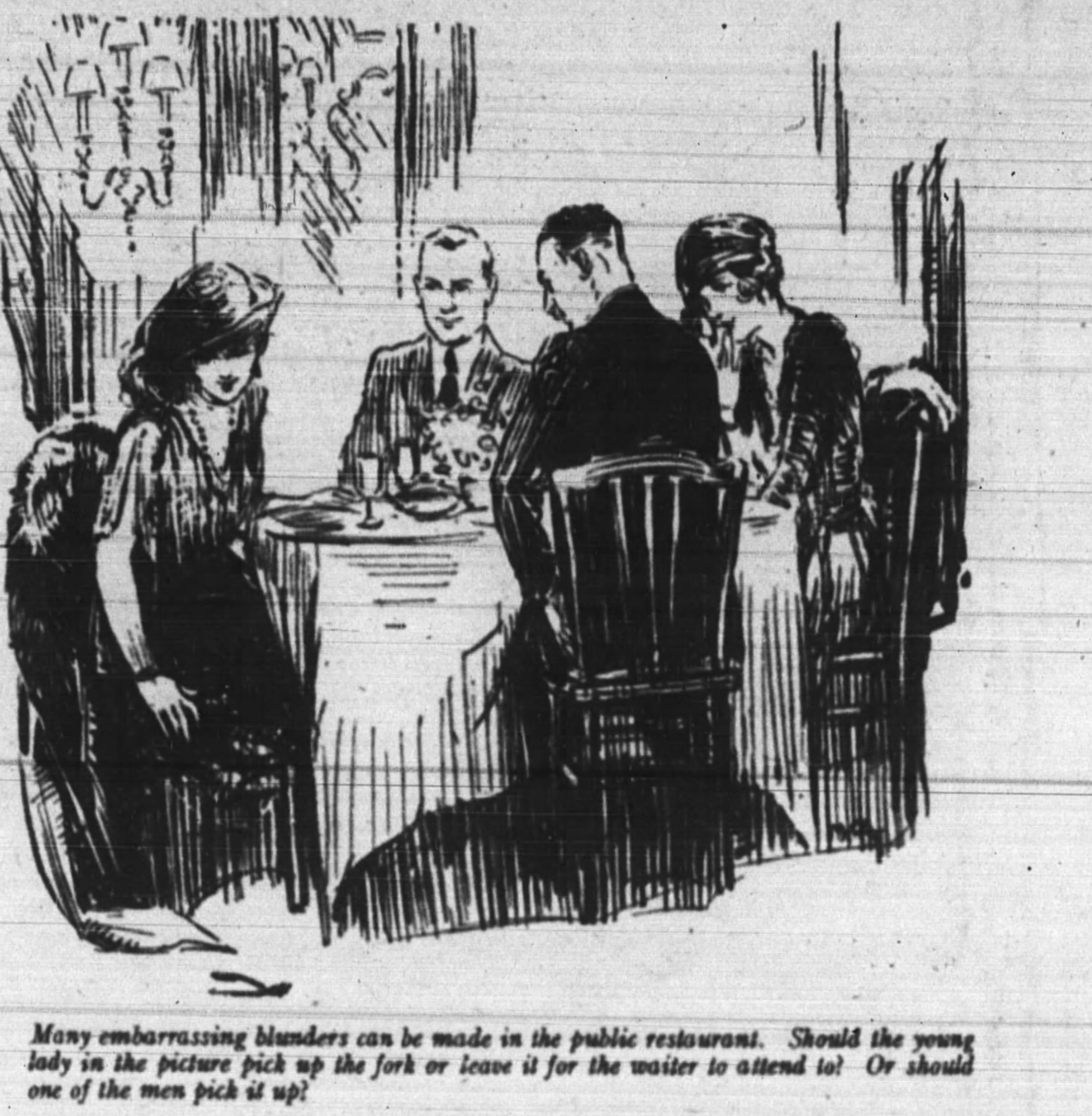
Did everybody in the 1920s have an etiquette book? They seem to have been everywhere. According to one promotion in the New York Times, you didn’t even have to pay! Just send the ad to Doubleday and receive a free copy of “Etiquette Problems in Pictures,” a book showing “mistakes that are constantly being made in public, in the dining-room, on the dance floor, at the theater.” Think you’re too good for an etiquette guide? Well, they’ve included a quiz to see just how much you know. See how many you can answer:

Via the New York Times

Via the New York Times

  • When a man and a woman enter the theatre together, who walks first down the aisle?
  • When the usher points out the seats, does the man enter first or the woman?
  • Should the knife be held in the left hand or the right?
  • Should olives be eaten with the finger or with a fork?
  • How is lettuce eaten?
  • What is the correct and cultured way to eat corn on the cob?
  • Are the finger-tips of both hands placed in the finger bowl at once, or just one at a time?
  • When a man walks in the street with two women, does he walk between them or next to the curb?
  • Who enters the streetcar first, the man or the woman?
  • When does a man tip his hat?
  • On what occasion is it considered bad form for him to pay a woman’s fare?
  • May a man on any occasion hold a woman’s arm when they are walking together?

I think I know the answer to one of these! Man, I would not have survived society in the 1920s.

If You Thought Hugging Was Complicated, Kissing Is Worse

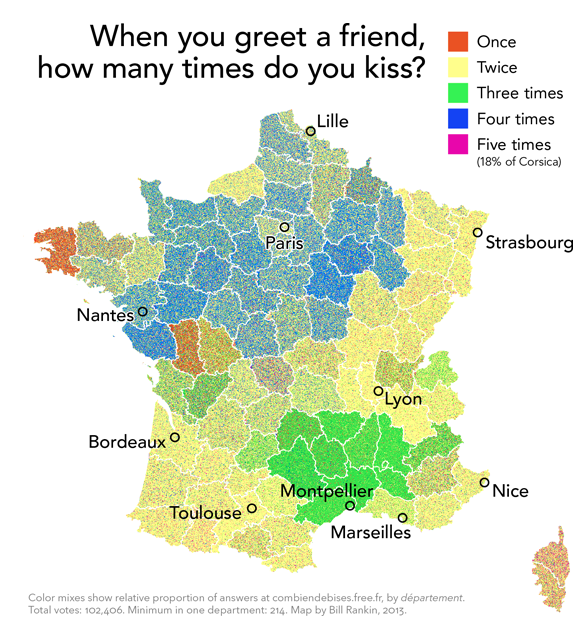
Last week we covered the slightly fraught topic of how to navigate the world of friendly greetings when you’re not much of a hugger, which brings us to an even more complicated version of greetings–kissing. I had a really embarrassing time on vacation in Paris with a cousin’s French fiance, who went in for the double kiss as I sort of frantically waved my arms in a hug attempt while also kissing the air and I think his neck? It was bad, guys. And according to this map by Radical Cartography, I am not alone in being totally confused about the protocol. The map was made in 2013 but whatever, we just found it, and it’s totally relevant.

Screen Shot 2015-07-01 at 11.58.07 AM


How are you supposed to know? Why is it spread out like this? WHO KISSES FIVE TIMES?? The lesson I’m pretty much getting out of this is never greet anyone in France.