Thank Goodness Bicycle Etiquette Is Not This Sexist Anymore

Why we don't have bicycling cowboys I'll never know. [Etiquette and bicycling, for 1896]

Why we don’t have bicycling cowboys I’ll never know. [Etiquette and bicycling, for 1896]

“Every advanced step toward a more perfect civilization requires some modification of the laws of society. Social intercourse varies under different conditions, but when an entirely new order of affairs presents itself a new code of etiquette is necessary. The question is naturally asked: Who is the authority for the establishment of social laws, and in the absence of precedent why is not one way just as good as another.”

This quote is attributed to something called Bearings, “the recognized authority on cycling matters,” as quoted in Etiquette and Bicycling, for 1896. It is the best summation about etiquette I think I’ve ever seen. Please apply this as you want, but today this is applied to the emergence of bicycling culture. In 1896, it was a total gamechanger, allowing people to travel through surrounding areas instead of staying in their towns, and emancipating women from “slavish conventionality in both dress and conduct.” Well, maybe not. Women were still “ladies,” and despite the ability to cycle about town, there were still a lot of rules to adhere to.

An unmarried cycling woman had to be chaperoned by a married woman, and married women had to be accompanied by their groom or another woman. Occasionally, married women trained had a “servant trained in the art” in order to adhere to this convention. And though women were reminded that “modesty is becoming at all times,” bloomers were acceptable.

Things were much different for experienced “wheelmen,” though the book admits that one of the draws of cycling was it was something men and women could do it together. It was therefore customary that men hold the handles as a woman mounts her bike, from the left with her right foot on the pedal. The book argues, “Let the new woman prate as much as she please about her independence of man, but she is the first nevertheless to rise up in indignation if any of the same old time chivalry is omitted.” Therefore, the author concludes, the man will do everything in his power to make the woman comfortable. This would be hilarious if I hadn’t met men who still think this way.

Men were still supposed to be hyper-aware of their female biking companions once riding, and women were pretty much expected to be complete idiots about the whole endeavor (“it is difficult for a man and almost impossible for a woman to ride without an instructor”). A man shouldn’t dare go ahead of a woman on a narrow road, or he may “get a long way ahead of his companion without knowing she was in distress.” He should ride on the left side of a woman so he could give his right arm in assistance, and the author makes a special point to say that all women deserve assistance, “handsome or otherwise.”

Okay, this is getting exhausting. How about some general ideas for bicycle etiquette? Social Etiquette, Or, Manners and Customs of Polite Society by Maud C. Cooke says that bikes are welcome in houses of worship, so “don’t absent yourself from church to go wheeling.” Also “don’t leave your bicycle in the lower hallway of your flat house,” which is absolutely applicable today. Pass on the right, and don’t speed down hills with curves at the bottom. However, she does advise “sweaters worn like a Chinaman’s blouse are almost indecent.” Whatever that means.

What To Do If You’re Woefully Underdressed

tumblr_m6v9saBuT61qmgz9uo1_500The other weekend, I went to a beautiful wedding of two close friends where the website clearly indicated “semi-formal” (aka cocktail attire, dressy, or black-tie optional) as the dress code. Everyone looked pretty great. However, at one point a number of us seemed to distinctly notice one guest who had shown up in an untucked button down shirt, shorts, and a backwards baseball cap. Of course it couldn’t distract from the amazing ceremony and reception, but for a while before things got rolling, our section of seats was a little distracted and surprised.

This guy seemed to have no clue that he was dressed a bit inappropriately (he didn’t even take his hat off for the ceremony!), but it happens to the best of us–you misread a situation and show up dressed completely wrong. Here are a few steps you can take to remedy the situation.

  1. Apologize! Make it clear that you too see how you’re dressed, and that you realize it’s wrong. You don’t need to be groveling to everyone all night, but a quick “Oh my god, I didn’t realize I needed a tie!” to the host will smooth things over greatly.
  2. Work with what you have. Take off your hat and tuck in your shirt. See if you can borrow lipstick from someone, or if you have a pretty pair of earrings at the bottom of your purse. The venue you’re at might have a lost-and-found with a spare sport jacket in it, or maybe you can run home quickly and change into pants.
  3. Don’t make yourself the center of attention. Okay, so at this wedding, the guy sat in the SECOND ROW. Don’t do that. If it’s a wedding or some other thing with seats, sit yourself in the back so you’re not in every single photo in your dumb hat.
  4. Be extra polite otherwise. Make up for your fashion faux-pas with impeccable manners elsewhere. Offer to grab people drinks, introduce yourself with a firm handshake. In general just be so charming that people forget you’re wearing shorts. That’s not too hard, right?

Let’s Talk About Divorce A Bit

Or have a cake, sure.

Or have a cake, sure. [Via]

Divorce is, unfortunately, a thing that a lot of people come into contact with in their lives. I don’t mean it like “oh no the broken homes won’t somebody please think of the children” unfortunate. More like, wouldn’t it be cool if we stopped treating marriage as the be-all-end-all relationship? So people wouldn’t feel this ridiculous pressure or expectation to fit themselves into it if it didn’t feel right? That’d be nice, but unfortunately that’s not where we’re at. And, even if we did treat it that way, divorce would still be sad because it’s sad when you share a large part of your life with someone and it ends. It doesn’t have to be all sad, but sadness is usually one of the emotions that wends its way in there.

Anyway, this is all to say you will most likely meet someone who has gotten a divorce, or will get a divorce, and you probably shouldn’t be an asshole about it. In fact, it’s probably a good thing. Louis CK probably put it best:

Divorce is always good news. I know that sounds weird, but it’s true because no good marriage has ever ended in divorce. That would be sad. If two people were married and … they just had a great thing and then they got divorced, that would be really sad. But that has happened zero times.

The way you handle it will change depending on the relationship you have with the divorcee, but first, do not presume to know anything about it. No matter how close you are to the person getting divorced, no one knows what goes on behind closed doors in a relationship. People do mean things, or disrespect each other, or even just change, and very often it is not the “fault” of one person or another. (However, if you suspect someone is being emotionally or physically abused, say something.) Do not try to accuse someone getting a divorce of not trying hard enough. I’m pretty sure it’s not a decision that’s often come to lightly, but even if it is, isn’t it better that it’s over instead of someone treating marriage lightly?

Debrett’s says that it’s likely you’ll find yourself closer to one person in the relationship than the other, but if you find yourself in a position where you’d invite both to an event, give them each a heads up. Oddly, both Debrett’s and Emily Post suggest certain behaviors that take into account the possibility that the couple will get back together. I don’t really think this is something you have to worry about, but it’s a good rule not to badmouth anyone, just because.

So, what if you’re the one getting a divorce? How do you do it in a way that, ideally, leaves you both feeling as comfortable as possible. Emily Post (who was divorced herself) says that separations are not publicly announced, just explained to close friends and family, and a divorce is usually implied by changed names, addresses, etc. Not everyone follows that rule: When Jack White and Karen Elson divorced, they threw a party (and when Jack White and Meg White divorced…they started a band). However, Debrett’s rightly suggests that you probably want to be the one to spread the news yourself, instead of letting gossip take over.

If you and your spouse have kids who are old enough to speak to, you should absolutely explain to them what’s going on, and never ever ever insult your ex-spouse in front of your kid. If it’s a case of child abuse obviously this changes, but the divorce is between you and your spouse, not your kid. Plenty of awful spouses are great parents, and you shouldn’t deprive them of that relationship just because your relationship didn’t work.

Trying To Separate Etiquette and Respectability Politics

In my time writing here, I’ve conducted a lot of fun research, from learning how to walk properly to how to take snuff. But it’s pretty obvious that the Western rules, no matter how arcane or relevant, have one thing in common: they were all dictated by rich white people.  In fact, I’m going to go ahead and guess that no matter where you are, most rules of social interaction come from those in power. Sure, etiquette is sold as a way for us all to navigate possibly confusing social situations, but let’s not pretend it wasn’t also used to weed out who wasn’t supposed to belong. It’s hard to make the rules fair when they’re being made by the winners.

Which brings us to respectability politics, or the idea of defining someone’s worth by how they present themselves to the world. Roxane Gay puts it excellently in her new book, Bad Feminist: “the idea that if black (or other marginalized) people simply behave in ‘culturally appropriate’ ways, if we mimic the dominant culture, it will be more difficult to suffer the effects of racism.”

If you squint, a lot of respectability politics can be mistaken for etiquette. We’re not rejecting people because of class or race or sex, we tell ourselves, but because they’re not being “respectable.” A girl who has sex on the first date surely can’t be worthy of a respectable relationship. A black guy can’t expect to get anywhere using slang all the time. Being gay is fine as long as you don’t flaunt it. Say the right things, dress the right way, don’t “act out.” Just adhere to the rules that you had no say in creating and you’ll be fine.

I remember times where I’ve fallen into this. Where I thought “it doesn’t matter who you are, as long as you’re like me,” and not noticing when it slipped into “No matter who you are, this is how you should be acting.” It’s letting personal preferences turn into value judgments. It’s mistaking a difference in culture for having no culture, or a difference in upbringing with rudeness, and expecting everyone to adapt to your standards.

I’ve said before that they core of etiquette is the balance between making room for others and keeping room for yourself. Literally this manifests itself through things like keeping to one side of a staircase so others can pass while you use it, hosting a party that’s fun for your guests and also fun for you, or making sure you and your roommate have equal living room time. But culturally, it’s about making sure we share the value of being considerate without imposing other value systems on each other. Etiquette is supposed to be about finding the good intentions in everyone, and that requires effort on all sides, especially if you’re on the side that’s been making the rules the whole time. In a perfect world, that’s all these rules are: shorthand to ensure your good intentions are clearly understood. But that doesn’t mean someone whose actions don’t look like yours doesn’t have those intentions.

You will not like everyone you meet in life. You will meet people who are downright rude to you, or who come from such different backgrounds that you cannot come to an understanding, despite your best efforts. This is fine for your personal life, but you should never mistake these personal differences for proof that somebody doesn’t deserve to be treated with basic humanity.

Don’t Talk To Me In An Elevator

Awkward

Awkward

Small talk is not something everyone is going to be good at. That’s fine, just making an effort in most social situations is good enough. However, I have one rule that I try to stick to as often as possible: do not engage in a conversation unless you both have an opportunity to leave at any moment.

This doesn’t really apply with close friends and family, because presumably you want to be talking to these people and hanging out in their houses. If you run into your best friend on line at the pharmacy, chances are they’ll want to talk to you. But with acquaintances/co-workers this is a different story. For instance, last week I got in the elevator at my office as I was first coming in, and another woman (someone I don’t work with) got in with me. It was just after 9 so I was still considering this ride part of my commute, and was mentally preparing myself for the day, when she begins talking to me about how my shoes match her shirt, and weather, and whatnot. There was nowhere to run, and it is a very slow, old elevator. It was my personal hell.

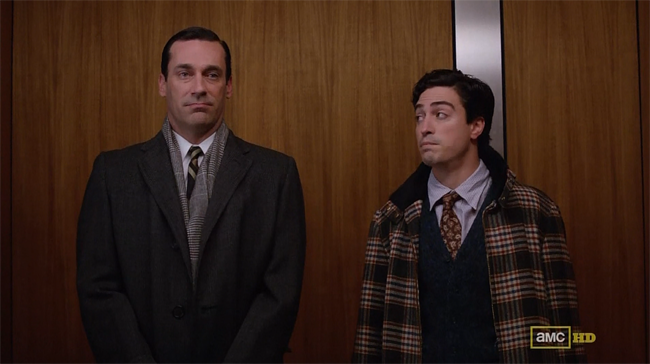
I’m not a jerk (I hope) so I made the required gestures and responses, but inside I was dying. It seemed to me accepted behavior to just nod at everyone in an elevator as you get on, unless you were already talking with someone you knew as you were both waiting. And if this isn’t accepted behavior, then dammit, it should be.

In a larger sense, why would you even want to conduct a conversation when you are literally trapped with the person? You have to know they are only conversing with you out of a lack of other options, not out of any sort of enthusiasm or interest. That’s just no way to treat someone.