
Thank Goodness We Don’t Have To Do That Anymore: The Trousseau

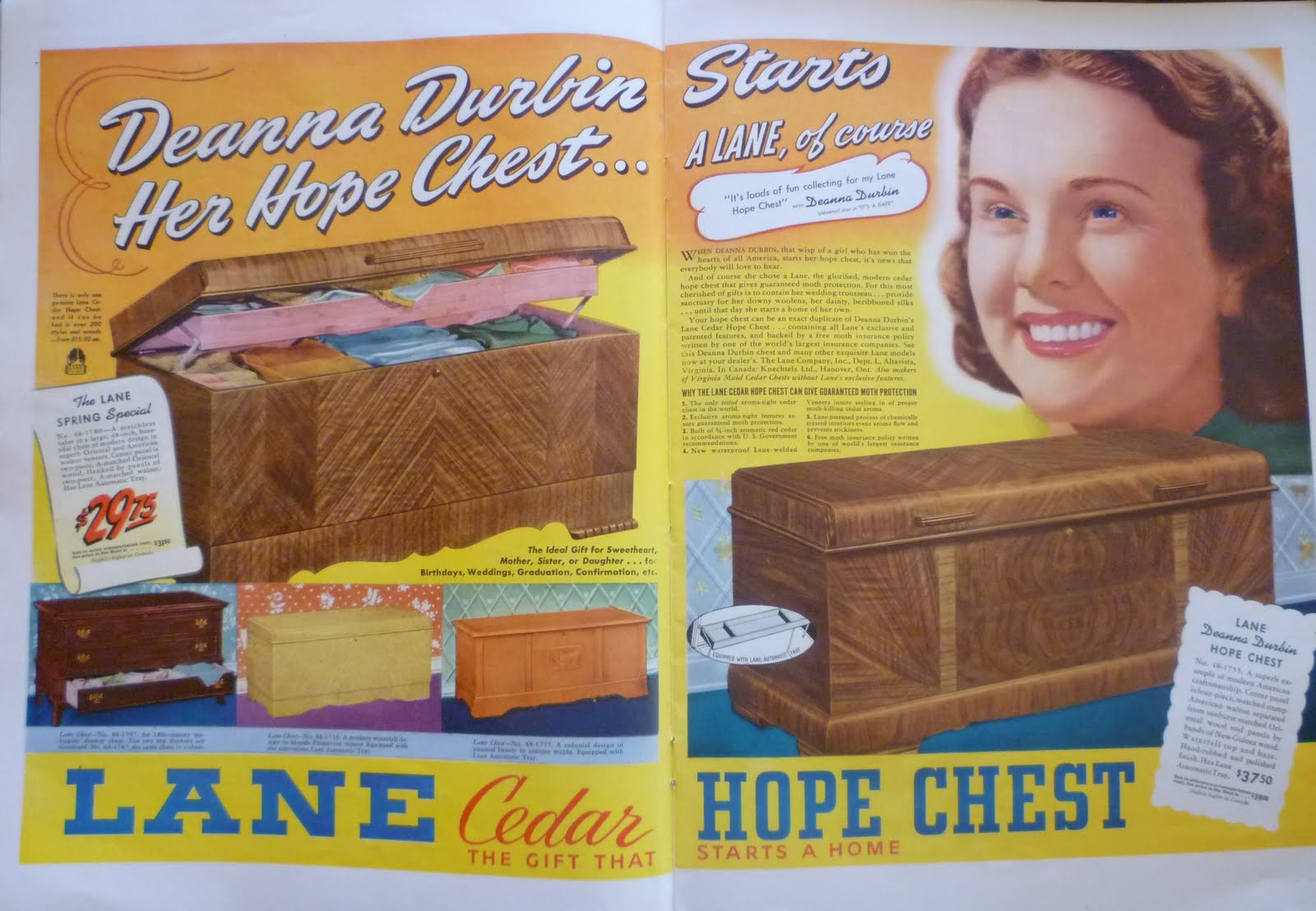
"provide sanctuary for her downy woolens, her dainty, beribboned silks...until that day she starts a home of her own."

“provide sanctuary for her downy woolens, her dainty, beribboned silks…until that day she starts a home of her own.” [Via]

Ladies! You know how when you were a kid you went to school and stuff, and it sort of sucked, and you spent all day wishing you could maybe not do that? Well, what if instead you spent your youth sewing tablecloths and blankets and clothing for your future husband? Childhood solved!

The Trousseau goes by many names–glory box, hope chest, bottom drawer, dowry–but essentially it was a collection of linens ‘n’ things for the bride and groom’s new home and/or clothing to last the bride the first few years of marriage. And for a long time, the bride was expected to make it all herself, and stow it all away until a groom finally appeared. According to Lillian Eichler’s 1921 Book of Etiquette, “The development is most marked in Roumania. Here we find the tiniest girls, some of them as young as five years, working on bridal finery each one striving to outdo the other in beauty and elaboration of work.” In many cultures female relatives pitched in too, and wealthier families simply had the maids do it.  However, once a suitor did arrive, he “had the privilege of examining the trousseau and deciding whether or not it was complete.” So tough luck if you sucked at sewing. Maybe you could find a job as a chaperone?

The whole reason you needed to do this is because your husband just wanted to come home to some comforts, ok?! Part of any western marriage, especially before the 20th century, was the agreement that the woman was the head of the household, and responsible for all the comforts found there. Lots of men looked forward to marriage as a way to finally have some nice things around the house. The irony was that often men were older and more established, so they could buy things like linens and blankets their damned selves.

Here’s an idea of how elaborate these things got. From “Lights and Shadows of New York” by James McCabe, 1872:

The society woman must have one or two velvet dresses which cannot cost less than $500 each. She must possess thousands of dollars worth of laces, in the shape of flounces, to loop up over the skirts of dresses… Walking dresses cost from $50 to $300; ball dresses are frequently imported from Paris at a cost of from $500 to $1,000… There must be traveling dresses in black silk, in pongee, in pique, that range in price from $75 to $175… Evening robes in Swiss muslin, robes in linen for the garden and croquet, dresses for horse races and yacht races, dresses for breakfast and for dinner, dresses for receptions and parties…

Ok, this was Vanderbilt Level Trousseauing, but that shit trickles down.

Thankfully, as time went on, the idea that a girl needed to spend all of her pre-engagement time sewing and collecting things for her household got a little ridiculous. Eichler argues “It seems rather a foolish waste of time for the girl of means to sit for endless hours sewing on rows rows of lace when machine made garments may be at reasonable figures. If she chooses her things carefully they will bear the stamp of her personality almost as as if she had fashioned them herself.” The 1920s were also the dawn of the Department Store in America, and buying pre-made items was a way to show off your middle-class status. So it was out with the homemade trousseau and in with buying one at Lord & Taylor’s…a modest improvement.

Traditional trousseaus fell out of fashion around the 1950s, replaced with the modern idea of the wedding present and registry. Until then, wedding presents were expected to be small, decorative items. It wasn’t until relatively recently that the idea became for all the guests to provide the gifts that would set up the new couple in their home. However, with many more couples living together before marriage, or choosing not to marry at all, the idea of setting up a new home is becoming a little dated, isn’t it? Does this mean there is an opening for the trousseau to make a comeback?!


Is It Rude To Un-Invite Someone To My Wedding?

The-Uninvited-movie-posterDear Uncommon Courtesy,

I am getting married soon, and included among the guests is a woman who  was a friend until recently.

When we compiled the guest list and sent out the Save the Dates, she and I were on great terms and, in fact, she was one of the first people I told about the engagement. Subsequent to that, she has gone through some personal turmoil that I was tangentially involved in, collateral damage-wise. As a result, she is no longer speaking to me though the turmoil really had only the smallest amount to do with me and I’ve indicated to her in about a hundred ways that I’m not upset with her over it.

What’s an exasperated bride-to-be to do?

Sincerely,

Invitation to Danger

OFFICIAL ETIQUETTE:

The official etiquette is that if you have sent someone a Save the Date, you must send them an invitation. However…

OUR TAKE:

Jaya: So do you send an invite?

Victoria: Hmmmm. Yeah, technically if you sent an STD you have to send an invite. But in a case like this, I guess it depends on if you want to reconcile.

Jaya: Yeah. Here it sounds like she does, so sending an invitation is a great way to show that. And if the other person doesn’t come, it’s not any shock.

Victoria: But if you don’t want to reconcile, I would actually not send her an invitation. I mean, it’s not news to her you’ve had a falling out. But that only works when, like in this situation, both parties know they’re fighting.

Jaya: Right.

Victoria: If you just randomly decided you hate them in between the STDs and the invitations, it’s a bit harder. In that case I’d invite them anyway!

Jaya: It’s easy enough to ignore someone at your wedding, I think. There are lots of people, no one will begrudge the couple for saying “Hi” and “Bye” and that’s it.

Victoria: I think this is a good lesson in being very judicious in who you send STDs to. It should be mostly people you REALLY REALLY must have there, or people who have to travel very far.

Jaya: Yeah, but it’s hard. If it’s a small wedding, everyone really is a necessary guest. And no one anticipates falling outs like this.

Victoria: True. In this case, they were really close before, but maybe for people who you aren’t super close to, just hold off sending anything until a little closer to the wedding, just in case (like coworkers and such!)

Jaya: This question is hard!

Victoria: It’s so eloquently written though!

Jaya: Save the Dates are strange. It’s such a recent invention, and now can be so easily accomplished by calling or emailing people.

Victoria: But then if you had specifically told someone to start making arrangements to come, you’d still be in the same boat. Because a verbal Save the Date still requires an invitation, I think.

Jaya: Yeah, I think you have to gauge where this anger is coming from. Here, it’s highly unlikely she’ll come, whether she receives an invite or not. So send the invitation if you honestly want to make amends. But you don’t want it to look like you’re trying to bury the hatchet when actually you’re just following the std=invite rule and you don’t really want her there anymore.

New Etiquette Rules We Learned From This Insane Email Exchange

IMG_2284We at Uncommon Courtesy are always on the lookout for the latest in modern etiquette: what’s become acceptable, what’s falling out of practice, etc. Which is why we were overjoyed to discover this illuminating email exchange between one bride and groom and a guest at their wedding. Here are some wedding rules we’ve apparently missed our whole lives!

  • Gifts are no longer de rigueur! As the bride points out, “People give envelopes.” In fact, “People haven’t gave gifts since like 50 years ago!” Oh, and those envelopes should be filled with money.
  • “Covering your plate” is back. This bride bemoans that she “lost out on $200 covering you and your dates plate… And got fluffy whip and sour patch kids in return.”
  • A wedding is an investment, so if you throw one, make sure it turns a profit. “Weddings are to make money for your future. Not to pay for peoples meals.” Or, as some people would call it, making your guests feel welcome.
  • Twigs are rude.

To find out the ACTUAL etiquette rules for wedding gifts, check out our post on how to buy a wedding present coming up in the next few weeks.

Wedding Invitations for the Guest

Make sure you know your stance on bells before RSVPing. (Via)

Make sure you know your stance on bells before RSVPing. (Via)

Welcome to our first how-to etiquette post! In this feature, we will be giving you a guideline for a basic etiquette situation. As these are guidelines, always take into account your situation and circumstances when applying them. If you have a tricky situation, write us and we will answer!

Wedding invitations have their own crazy etiquette (which we will definitely be talking about later on) that can be intimidating and confusing for the first time guest. There’s really formal language and it looks so fancy! And there are so many inserts and what’s this little stamped envelope? Should you be judging people based on their fonts? Let’s break it down:

Save The Dates

Save the Dates are sometimes sent out WAY in advance to let important people know the wedding date. They might be a cute card or a little magnet to stick on your fridge, or it might just be an email. They do not require a response, they are simply a notification of the wedding date and that you can expect an invitation. However, they are an opportunity for you to start planning. If the wedding is far away, you will want to start making travel arrangements. And if you know for a 100% fact that you won’t be able to make it on that date, let the couple know.

RSVP

RSVP stands for respondez-sil-vous-plait, which is French for “please, please tell me if you are coming by the deadline posted here so I can give the caterer a headcount in time.”

There may be a little card included in the invitation with its own stamped envelope (though sometimes you will have to stamp it yourself!). On this card there might be a M___________. You are suppose to write Mr./Mrs./Miss/Ms. YourFirstName YourLastName on this line. Sometimes I forget the title in my excitement and just write my name. Or there might be a box for you to write the number of people. Just make sure your name is on there somewhere so they know exactly who it is that is coming. Send it back ASAP and definitely before the deadline if given.

If there is no response card, either call or email as directed- the important thing is to make sure they know you are or are not coming. You MUST still RSVP even if you are not coming.

If you want to be really fancy, you can write your response on your own stationery as follows (try to mirror the formatting and language from the invitation):

Ms. Honoria Snodgrass

accepts with pleasure

Mr. and Mrs. Doodly’s

kind invitation for

Saturday, May 31

Plus-Ones

Generally, the only people invited to the wedding are those listed on the invitation. If Mr. and Mrs. Chatterton are the only names on the invitation, they are not welcome to bring their 5 charming children. “Mr. and Mrs. Chatterton and Family” is sometimes used to invite the whole family, though it is nicer to write out the names of all the kids. Sometimes though, single people will be invited with an “and guest” or “plus one”. In these circumstances you are welcome to bring a date. DO NOT BRING A DATE IF YOU ARE NOT INVITED TO BRING ONE. Whew! Also, you can’t just write plus one or Ms. Tiddlywinks and Mr. Fancypants (Mr. Fancypants being your uninvited date) on your RSVP if you haven’t been given a plus one in the first place. You also cannot substitute an uninvited guest for an invited one who can’t make it- wedding invitations are not write-in ballots.

Inserts and the Wedding Website

Often an invitation will come with a bunch of inserts of information. There might be directions and hotel info or registry info. There might even be a little card with the groom’s parent’s names (this is very old fashioned and unlikely- it is used when his parent’s names aren’t on the invitation so that their side of friends and family will be reminded of who the groom is).

Nowadays, more people are putting this information on their wedding website and they will either send the address along with the invitation or will announce it or email it to you some other way.

Do I have to keep the invitation?

No! Keep it handy until the wedding so you will have the information about the time and location, but after that feel free to discard or keep as you please.