Thank Goodness We Don’t Have to Do That Anymore: Know How to Treat Servants

By the way, it is unlikely that your servants will become your BFFs.

Back in the day, having servants, even in a modest household, was very common as labor was very affordable and the day to day work of running a household was very, very difficult. Today, if you are in the position of having live in help, most of this is still likely to apply. I’ve sourced this information from Emily Post in 1920 and Amy Vanderbilt in the 1960s and the basics are very similar, so they are likely to hold up today as well.

Hiring Servants:

  • Interview candidates in your own home, making sure to state all the bad parts of the job as well as the good parts. Be upfront and clear about the wages.
  • Be sure to have your children present when interviewing nannies and nursemaids, as you shouldn’t hire someone who your child instantly dislikes.
  • Always be in charge during the interview- if a servant starts bossing you around from the beginning, they will always be in charge in the relationship
  • When introducing a new servant to the household, make sure to introduce them to everyone, even the men! (ed: yay, sexism!)
  • References are the standard currency of servants and withholding one is a very serious matter indeed. Always make sure you check references when hiring and offer them to departing servants.

Servants in the Home:

  • Children are called by their first names by servants. In very formal household, teens are called Master John and Miss Jane. Adults, of course, are called Mr. Smith or Mrs. Smith.
  • If you can, call servants Mrs. Jones instead of Lucy, unless she prefers to be just Lucy. This is especially important for more senior servants like a housekeeper.
  • Introduce servants to guests, but don’t introduce the guest to the servant.
  • Always be polite to servants, say please and thank you.
  • For adequate service you need at least three servants: a cook, a butler (or waitress), and a housemaid. But if you can only afford one, both Post and Vanderbilt helpfully provide menus for entertaining that can be handled by one servant. (ed: no servants is unimaginable!)
  • Live in servants must be given as much independence as possible and their room should be comfortable and be a place where they can visit with a friend. The furniture should be comfortable- spend a night in your servant’s quarters to test it out!
  • In the US it is customary that the servants eat the same food as the family, except for perhaps, special delicacies. If the special foods do disappear, you can buy a locked food safe!
  • In households with minimum servants, the employers have to be more aware of fitting into the cleaning schedule and making sure they are out of the way so things can get done.

Post stresses that if you have “servant trouble” the cause is probably your poor management and poor treatment of your servants.

Examples of poor servant management are:

  • Allowing poor work to slip by, too much leniency is just as bad as too much strictness.
  • Reprimanding a servant in front of another person.
  • Reprimands for work left undone when there are more tasks than time.
  • Being distrustful: locking up all valuables, watching the servants at all times.
  • Not allowing them to have some space for themselves in the house where they can entertain friends.
  • You should know how to do all of a servant’s tasks so you can teach and direct instead of complain.
  • Be careful when servants do the household ordering- some merchants give kickbacks to servants for bringing in business and pad their bills, or they charge for things they don’t send. Always ask to see receipts!

Etiquette for Servants:

  • Always be neat and speak in a low voice.
  • Always say “Yes, ma’am/madame” or “No, sir”
  • Everything is always presented to employers on a tray.

Nancy Mitford and U vs Non-U Speech

Nancy Mitford calling to say you sound like a pleb. [Via]

Obviously, I think that etiquette and manners today has nothing to do with wealth or social class- manners are for everyone! Historically, however, the rise of etiquette books in the Victorian period had a lot to do with the growing middle class and their desire to act like the upper classes. So someone had to teach them how to act. But then the rich caught onto this and constantly changed the rules to throw the middle classes off. Nice, huh? The moral of the story, is that there was (is?) a way to tell social class, regardless of money or education.

In the 1950s, Nancy Mitford (of the endlessly fascinating Mitford sisters), borrowed an idea from British linguist Alan S. C. Ross about U vs non-U vocabulary and wrote a very popular essay about it, “The English Aristocracy,” in which she gave a list of words that were Upper Class (U) and their non-U (not Upper Class) counterparts. She argues that with the Upper Classes in Britain no longer being necessarily richer or better educated than anyone else, their language was the only thing left to distinguish them as Upper Class/aristocratic.

A selection:

U
Bike
Vegetables
A Nice House
Graveyard
Die
Jam
Napkin
Sofa
Rich
Lunch then Dinner
Non-U
Cycle
Greens
A Lovely Home
Cemetery
Pass on
Preserve
Serviette
Settee or Couch
Wealthy
Dinner then Supper (except U-children and U-dogs also have these meals!) [ed. this is my fave]


Interestingly, Emily Post had her own list of “U vs Non-U” vocabulary in 1920 (30 years before Nancy Mitford’s famous essay). Some of Emily’s choices:

U
At our house we go to bed early (or get up)
Beautiful house—or place
Went to
Gave him a dinner
Had something to drink
Wash
Non-U
In our residence we retire early (or arise)
Elegant home
Attended
Tendered him a banquet
Partook of liquid refreshment
Perform ablutions


Perhaps you will notice a pattern in both the Mitford and Post lists- a large portion of the “non-U” word choices are pretentious and overly wordy. Mitford actually says that the “non-U” speakers are mostly among the middle class- the lower classes tend to use the same words as the U speakers. The reason for this is that the lower and upper classes were pretty comfortable with their station and it was only the middle classes that were striving to “better themselves” by using fancy words that they thought sounded upper class.

Now, Mitford’s essay wasn’t completely accepted as truth, even at the time. Evelyn Waugh wrote a rebuttal essay that was published in Noblesse Oblige: a book containing Mitford’s essay, the original article by Ross, Waugh’s rebuttal, and other related essays. Waugh argues that these “U” and “Non-U” differences don’t actually exist as language is constantly in a state of flux and is also regional and family specific.

Today, especially in America, I don’t think you can pick out any words as being specifically upper vs middle class (unless you are the type of person to see entire regions as more lower class than the region you live in!), our culture is too homogenized for that, and it seems that differences are more regional and generational.  Though in 1983, Paul Fussell argued that America does have a class system in Class: A Guide Through the American Status System. His benchmarks for upper, middle, and lower class were: the upper class says “Grandpa died,” the middle class says “Grandpa passed away,” and the lower class says “Grandpa went to Jesus.”

However, I think the point about pretension vs being comfortable with yourself absolutely does exist, and for that reason, Emily Post’s list seems to hold up pretty well. Pretension is sort of rude because it is extreeeemely annoying- we all know someone who uses “myself” instead of “me” (incorrectly) and other big words that they don’t seem to know the meaning of, or they just talk in a roundabout manner of “needing to equip themselves with the necessary instruments of learning” instead of “buying school supplies.” This kind of thing makes everyone uncomfortable, and as we all know, causing discomfort in others is one of the hallmarks of rudeness.

What say you? Is pretension rude? Are there any words or phrases that you would argue are definitively class-based? Are middle class people in Britain really trying to act working class? Tell me in the comments!!

Things In The Emily Post Wedding Etiquette Book We’ve Never Heard Of

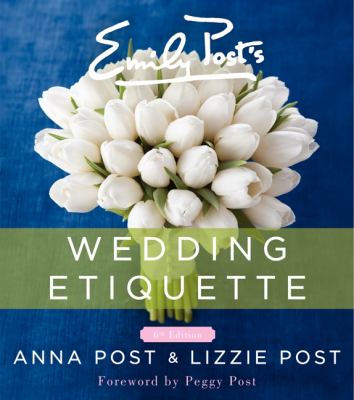
9780062326102The thing about etiquette is that there are now thousands upon thousands of “rules,” and all of them have precedent. With many ceremonies we rely on “tradition,” and though that’s a fleeting and ever-changing thing, you can always reach back to something a specific group of people did a few times 200 years ago and say “well, it’s tradition!” and everyone will take you at your word. The flip side of this is that, during the ongoing pressure of planning a wedding, people will insist on traditions you have never heard of, and you may feel forced to comply just because you’ve been convinced said-custom is indeed a tradition.

Recently, I received a copy of the 6th edition of Emily Post’s Wedding Etiquette, a lovely hardcover filled with tips on seasonal flowers, invitation wording, and updated text about same-sex marriage and having a “man of honor.” (It does still say that “men may choose not to wear a ring” but makes no mention that women don’t have to wear rings either. Ugh.) But looking through, there were a number of things that I realized I have never seen in person. I have been to 15 weddings in my lifetime (18 by the end of the year, including my own), from Catholic to Polish Orthodox to secular, Indian to Jewish, formal to garden party, and none of these things has ever happened. That doesn’t mean they never happened, or don’t still happen, or that you shouldn’t do them; this is just a reminder that you do not have to take every bit of advice given to you.

  • Having a separate “bridal bouquet” and “tossing bouquet.”
  • During the Best Man’s toast, it used to be customary for him to read any congratulatory telegrams. I’d actually be cool with bringing this back, so someone send me a wedding telegram.
  • Seeing the bride and groom serve cake to their parents. “Tradition has it that the bride serve the groom’s parents, and he serves hers.”
  • We knew it was tradition for the bride’s family to pay for the ceremony and reception, and the groom’s family to pay for the rehearsal dinner. However, the groom’s family is also apparently supposed to pay for the engagement and wedding rings, the officiant’s fee and transportation, and all the corsages. This seems complicated.
  • “Always address wedding invitation envelopes by hand, even when inviting hundreds of guests.” I have received plenty of wedding invitations with our names printed on the envelopes, and the world kept spinning.
  • Checking whether throwing rice/confetti/etc is allowed with your venue. Does anyone actually throw rice anymore???
  • The groomsmen also serve as ushers and show the guests to their seats.
  • Technically, this is from the 5th edition of this book, but traditionally, the couple was supposed to pay for the accommodations of their bridal party.
  • One of the groom’s traditional duties was to plan the whole honeymoon, often not telling the bride where they were going until they got there.

I Read a 500 Page Emily Post Biography So You Don’t Have To

Emily Post: Daughter of the Gilded Age, Mistress of American Manners by Laura Claridge is a fascinating in-depth biography of our favorite etiquette expert, Emily Post. Very in-depth and looong. So I have compiled twenty of the most interesting facts about this woman who was so much more than just an etiquette expert.

1. Her father participated in the building of the Statue of Liberty base and she played inside as a girl. She also attended the opening of the Statue.

2. Her father was a famous architect who basically built Tuxedo Park, NY.

3. Was called the best banjoist in fashionable society when she was young. Banjos were trendy in the 1890s.

4. Motto was “toujours la politesse, jamais la verite” meaning “always courtesy, never the bare truth.”

5. She had a terrible loveless marriage and was divorced. As a dissatisfied wife, she took up writing and was a successful novelist.

6. She was a guest at Mark Twain’s 70th bday party.

7. After her divorce, she helped with interior design for her father’s architect friends and was somewhat of an amateur architect herself. She even wrote a famous book on architecture.

8. She started writing non fiction as an advice columnist but she was originally discouraged from writing about etiquette publishers thought it would be tedious for her.

9. She took a road trip across the US in 1915 with her sons and wrote about it. This was before there were good roads and they were constantly getting stuck in the mud.

10. Her son received the first award conferred on an American pilot during WWI.

11. Emily liked to claim that everyone had begged her to write etiquette, it was more something that was offered to her and she took on bc she found the existing books so bad.

12. She wrote the first edition Etiquette longhand in a year and a half. Published in July 1922, Etiquette originally cost $4 (abt $45 today).

13. Emily was listed as one of Life magazine’s 100 most influential people of the 20th century.

14. Statistics say that Etiquette was the second most stolen book from public libraries, after the bible through the end of the 20th century.

15. She was an activist against prohibition.

16. She hosted an etiquette radio show during the 1930s and loved being on the radio.

17. Was not above some snobbishness: when the Duke and Duchess of Windsor were touring the US, she said he should be addressed as royal highness and she should be addressed as “you.”

18. As an older woman, she had a closet full of red shoes.

19. After WWII she worked to bring Jewish orphans to the United States.

20. Didn’t care about elbows on the table and would regularly put hers on the table at fancy parties.

Thank Goodness We Don’t Have To Do That Anymore: Turning Of The Tables

You will never be this fancy. (Via)

You will never be this fancy. (Via)

I think we can all agree that being that one person left out of a conversation at the dinner table is really uncomfortable. It’s happened to me plenty of times when I’ve tried to jump into conversations happening to my right or my left, and, after a few unsuccessful attempts, retreated back to my wine. This is nothing I get too frustrated at, but it can be stressful.

You know what’s more stressful, though? Appointed conversational start and end times with assigned partners. Which is what we had to apparently do at formal dinners in the 1920s. It was called the “turning of the table” and it sounds awful. Emily Post writes:

“The turning of the table is accomplished by the hostess, who merely turns from the gentleman (on her left probably) with whom she has been talking through the soup and the fish course, to the one on her right. As she turns, the lady to whom the ‘right’ gentleman has been talking, turns to the gentleman further on, and in a moment everyone at table is talking to a new neighbor.”

That’s right, some time before the fish you are required to stop talking to the person which whom you’d been talking, and start talking to someone else. God forbid you try to talk to someone across the table, or with more than one person, etc. A few people have made the argument that elaborate centerpieces at formal dinners 100 years ago often made speaking to the person across from you impossible. However, elaborate formal place settings would probably make the person next to you equally distant. I imagine people communicated solely by the tones you make when you rub the rim of your crystal water glass.

We’ve mentioned before that the point of etiquette is making people feel comfortable, which this definitely tries to accomplish. It’s a good idea to make sure everyone has someone to talk to! You don’t want your guests to feel lonely! But this is an example of when slavish devotion to a rule (Emily Post called this an “inexorable rule”) obstructs the actual idea behind it. For example, this is what is recommended if a guest is so engaged in conversation that they do not want to switch partners:

“At this point the hostess has to come to the rescue by attracting the blocking lady’s attention and saying, “Sally, you cannot talk to Professor Bugge any longer! Mr. Smith has been trying his best to attract your attention.” “Sally” being in this way brought awake, is obliged to pay attention to Mr. Smith, and Professor Bugge, little as he may feel inclined, must turn his attention to the other side. To persist in carrying on their own conversation at the expense of others, would be inexcusably rude, not only to their hostess but to every one present.”

Oh, and do you hate the person sitting next to you? Too bad. You’re encouraged to do something like recite the times tables to each other to make it look like you’re talking.

I hate rude people as much as the next person (maybe more, since I co-founded a website about etiquette), but publicly shaming your dinner guests seems a little extreme. Granted, we live in a time where it is highly unlikely that you’ll be dining this formally, and the prevalence of circular tables at fancy occasions makes various triangulations of conversation much easier. So let’s toast to the fact that, no matter where we eat, we can generally converse with whom we want, and about more interesting topics than the times tables.

Come see Jaya speak more on this topic at TED-y Talks next Tuesday at the Branded Saloon in Brooklyn. Facebook event with time and address here!

Thanks for joining us for our first week! Stay up to date by following us on Twitter and on Facebook.