
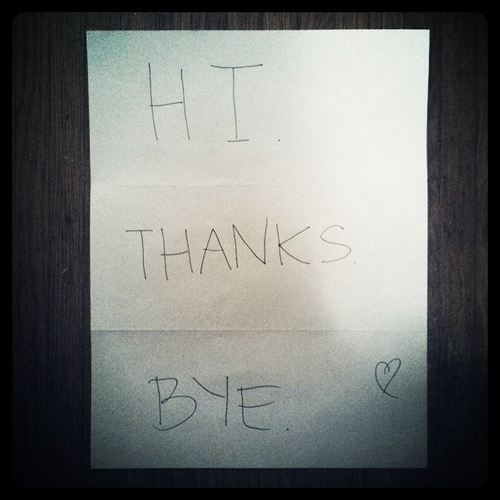
How To Write A Thank You Note

No matter how old I get, my mom (hi, Mom!) still asks if I’ve written a thank you note for every single present she knows I’ve received.  Well, every present I’ve received from someone older than 40. Perhaps my 20-something friends don’t deserve the stationery, or perhaps they just don’t care. I think it’s the latter. But whatever your personal views on thank you notes are, the fact is that lots of people enjoy getting them. I enjoy getting them! I don’t expect them, but it’s always a treat getting some  mail.

Ultimately the goal of this is pretty obvious: you want to make the person feel appreciated. There are many times when this can be accomplished with a phone call or an email. Seriously. I give you full permission to just call your cousin and tell her what a nice time you had at dinner. But sometimes a handwritten note is really what’s needed.

That’s the first key to this: handwritten. With everyone typing nonstop to each other, there really is something nice about receiving something no one had to stare at a screen to do. Well, except you, staring at this screen, learning how to write a thank you note. Get a nice, blank card (signing your name at the bottom of a pre-written card is cheating) or stationery, and get at it.

Step 1: Who do you send thank you notes to?

If you sent a note to everyone who ever did anything nice for you, you’d probably be responsible for the genocide of the whole Amazon. I don’t write thank you notes for birthday gifts, or for holiday gifts I receive in person. For instance, I’m not gonna write to my mom about the sweater she gives me in person on Christmas morning, but I will write to my aunt in Minnesota to thank her for sending me new pajamas as a gift. I do write thank you notes for engagement/wedding gifts, gifts sent a long distance, and other instances where someone has really gone out of their way for me. (P.S. There are instances where you write thank you notes for job interviews and other business interactions, but that’s a whole other conversation). It is also generally recommended that you send one to your grandmother, even if you thanked her when you opened it. She will appreciate hearing from you.

You do not need to send a note for a thank you gift. So if you are a bridesmaid and the bride gives you a little gift to thank you for your help and participation, leave it at that,  lest you end up in a never ending circle of thanking.

Step 2: How does this person want to be addressed?

When in doubt, use Mr./Ms. Firstnames Lastnames on both the envelope and salutation. I generally like doing something like Mr. Obediah Pennywitt and Mrs. Lucreca Pennywitt, instead of Mr. and Mrs. Obediah Pennywitt, because we’re all modern people who understand women have their own first names. But if you know how said person wants to be addressed, use that. If you’re a bit closer to the person in question, you can just use their first names in the salutation. For example, address Ms. Muffy MacSween on the envelope, and say “Dear Muffy” on the inside. For your signature, the rule is to go as formal as you’ve addressed them. If you said “Dear Ms. Muffy MacSween,” sign your full first and last name. If you said “Dear Muffy,” your first name will suffice.

Step 3: What do you actually write?

As usual, this depends on the situation, and on your relationship with the recipient. But whatever you do, make it personal. Saying “Thank you very much for the gift/meeting/reference, it was very nice” makes it sound like you’re 11-years-old and your mother is hovering over you and forcing you to write. Once, a friend’s mom got a note for a Bat Mitzvah present that said just “Thank you for the $50.” Don’t be that girl/boy/cat.

Did someone get you a nice gift? Tell them how you plan to use it. Cash? Say how generous it is and what you may be saving up for, but don’t mention the exact dollar amount. Did you meet with someone in your field who gave you some good advice? Tell them how it’s helped you, or a specific situation in which you’ve used it. It doesn’t have to be any longer than 3-4 lines.

Step 4: The tricky stuff.

There are times where you will have to write a thank you note for something you can’t be specific about. It may be a gift that you think is hideous and plan on returning, or something you already have, or to someone you just don’t know all that well and can’t get specific with. One way to solve this is to lie, which obviously you shouldn’t do because it can totally backfire. You don’t want to be writing “We loved the crystal bowl and will be so proud to display it in our foyer” only to return it and then someday have them come over and see that your foyer is decorated with some other bowl and feel hurt.

The better option is to be specific about the thought.  Say how much it means to you that they thought to get you a gift, instead of the gift itself. Mention something about the last time you saw them, or the next time you’re getting together. If you take the focus off the physical thing they got you, they’ll rarely think to ask about it.

Sample thank you notes:

Thank you for a gift from a friend or relative:

Dear Grandma,

Thank you so much for the lovely scarf. I can tell you put a lot of effort into making it for me and I can’t wait to wear it all winter. Purple is my favorite color! It was great seeing you at my birthday dinner the other night, isn’t Chez Fancypants a great restaurant?

Love,

Matilda

Thank you note for a monetary gift:

Dear Aunt Trudy,

Thank you for the kind graduation gift. I’m sure it will come in great help when I am setting up my new apartment in New York City! It was so kind of you to come to the ceremony, I could hear you all yelling when they called my name!

Love,

Tammy

Thank you note for a gift from a stranger (weddings/engagements)

Dear Mrs. Doolittle,

Thank you so much for the beautiful bowl! It is so kind of you to think of us at this exciting and happy time. Craig has such happy memories of playing with Tommy back in pre-school!

Warmly,

Susie and Craig

Thank you note for a favor:

John-

Thank you so much for hosting me when I was in New York! It was so great to get the chance to catch up after my interview. What a great bar that was- I hope we will get to hang out there a lot if I get this job.

-Joe

We are having a little launch party get-together thing on Friday at Otto’s Shrunken Head in the East Village, please join us! See the Facebook event here.
Am I Rude For Not Doing All The Dishes?

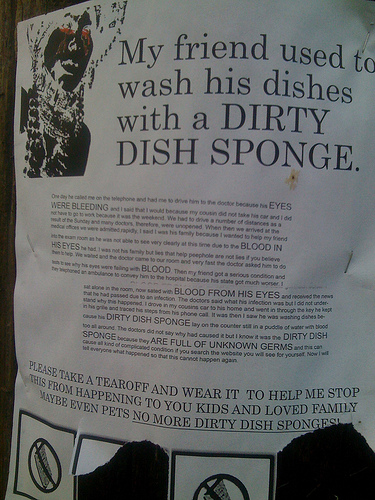
Just don't use a dirty sponge or your will BLEED FROM YOUR EYES. (Via MrGluSniffer)

Just don’t use a dirty sponge or your will BLEED FROM YOUR EYES. (Via MrGluSniffer)

Dear Uncommon Courtesy,

So, my question involves good guest etiquette. I stayed with friends recently and they cooked me a meal when I arrived. Afterwards, I offered to do the dishes. There were already dishes from earlier in the day stacked near the sink, but I decided to leave those and just washed ours from the dinner.

Then, last week my boyfriend and I stayed with a friend and again, a dinner was cooked for us. My boyfriend however, did ALL the dishes around, including some dirty pots from way before our arrival. Now I feel guilty, should I have washed all the dishes at my friend’s place before? Is that good guest behaviour? My boyfriend says he did it to be nice and he doesn’t think anyone should have to do extra dishes, but am totally paranoid now.

Help!

Sincerely,

Dishwashing Dilemma

OFFICIAL ETIQUETTE

The original Emily Post book and other similar books assume all houses have servants, so would never even think to cover such an issue (though, if there are servants, definitely don’t volunteer to do dishes!). The current Emily Post Institute doesn’t go into such detail, but they suggest volunteering for very specific tasks in the kitchen and not hanging around trying to pounce on chores.

OUR TAKE

Victoria: Okay, so at first I thought that this was a one-off dinner, in which case I would say it’s kind of weird to offer to do the dishes instead of bringing a bottle of wine or other hostess gift. But, she seems to have been staying with these friends.

Jaya: Right. So I get the “If you let me sleep on your couch, I’ll do chores” thing. Which is a great thing to do if you’re staying with someone.

Victoria: Totally! And I think it was okay and understandable to just do the dishes from that meal.

Jaya: Especially since the dishes were stacked “near” the sink. If you removed dishes from the sink, didn’t do them, and put them back later, that is weird. But this seems fine.

Victoria: However, personally, I think if you are going to do something, you might as well complete the task. And that means doing all the dishes that are around, wiping down the counters, etc.

Jaya:  Yeah! So based on that, I don’t think this is that strange. She shouldn’t feel guilty. But yeah, I would probably have just done all of them.

Victoria: And you could always ask—especially if they are pots or pans that might need special care, you know?

Jaya: Oh yeah. Perhaps they were on the side for a reason. But I don’t think this is necessarily good guest behavior v. bad guest behavior. She still sounds like a good guest. She did dishes!

Victoria:  Yes!

Jaya:  So she shouldn’t feel guilty. No one would fault her on this. But maybe in the future, just do all the dishes. It’s just easier and more considerate to get it done in one swoop.

Thank Goodness We Don’t Have To Do That Anymore: Turning Of The Tables

You will never be this fancy. (Via)

You will never be this fancy. (Via)

I think we can all agree that being that one person left out of a conversation at the dinner table is really uncomfortable. It’s happened to me plenty of times when I’ve tried to jump into conversations happening to my right or my left, and, after a few unsuccessful attempts, retreated back to my wine. This is nothing I get too frustrated at, but it can be stressful.

You know what’s more stressful, though? Appointed conversational start and end times with assigned partners. Which is what we had to apparently do at formal dinners in the 1920s. It was called the “turning of the table” and it sounds awful. Emily Post writes:

“The turning of the table is accomplished by the hostess, who merely turns from the gentleman (on her left probably) with whom she has been talking through the soup and the fish course, to the one on her right. As she turns, the lady to whom the ‘right’ gentleman has been talking, turns to the gentleman further on, and in a moment everyone at table is talking to a new neighbor.”

That’s right, some time before the fish you are required to stop talking to the person which whom you’d been talking, and start talking to someone else. God forbid you try to talk to someone across the table, or with more than one person, etc. A few people have made the argument that elaborate centerpieces at formal dinners 100 years ago often made speaking to the person across from you impossible. However, elaborate formal place settings would probably make the person next to you equally distant. I imagine people communicated solely by the tones you make when you rub the rim of your crystal water glass.

We’ve mentioned before that the point of etiquette is making people feel comfortable, which this definitely tries to accomplish. It’s a good idea to make sure everyone has someone to talk to! You don’t want your guests to feel lonely! But this is an example of when slavish devotion to a rule (Emily Post called this an “inexorable rule”) obstructs the actual idea behind it. For example, this is what is recommended if a guest is so engaged in conversation that they do not want to switch partners:

“At this point the hostess has to come to the rescue by attracting the blocking lady’s attention and saying, “Sally, you cannot talk to Professor Bugge any longer! Mr. Smith has been trying his best to attract your attention.” “Sally” being in this way brought awake, is obliged to pay attention to Mr. Smith, and Professor Bugge, little as he may feel inclined, must turn his attention to the other side. To persist in carrying on their own conversation at the expense of others, would be inexcusably rude, not only to their hostess but to every one present.”

Oh, and do you hate the person sitting next to you? Too bad. You’re encouraged to do something like recite the times tables to each other to make it look like you’re talking.

I hate rude people as much as the next person (maybe more, since I co-founded a website about etiquette), but publicly shaming your dinner guests seems a little extreme. Granted, we live in a time where it is highly unlikely that you’ll be dining this formally, and the prevalence of circular tables at fancy occasions makes various triangulations of conversation much easier. So let’s toast to the fact that, no matter where we eat, we can generally converse with whom we want, and about more interesting topics than the times tables.

Come see Jaya speak more on this topic at TED-y Talks next Tuesday at the Branded Saloon in Brooklyn. Facebook event with time and address here!

Thanks for joining us for our first week! Stay up to date by following us on Twitter and on Facebook.

New Etiquette Rules We Learned From This Insane Email Exchange

IMG_2284We at Uncommon Courtesy are always on the lookout for the latest in modern etiquette: what’s become acceptable, what’s falling out of practice, etc. Which is why we were overjoyed to discover this illuminating email exchange between one bride and groom and a guest at their wedding. Here are some wedding rules we’ve apparently missed our whole lives!

  • Gifts are no longer de rigueur! As the bride points out, “People give envelopes.” In fact, “People haven’t gave gifts since like 50 years ago!” Oh, and those envelopes should be filled with money.
  • “Covering your plate” is back. This bride bemoans that she “lost out on $200 covering you and your dates plate… And got fluffy whip and sour patch kids in return.”
  • A wedding is an investment, so if you throw one, make sure it turns a profit. “Weddings are to make money for your future. Not to pay for peoples meals.” Or, as some people would call it, making your guests feel welcome.
  • Twigs are rude.

To find out the ACTUAL etiquette rules for wedding gifts, check out our post on how to buy a wedding present coming up in the next few weeks.

Wedding Invitations for the Guest

Make sure you know your stance on bells before RSVPing. (Via)

Make sure you know your stance on bells before RSVPing. (Via)

Welcome to our first how-to etiquette post! In this feature, we will be giving you a guideline for a basic etiquette situation. As these are guidelines, always take into account your situation and circumstances when applying them. If you have a tricky situation, write us and we will answer!

Wedding invitations have their own crazy etiquette (which we will definitely be talking about later on) that can be intimidating and confusing for the first time guest. There’s really formal language and it looks so fancy! And there are so many inserts and what’s this little stamped envelope? Should you be judging people based on their fonts? Let’s break it down:

Save The Dates

Save the Dates are sometimes sent out WAY in advance to let important people know the wedding date. They might be a cute card or a little magnet to stick on your fridge, or it might just be an email. They do not require a response, they are simply a notification of the wedding date and that you can expect an invitation. However, they are an opportunity for you to start planning. If the wedding is far away, you will want to start making travel arrangements. And if you know for a 100% fact that you won’t be able to make it on that date, let the couple know.

RSVP

RSVP stands for respondez-sil-vous-plait, which is French for “please, please tell me if you are coming by the deadline posted here so I can give the caterer a headcount in time.”

There may be a little card included in the invitation with its own stamped envelope (though sometimes you will have to stamp it yourself!). On this card there might be a M___________. You are suppose to write Mr./Mrs./Miss/Ms. YourFirstName YourLastName on this line. Sometimes I forget the title in my excitement and just write my name. Or there might be a box for you to write the number of people. Just make sure your name is on there somewhere so they know exactly who it is that is coming. Send it back ASAP and definitely before the deadline if given.

If there is no response card, either call or email as directed- the important thing is to make sure they know you are or are not coming. You MUST still RSVP even if you are not coming.

If you want to be really fancy, you can write your response on your own stationery as follows (try to mirror the formatting and language from the invitation):

Ms. Honoria Snodgrass

accepts with pleasure

Mr. and Mrs. Doodly’s

kind invitation for

Saturday, May 31

Plus-Ones

Generally, the only people invited to the wedding are those listed on the invitation. If Mr. and Mrs. Chatterton are the only names on the invitation, they are not welcome to bring their 5 charming children. “Mr. and Mrs. Chatterton and Family” is sometimes used to invite the whole family, though it is nicer to write out the names of all the kids. Sometimes though, single people will be invited with an “and guest” or “plus one”. In these circumstances you are welcome to bring a date. DO NOT BRING A DATE IF YOU ARE NOT INVITED TO BRING ONE. Whew! Also, you can’t just write plus one or Ms. Tiddlywinks and Mr. Fancypants (Mr. Fancypants being your uninvited date) on your RSVP if you haven’t been given a plus one in the first place. You also cannot substitute an uninvited guest for an invited one who can’t make it- wedding invitations are not write-in ballots.

Inserts and the Wedding Website

Often an invitation will come with a bunch of inserts of information. There might be directions and hotel info or registry info. There might even be a little card with the groom’s parent’s names (this is very old fashioned and unlikely- it is used when his parent’s names aren’t on the invitation so that their side of friends and family will be reminded of who the groom is).

Nowadays, more people are putting this information on their wedding website and they will either send the address along with the invitation or will announce it or email it to you some other way.

Do I have to keep the invitation?

No! Keep it handy until the wedding so you will have the information about the time and location, but after that feel free to discard or keep as you please.