
Thank Goodness We Don’t Have To Do That Anymore: Bathing Machines

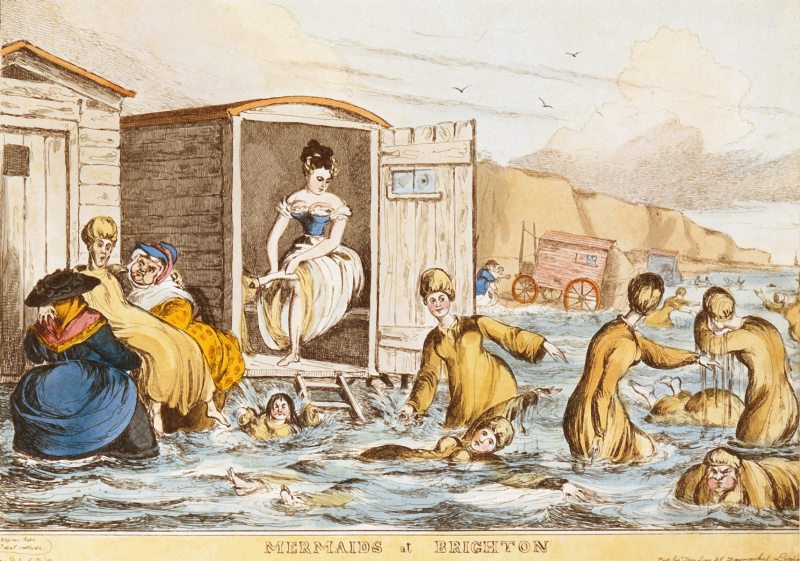
 "Mermaids at Brighton" by William Heath (1795 - 1840), c. 1829. Depicts women sea-bathing with bathing machines at Brighton.

“Mermaids at Brighton” by William Heath (1795 – 1840), c. 1829. Depicts women sea-bathing with bathing machines at Brighton.

I know it’s November, but I think now is the perfect time to talk about some of the eccentricities of beach etiquette in the Victorian era. Because you know that cozy outfit you’re wearing right now? Imagine wearing that on the beach. Summertime fun!

Bathing, whether by spa or by sea, began as a recreational activity in the mid-1800s. Prior to that, prolonged time in the water was assumed to cause instant death (something about water opening the pores so all the disease can get in). But by the mid 19th-century, many doctors began espousing the restorative and medicinal properties of a good soak or swim, and the middle-class began associating cleanliness with refinement, and dirtiness as a sign of disease and immorality. So all of a sudden, everyone wanted to go to the beach, and realized you couldn’t really do this in your everyday clothing.

Beaches have always been fun for men. They could bathe in their underwear, within full view of any delicate woman. But women had to hide their beach bodies and activities. According to Victoriana Magazine (why don’t I have a subscription to this), “Women typically dressed in black, knee-length, puffed-sleeve wool dresses, often featuring a sailor collar, and worn over bloomers trimmed with ribbons and bows. The bathing suit was typically accessorized with long black stockings, lace-up bathing slippers, and fancy caps.” This just goes to show you that even though we still argue about abortion and health care and intersectionality in feminism, things have changed. I am wearing a more revealing outfit right now, and I’m at work. Also I am a woman at work.

As you can imagine, these bathing outfits were not really easy to swim around in. In Extraordinary Origins of Everyday Things, Charles Panati mentions that there were a number of fatalities in Europe and America due to “waterlogged bathers caught in an undertow.” But, y’know, modesty.

Now, these outfits were only appropriate for the beach, so how did a woman get into them? Surely you couldn’t just hop in the car with a sarong around yourself. No, for this, we had bathing machines! These devices first showed up in England in the 1750s and lasted until the early 20th century. W.C. Oulton in The Traveller’s Guide; or, English Itinerary, Vol II describes them as “four-wheeled carriages, covered with canvas, and having at one end of them an umbrella of the same materials which is let down to the surface of the water, so that the bather descending from the machine by a few steps is concealed from the public view, whereby the most refined female is enabled to enjoy the advantages of the sea with the strictest delicacy.” Once in the water, a “modesty hood,” sort of like an awning,  hid her activities from male bathers.

As you may have expected, these were incredibly uncomfortable to use. Women would get in, change and store her street clothes in a little shelf up top so they wouldn’t get wet, and then get yanked into the water by horses. Sometimes other, stronger women would be hired to throw and retrieve the bathers to and from the sea, and if you couldn’t swim they’d tie a rope around your waist and let you bob there for a while, until a wave banged you around. (These “dippers” were also in charge of getting rid of male gawkers, and can we please get some erotic fiction going about them.) In The Hand-Book of Bathing, the author writes “if, therefore, the good effect of the bath is to be immediately counteracted by what must inevitably follow in a common bathing-machine, the patient had better totally refrain from sea-bathing.”

Like with most practices of modesty, we got over it, probably faster because of that whole drowning thing.

Etiquette for Witches

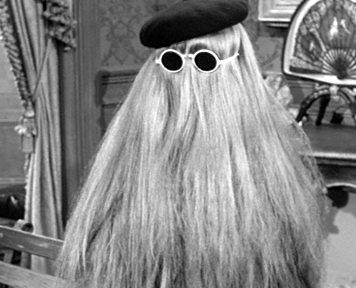
Photo courtesy of Ellen Pratt

Actual Wiccans have a great rule that “everything you put out into the world will come back to you threefold,” which is actually a really great lesson for etiquette. If you are polite, people will be polite to you. Probably.

However, today is the day before Halloween (and coincidentally, Victoria’s birthday. Jaya’s birthday was yesterday! Happy Birthday to us!) and it is the time for etiquette for Halloween-time witches:

  • Try to keep your black cat from crossing people’s paths.

  • Label your ingredients well so you don’t mix up your eye of newt and toe of frog.

  • Don’t mix your black clothes in with people’s white laundry, it will make the whites dingy.

  • Love spells are emotional manipulation and a big faux pas.

  • Wash your cauldron carefully or your roommate will be pissed when she ends up with batwings in her bouillabaisse.

  • If you keep your house on chicken feet, you will have to send out change of address notices every time you move. What a pain.

  • Take good care of your flying monkeys and they will take good care of you.

  • After riding your broom, why not give the kitchen floor a quick going over?

Etiquette for Dealing with Witches:

  • If you are a virgin, don’t ever light the black flame candle.

  • Always invite them to your wedding and baby’s baptism, it’s the only way to avoid a curse.

  • If you don’t want a witch to ride your horse, braid its mane with corn shucks.

  • Avoid touching a witch’s “Book of Shadows,” or handling their ceremonial dagger.

  • According to a guide book given to the Metropolitan Police, “do not jump to conclusions if you encounter a situation where a blindfolded, naked person is tied by their hands – you could merely have stumbled upon a pagan ritual, where such activities are normal practice.”

  • If you don’t want a witch to bother you, plant 10 pumpkin seeds in the shape of a cross outside her house.

  • If you drop a house on her sister, a witch is likely to get mad at you.

In the comments, please tell us your Halloween costume this year OR your greatest Halloween costume ever.

This year, I am dressing up as a….witch!

Help! Can I ask my hairdresser to fix my hair?

Dear Uncommon Courtesy,

I have a question about hairdresser etiquette!

You can’t be afraid of hairdressers or you will end up looking like this.

I recently switched hairdressers (silently, shamefully, and in fact that is probably its own etiquette question, but not what I’m curious about today). I went to a new hipster barbershop/salon in my neighbourhood. I brought a photo to the stylist, let her know about some of my hair’s particularities and issues I’ve had with cuts in the past, and made it clear that while I had a cut and style in mind, she should feel free to make it work the way she thought was best for my hair. It was a nice experience, but two weeks later I have a decided cowlick situation messing with the back of my severe side part, and my curls are not sitting as full as she promised. What are your thoughts on asking a hairdresser to fix a cut that’s off? I’ve done it once before and found it VERY awkward–my then stylist and her colleague were pleasant but definitely made me feel like I didn’t know what was right for my own hair. I don’t know how long to wait (more than a week seems too long, but a few days feels like not giving the cut enough chance). and asking a new hairdresser after a first visit seems like setting a bad tone for the “relationship.” Is asking for a hairdresser to fix a cut ever okay, and is there a way to do it without harming your relationship with them?

Sincerely,

Chopped?

OFFICIAL ETIQUETTE

Yes, of course you should ask your hairdresser to fix it. Politely.

OUR TAKE

Jaya: I do think that in our everlasting desire to get rid of all vestiges of servitude, sometimes we go too far and forget that when someone has a service job, their job is to do what you pay them for. And like, not in a mean way.

Victoria:  Hahah yeah! that’s a great way of putting it

Jaya:  But if it’s a haircut, you want a nice haircut!

Victoria:  Totally. And to be honest, haircuts are really expensive.

Jaya:  Especially for women. And you can be all like “well that’s your fault, go to a barber for $10” but c’mon, your hair is a huge part of how you look, and I don’t think there’s any shame in caring about that

Victoria: Nope! I really need to not be such a baby and ask about bang trims more often.

Jaya:  Haha yeah, it’s hard to do on your own. Also, I  do think most hairdressers offer this kind of week-later check up. even if they don’t flat out say it.

Victoria:  Yeah, i think hair stylists expect to have to fix things sometimes and honestly, lots of them get cried at and yelled at, so i’m sure they appreciate a polite “could you please fix this weird thing my hair is doing.”

Jaya:  Yeah! that’s so much nicer than just freaking out.

Victoria: Or not coming back.

Jaya:  Also, they’re professionals. They know what hair is like, and if it’s your first time, duh there are gonna be cowlicks and weird head shapes they’re not going to immediately know, so it helps both of you.

Victoria:  Yep, I think they’d rather fix it and get a loyal customer.Plus then you will have a person who knows about your hair.

Jaya:  Absolutely. I made the mistake for too long of not alerting hairdressers to the weird things my hair does and once I got over that I started getting much better haircuts.

Victoria:  Hahah yeah, it’s scary to try to speak up since they are supposed to know what they are doing.

Jaya:  I think that’s the thing though. They know what they’re doing, but they’re not psychics. They don’t know your head.

Victoria:  Haha yeah, what’s inside it or what’s on it.

Jaya:  If they’re not willing to have a conversation then ok, they’re assholes and find someone else.

Victoria:  Yep.

Jaya:  But there should be a back and forth. They trust you to speak up about anything weird, you trust them to know what looks good from there.

Victoria:  And I think dye jobs too, are especially something you should ask to have fixed if they don’t come out quite right because that’s really normal.

Jaya:  Oh yeah. I’ve never really done that, but that makes sense.

Victoria:  Yeah me either, but it crops up a lot in articles about hair dressers.

Jaya:  how many articles about hair dressers are you reading?

Victoria:  I meaaaaan…

Victoria: Some.

Jaya:  Hahahaha.

Victoria:  Anyway, in sum, hairdressers are professionals and if you aren’t happy with their service, tell them and try to work something out.

Or complain on the internet and tell us your worst hairdresser stories.

Thank Goodness We Don’t Have To Do That Anymore: Dance Cards

“‘Here comes Ned Moffat. What does he want?” said Laurie, knitting his black brows as if he did not regard his young host in the light of a pleasant addition to the party.

‘He put his name down for three dances, and I suppose he’s coming for them. What a bore!’ said Meg, assuming a languid air which amused Laurie immensely.”

-Little Women

Dance cards are one of those things people are always referencing in regards to how stuffy etiquette is. They are a common trope in literature and movies about the “olden days” but how common were they really? And how were they used?

Before we get into dance cards, it is important to know a few things about balls from the early 1800s to the early 1900s. Hereby follows a brief history of social dance: In the early period (think Jane Austen times), social dancing was very formal with all the dancers dancing in a big group, moving around in figures, similar to square dancing (rent any of the many versions of Pride and Prejudice to see examples). Because of this, all the dancers had to be in place at the beginning of the dance and had to dance the whole dance.

A dance card is simply a card that was provided at large balls and dances with a list of the dances for the evening with a space beside it. The ladies would each have a card, sometimes with a small attached pencil, and when a gentleman asked her to dance, he would write his name in for a particular agreed upon dance. This was to help the lady remember who she agreed to dance with and to avoid the embarrassing situation of promising to dance the same dance with two different men. (Though I have always been confused about how the men were supposed to remember who they promised to dance with!)

Dance cards were common in Vienna for hundreds of years, but didn’t come into use in England or the US until the 1830s or so. The Viennese custom was probably introduced to the rest of Europe during the Vienna Congress of 1814/1815, which was a big meeting to settle Europe after the Napoleonic Wars. Right around this time was also a shift in dance styles from longer formal dances like the minuet to shorter dances like the waltz, meaning that there would be many more dances in an evening and more partners to remember. Because of this, ladies started taking it upon themselves to write down the names of their partners in small notebooks or on the backs of their fans. Later on, the ball organizers would have cards preprinted with the names of the dances with a space for your partner to write in his name.

Upon consulting a dozen or so etiquette books from the mid-1800s to the 1950s, it is unclear exactly how common dance cards were at any given point in time. The majority of etiquette books do not mention dance cards specifically and if anything simply allude to “being engaged for a dance.” By the time Emily Post comes along in the 1920s, she says that they are used at public balls and college dances but laments that they are unheard of in fashionable society. It seems as though when dance cards were used, they would be used to arrange to dance in the future, but if a gentleman asked a lady at the beginning of a dance if she was engaged for that dance and she was not, it would be perfectly fine for them to dance without having to write it down.

Dance cards clearly fell out of use when society, for the most part, stopped having formal, set dances. They aren’t particularly useful when you don’t have to know when the waltz, foxtrot, or rhumba are coming up. I think that later on in the early 20th century they were more of a keepsake, being highly decorated and with a list of all the dances and perhaps even the menu of refreshments, than a true way of keeping track of dance partners. Afterall, in the more modern form of social dancing, it’s much easier to quickly ask to dance than it was when dancers were set up in lines and figures that needed to be organized more in advance.

Some related ballroom etiquette:

  • If a gentleman other than your father or brother escorts you to the ball, you must give him the first dance and go into supper with him.

  • If you do accidently agree to dance with two different men for the same dance, it is better to dance with neither to avoid hurt feelings

  • You shouldn’t dance more than 2 or 3 times with the same person as the purpose of balls is to be social and mingle

  • You shouldn’t agree to dance dances when you don’t know the steps

  • If you accept an invitation to a ball you should be prepared to dance, not hang around the edges

  • A gentleman must ask a lady if she would like a refreshment after a dance, she may accept, but if she does, she shouldn’t keep him too long which might prevent him from being timely for the next dance he has promised to another

Many common sayings are derived from the use of dance cards. “To pencil someone in” comes from this practice as well as the more obvious use of “my dance card is full” to indicate a full schedule.


Bonus image because this dance card is a fan. via Wikimedia Commons

How to Be a Considerate Urban Dweller

We firmly believe that city dwellers can be some of the nicest, most polite people out there. After all, you are forced to be in close quarters with hundreds of people every day. You need to learn to read social cues and put others needs above your own. And yes, we all dream of retreating to a ranch in the middle of nowhere where we don’t have to talk to anyone or remember to be nice to the deli guy and we can walk however slowly we want on the sidewalk, but humans are social creatures, and nowhere represents this better than our bustling cities.

That being said, city living doesn’t come naturally to everyone, so here are a few tips on how to handle yourself if you suddenly find yourself in an apartment building in the middle of a metropolis. (Public transportation is a whole conversation unto itself, so we will cover that in depth later!)

  • Remember that there are people around you! Avoid very loud conversations in person or on your phone. Also be aware of music leakage. Even if you’re using headphones, loud music can definitely be heard by those around you. (Also, please use headphones. Do not be that person who is just watching music videos on their phone OUT LOUD.)

  • Sidewalks are the city’s highway, so treat walking as though you were driving. “Pull over” if you need to stop for any reason, don’t just stop dead in the middle of the flow of traffic, especially if you are a group of people. If you are walking and texting, you are NOT walking as fast as you normally do. Try to move out of peoples way. Also, like on roads, keep to the right (or left if you’re in Europe I guess?), especially on stairs, so traffic can flow both ways.

  • Don’t block things! Don’t stop in doorways or at the top, bottom, or middle of subway stairs.

  • Don’t walk three abreast (or more, jeez!) down the sidewalk!

  • Be mindful of your downstairs neighbors and don’t clomp around on your hardwood floors or play very loud music all of the time. On the flip side, be aware that you are living in very close quarters and don’t be too hard on your neighbors unless it is very intrusive and persistent.

  • Be mindful of jaywalking. If you can see cars aren’t coming for a while, then it’s probably safe, but don’t run into the middle of the street if you see someone coming.

  • If you are on a bike, remember you are still a vehicle and obey all traffic laws. No riding against traffic, no running red lights, no biking on the sidewalk.

  • Telling neighbors to quiet down: Doing it in person the first time is probably best, or if you can’t, leave a friendly note. However, I’ve been known to resort to/respond to a few bangs on the ceiling or floor with a broom handle. It’s quick, unobtrusive, and everyone knows what it means.

  • For gods sake pick up your dog poop! There is no excuse not to do this.