In My Opinion The Best Wedding Favors Are Edible

First let me state that wedding favors are purely optional. But if you do want to do them, don’t waste your money on stupid trinkets that your guests are going to throw away. Do something edible so that they can snack on the way home or shortly after the wedding. Here is a list of edible favors that I think are great (some are from real weddings!)

  • Beach wedding: salt water taffy
  • Barn/ranch/southwestern wedding: trail mix or some kind of cutesy Cowboy mix
  • Theater wedding: popcorn
  • Related to your honeymoon destination: biscotti for Italy (real wedding!), British candy for Britain, baklava for Greece, etc.
  • Vineyard: local olive oil (real wedding!)
  • Fall wedding: caramel apples if you have $$$$, apple chips or other apple-y themed snacks
  • Winter wedding: hot chocolate (real wedding!)
  • Summer wedding: honey (real wedding!)
  • State fair/circus wedding: cotton candy
  • Baseball wedding: Cracker Jack
  • Colorful/rainbow wedding: Skittles (taste the rainbow)
  • Camping wedding: s’mores
  • NYC wedding: black and white cookies

What If I’m Not a Hugger?

200_sHi Uncommon Courtesy,

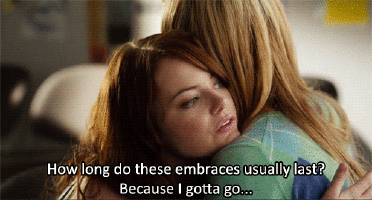
What is your stance on hugs as a hello or goodbye?

I, personally, hate hugs, unless they’re with all but the closest of family and friends- and even then, just for a) comfort in the direst of emotional states or b) when this is goodbye for at least a few weeks to a month, or before some kind of trying endeavour. I don’t even particularly enjoy a hug with anyone but my husband, but I will do it because I’m not a monster and know when someone wants one.

This is obviously an idiosyncratic thing, perhaps set in place by my undemonstrative Irish family, but they make my skin crawl, and when I see an acquaintance/parent of a friend/colleague who I’m friendly with but don’t want to touch coming in for one, I’m like, oh god oh god no. Especially, because I feel like I tend to be forced into hugging while my husband gets to shake hands! 

Leaving aside the gendered complexity of hugging, I ask you two things.

1. What is your opinion on hugs (is my dislike of hugs my own cross to bear, or is there some merit to it), and, 2. considering I can’t avoid all hugs and must occasionally wrap my arms around semi-strangers, what would a modern guide to social hug etiquette look like?

Thanks for any light you can shed on this matter.

Yours faithfully,

Not feeling it


Official Etiquette

Emily Post didn’t really say much on hugging, but according to MTV Lauren Conrad is the Emily Post of hugging (???). She lays down some rules here, but says to save the big, two-armed hugs for close family and friends.


Our Take

Jaya: So how do we navigate an increasingly hug-friendly world? I was caught by LW’s mention of how gendered this can be. I hadn’t really thought of it, but that totally happens.

Victoria: Ugh yes, this happened to me once! With a young guy–he was shaking hands with all the guys and then I go to shake his hand and he’s like, “I think we can hug.”  I did because I don’t really care, but ugh! Not if it’s just the girls that you hug!

Jaya: That’s ridiculous, especially if it’s a professional setting. Though I admit, I’m a total hugger.

Victoria: Me too. I guess I am somewhat sexist about hugging–I will hug strange women more than strange men. Like friend’s parents, I will hug the mom but not the dad.

Jaya: I find myself doing that as well. I guess it comes from an assumption that it won’t be taken sexually, which obviously it can be no matter who you hug. I do my best to read body language and see if someone is uncomfortable with it. And honestly some days I don’t feel like hugging, or there are some people I don’t want that level of intimacy with, and try to quickly get my hand out there for a handshake.

Victoria: I also think that social hugs can be like, gentle, quick hugs that leave a fair amount of space between the people. But it’s perfectly fine to say “I’m not a hugger” and stick out your hand.

Jaya: Is it though? I mean, it should be, but I feel like if everyone is hugging and you say no it’s gonna turn into like “who’s the ice queen?” situation. Which is just to say that huggers need to be more aware of those personal boundaries.

Victoria: Yeah, if someone’s giving you pressure you don’t want to be friends with them anyway. I guess you try to read the situation and see if you can get away with not hugging. Also a good time to take up Irish exits–if you don’t say goodbye, they can’t force you to hug.

Jaya: Hahaha yes. I think sticking out your hand first is key, and if someone comes in for a hug anyway do your best to make it quick and create as much space as possible, to send the message that you’re uncomfortable. Also, this question got me thinking a lot about a few articles I’ve read about not forcing children to hug anyone, even family members. This is a good example, but basically it comes down to teaching children body autonomy at an early age, and understanding that something like a hug can be very intimate. And maybe we’re forgetting that applies to adults too.

Victoria: Absolutely. You should teach kids how to politely greet people and not hide and stuff, but they should get to choose. Plus, get them started early on firm handshakes and maybe there won’t be so many people with terrible handshakes.

Jaya: Ugh preach.

Victoria: Want to hear how I learned to shake hands? So I went to Take Your Daughters To Work Day with my mom when I was 11 or 12, and she was introducing me to people and I was shaking their hands, and she observes my weak handshake a few times and tells me that no one likes shaking a dead fish. And thus I have always shook hands pretty well (I think!).

Jaya: That’s amazing! I do not remember how I learned, but I think I’m good at it. But handshakes are great because they’re very neutral. Like yes, we live in a society where if you refuse any sort of accepted greeting you’re going to be a bit ostracized, but you should feel free to decline a hug.

Victoria: Definitely, and people should be very understanding.

Jaya: What do you think could be said if someone gives you shit for it? I can imagine some jovial fellow coming in for a hug, me saying “I’m sorry, I’m not really a hugger,” and getting a lot of pressure to just lighten up.

Victoria: I mean, to an extent you either play it serious or act even jokier, depending on the situation. Alot of situations, you probably won’t be able to get out of though. I guess the more people who make a stink about it, the more people who will get it that some people don’t like hugging.

Jaya: Yeah, if you’re willing to be that person.

Victoria: I mean, you can feel the moral superiority that the person who is pressuring is the rude one. Which is cold comfort, I realize. My thoughts come down to: say you aren’t a hugger, and if they insist, decide if you are going to fight that battle, and if you are not, try to give a brief, light hug or whatever makes you comfortable. My bugaboo is the cheek kissing thing–I never know when its going to happen! Especially the double kiss! I’m always like, hey, oh, are we doing this? Okay then.

Jaya: That happened to me in France with a French guy, and I made the biggest American idiot of myself.
Regional Wedding Traditions: Cookie Table

Previously: Cake Pulls

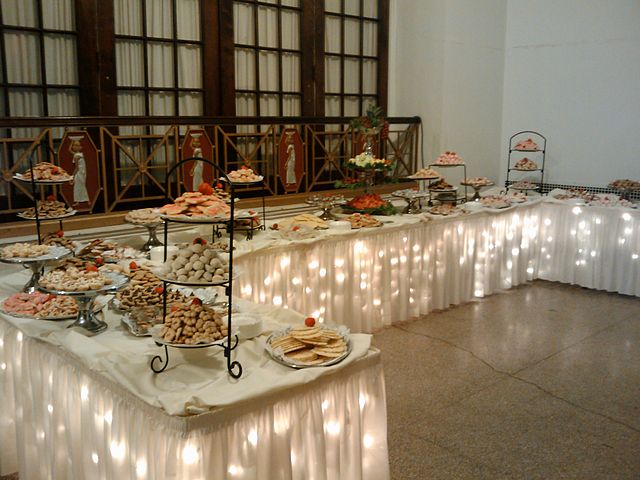
This is a regional wedding tradition I can get behind- a cookie table!

This tradition is regional to southern Pennsylvania/Pittsburgh and some other industrial East Coast cities that have large Catholic populations of Italian or Eastern European groups, says Wikipedia. I can’t remember where I first read about it, but it always struck me as a particularly nice tradition. In addition to your usual wedding cake, there is a table full of cookies at the wedding for the guests to enjoy. The great thing is that the relatives of the couple bake the cookies, giving it a great community feeling and something that hasn’t been totally Pinterestified like it’s cousin (and another favorite of mine- the candy buffet). Supposedly the tradition started before wedding cakes were a big thing and it was a way to spread out the cost of the reception between many family members.

These cookie tables aren’t playing around, either. I read about one wedding that had 500 dozen cookies!  That’s 6000 cookies, and unless these weddings have a thousand guests, that’s an awful lot of cookies per person. This wedding had 200 guests- which is 30 cookies per guest. That’s so many! Even a sweet fiend like me would have a hard time with that. Luckily, you get to take them home to enjoy at your leisure.

There is a bit of etiquette involved- are you really allowed to take them home (apparently these days it’s all good and some families even provide containers)? When can you start eating them, from the beginning of the reception or do you have to wait until dessert time (definitely not until after they’ve been revealed, but it depends on what the couple wants)?

So, let’s definitely bring this tradition to other weddings because unlike cash bars, who doesn’t love a good, homemade cookie?

What I Learned About Making Plans From Planning A Wedding

Every summer it happens–there are weekends to use up, and warm weather to be enjoyed, and suddenly I’ll find myself 20 replies deep in an email chain and ready to kill all my friends. Not that they’ve done anything wrong, it’s just that watching these plans being hashed out and having ten people trying to figure out a free weekend in common makes my head spin. Making plans with a large group of people has gotten really complicated, largely because we’re all so nice. We want to accommodate everybody. But if there’s one thing I learned from wedding planning is that that is not possible, and it’s been freeing.

The bigger your wedding, the less likely it is that everyone is going to be able to make it. Four people at City Hall? Easy. Twenty five in your backyard? Trickier. A hundred in a banquet hall? Someone is going to drop out. Those are just the facts. There are only so many days in a year, and people have their own lives and plans and conflicts. So when we picked a date, we double checked with our parents and siblings, and then set it. Yes, some people we dearly wanted to be there couldn’t come, but that would happen no matter which weekend we picked.

I’ve started applying this to making plans in the rest of my life. The other day, instead of having all of my friends tell me their free weekends for a beach trip, I just said I was going to the beach next Sunday and any and all who want to join should. Some people had plans, and some people could make it. Of course, this is predicated on the idea that if nobody could make it, I would still be going to the beach, which actually I would. But the point is that making firm decisions before you talk to all your friends can cut down on a lot of back and forth and hurt feelings.

For instance, let’s say you and some friends want to see a movie, but there’s no night in the next week that works for all of you. If you start your planning by asking when everyone is free, it’ll become clear that not everyone is free at the same time, and then you’ll have to make a decision about who to leave out, which could hurt some feelings. On the other hand, if you said “I’m seeing Mad Max at 9pm on Thursday if anybody would like to join” then people are free to accept or decline, knowing plans have already been set, and that it’s not personal.

This doesn’t work for all things. Obviously if the point is seeing specific people then a little more coordination has to happen, and if absolutely nobody can make it then you’ll have to change things around. But what I learned from weddings is that, while it’s the planner’s job to make reasonable accommodations, no plan will satisfy everyone. Picking a date and giving everyone reasonable notice of plans is all that’s really required, and if a few people can’t make it, that’s just fine. Maybe it’s pre-anxiety over FOMO that’s making us worry about including everyone. Of course we don’t want anyone to feel left out, or feel like our friends are doing things without us. But sometimes that’s life. Personally I’d rather miss a movie outing than suffer through another 40 emails.

Genealogy Etiquette

The grave in question in bullet [Courtesy Victoria Pratt collection]

The grave in question in bullet 4 [Courtesy Victoria Pratt]

Jaya and I, in addition to being etiquette experts are really into genealogy. We both have branches of our family trees that go way back in America, both to the American Revolution and the Mayflower. I’m even a member of the Daughters of the American Revolution. Family history can be great fun- like being a detective! And it’s very rewarding in having the opportunity to connect with very distant family members.

However, like anything, there are a lot of rude genealogists out there! So here’s how to be polite:

  • Family trees are not subject to copyright. I had a 3rd cousin of my grandfather’s send me a very nasty email after I put the names and dates of our mutual family members into my Ancestry.com family tree. By all means, if you’re relying on a significant chunk of research from one person or website, cite it. But just because you are the one who told me that Charles Smith was born in 1790 and died in 1840 doesn’t mean I can never use that information for my own publically accessible trees! Of course, don’t plagiarize written stories and things that are original work.
  • Ask nicely- if you believe someone has some information that will be useful, ask them nicely for it, don’t demand it. That goes for professionals such as librarians as well.
  • Be careful with original documents so they will be available for future genealogists as well.
  • Don’t make assumptions! I had set up a Find-a-Grave page for one of my ancestors several years ago. Recently someone emailed me through the site and asked me to transfer the page to him as he was a direct descendant. Well, I am ALSO a direct descendant and I was there first, so no. If he had said, I’m a direct descendant of so-and-so and I would love to take control of the page to do this, this, and this and would you be interested in transferring it to me? The answer might have been different.
  • Always be thankful when people help you. Find-a-Grave does this awesome thing where you can submit requests for people to photograph a particular grave in a particular cemetery for you. (This is a very fun hobby, btw!!) I have submitted a few and gotten the photos I asked for. Of course I immediately wrote to the photographer to thank them for taking the time.
  • Don’t publically list information about living people! Ancestry.com hides all information about living people and you should too.
  • Always be willing to collaborate- don’t take and take information from people without giving any information back.
  • Feel free to reach out to people you might be related to, but don’t get mad if they aren’t interested. As weird as it may seem, not everyone is super into genealogy. You might trace some living relatives down through obituaries and then find them on Facebook or whatever, and that can be awesome! I’ve done it and had a great time chatting with someone who is my 5th or 6th cousin. However, I’ve also reached out to people and never heard anything back. It’s fine and totally their choice.
  • Be specific in your information requests. When reaching out to someone who might have a connection to you, make sure that you are specific in who you are researching and how you think they might fit into the other person’s research.
  • Don’t assume everyone is as fascinated by your family tree as you are. Family history is kind of like dreams- utterly fascinating to you, but a total bore to everyone else. If you must talk about it, keep it short and punchy with good anecdotes. For example, some of my family are buried in a small cemetery in the East Village in NYC and I always point it out to people when we are walking by and tell them about the dramatic suicide of one of my ancestors who is buried there.
  • Take rejection well. I get emails from other researchers occasionally who think that someone in my tree might be someone that they are searching for. After getting more information, sometimes it turns out that there’s no actual connection. Most people are fine. However, I emailed one woman back and said something along the lines of “I don’t think I have anyone by that name in my family tree and it doesn’t look like I can help you. Good luck in your research!” and she wrote back that it was the rudest response she had ever gotten and why didn’t I want to hear more about her family tree?

Also, apparently gravestone rubbing is passe now that everyone has digital cameras. Plus it’s bad for the preservation of the inscriptions. Happy family hunting!