Sports Etiquette Sounds Like A Good Idea

The world of sports and sporting is something I’ve never really felt a part of, even though a decent part of my childhood was spent on various sports teams (soccer, volleyball and softball). I liked being athletic and active, but the word “athlete” always seemed to describe other people who held teamwork through physical strength in much higher regard. Just let me run around and throw things in peace.

(I also may have avoided becoming too entrenched in team athleticism because I am the worst competitor when it comes to board games and the like. My fiance refuses to play air hockey with me anymore because I am a BITCH about both winning and losing. Don’t I just sound darling?)

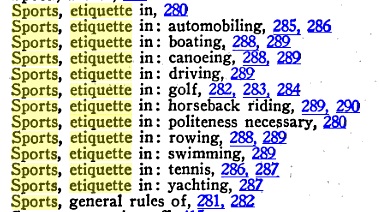
Anyway, the etiquette of sport was very real when interest in sport=good breeding. In Marion Harland’s Complete Etiquette (1914), she writes that participating in sports is the way for humans to express our primal natures in everyday civilized life, which is why it may be so easy for normally well-mannered people to flip the fuck out if they miss a tennis return. It is because of this that etiquette must be enforced, and really, the rules she lays out are not that complicated: play fair, don’t lose your temper, and remember that the “other fellow has as much right to a good time as you have.” She also writes “no sport in which people of breeding can participate demands loud talking, ill bred language or actions, or the abridgment of any of the small sweet courtesies of life.” And you want to be well bred, right? Like a dog? Yes.
Best search ever

Best search ever

Of course, there are many rules that seem hopelessly outdated. If a man and a woman are playing golf together, the man is not supposed to let himself get too far ahead of her and leave her alone on the field. When “automobiling,” always stop at a disabled car and see if you can be of assistance (on those days when you just drive around for fun because gas costs a nickel). Also, “Do not boast of the phenomenal runs you have made. You are not a record holder. And when you become one, the newspapers will gladly exploit the fact without any viva voce testimony from you.” God I love how catty etiquette experts can be.

Many of the other tips have to do with how to handle a female opponent if you’re a man, so let’s all appreciate that the current etiquette is most likely “just play the dang sport.”

The other part of sports etiquette has to do with sports and business, since many a business deal has been brokered on the tennis court, ringside at a boxing match, or on the golf…field? Business Skills for Dummies (they have good tips!) says that no matter the sport, be honest about your skill level: “Rank beginners and fakes aren’t appreciated. It’s better to decline than to embarrass yourself in a sport you don’t know how to play at least passably well.” However, they miss something here. Think about it: a high level executive makes all his business deals (you know, business deals. I don’t know business speak.) while playing tennis. You cannot play tennis, and say so when you’re invited by him to the court. It is far more likely that you will just not be invited to any more tennis meetings than this executive changing up his routine to accommodate you.

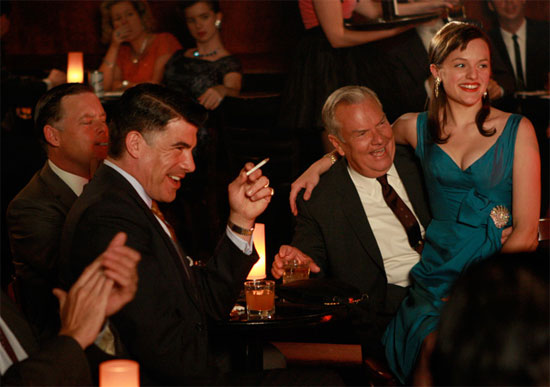
The problem with combining business with sports is that it automatically sets up a system where some people can’t participate. Just because someone doesn’t know how to play golf doesn’t mean they won’t be a good business partner, and limiting your business deals to a club of people with your same interests means you’re missing out on a lot.  Like, remember in Mad Men when they all kept doing business at a strip club and Peggy couldn’t really go, but she decided to “man up” and go anyway and it was super weird but it was her only option if she wanted to get ahead? Don’t make someone be a Peggy, just have your meetings in a damn conference room.
Don't make coworkers sit on your lap either???

Don’t make coworkers sit on your lap either???

But ok, back to sports. In general, I’m for a lot more etiquette in sports, and essentially remembering that it is only a game. This goes for pickup basketball games with friends, or Richie Incognito. Your skill level at a particular sport is not indicative of your character, and your joy should never come at the expense of someone else’s sorrow. That’s not to say you should never compete, just be mindful that after you’ve won or lost, you still have to return to everyday life.

Oh yeah and let women play the same way as men.
Things In The Emily Post Wedding Etiquette Book We’ve Never Heard Of

9780062326102The thing about etiquette is that there are now thousands upon thousands of “rules,” and all of them have precedent. With many ceremonies we rely on “tradition,” and though that’s a fleeting and ever-changing thing, you can always reach back to something a specific group of people did a few times 200 years ago and say “well, it’s tradition!” and everyone will take you at your word. The flip side of this is that, during the ongoing pressure of planning a wedding, people will insist on traditions you have never heard of, and you may feel forced to comply just because you’ve been convinced said-custom is indeed a tradition.

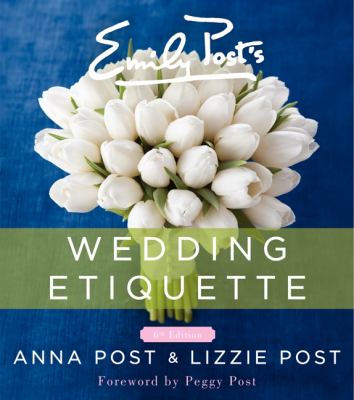
Recently, I received a copy of the 6th edition of Emily Post’s Wedding Etiquette, a lovely hardcover filled with tips on seasonal flowers, invitation wording, and updated text about same-sex marriage and having a “man of honor.” (It does still say that “men may choose not to wear a ring” but makes no mention that women don’t have to wear rings either. Ugh.) But looking through, there were a number of things that I realized I have never seen in person. I have been to 15 weddings in my lifetime (18 by the end of the year, including my own), from Catholic to Polish Orthodox to secular, Indian to Jewish, formal to garden party, and none of these things has ever happened. That doesn’t mean they never happened, or don’t still happen, or that you shouldn’t do them; this is just a reminder that you do not have to take every bit of advice given to you.

  • Having a separate “bridal bouquet” and “tossing bouquet.”
  • During the Best Man’s toast, it used to be customary for him to read any congratulatory telegrams. I’d actually be cool with bringing this back, so someone send me a wedding telegram.
  • Seeing the bride and groom serve cake to their parents. “Tradition has it that the bride serve the groom’s parents, and he serves hers.”
  • We knew it was tradition for the bride’s family to pay for the ceremony and reception, and the groom’s family to pay for the rehearsal dinner. However, the groom’s family is also apparently supposed to pay for the engagement and wedding rings, the officiant’s fee and transportation, and all the corsages. This seems complicated.
  • “Always address wedding invitation envelopes by hand, even when inviting hundreds of guests.” I have received plenty of wedding invitations with our names printed on the envelopes, and the world kept spinning.
  • Checking whether throwing rice/confetti/etc is allowed with your venue. Does anyone actually throw rice anymore???
  • The groomsmen also serve as ushers and show the guests to their seats.
  • Technically, this is from the 5th edition of this book, but traditionally, the couple was supposed to pay for the accommodations of their bridal party.
  • One of the groom’s traditional duties was to plan the whole honeymoon, often not telling the bride where they were going until they got there.

Thank Goodness We Don’t Have to Do That Anymore: Paying Calls

Not this kind of call. [Via FreeDigitalPhotos.net]

Not this kind of call. [Via FreeDigitalPhotos.net]

Jaya has already written a really great post about calling card etiquette that you should check out. But calling cards are only a small part of a larger social nightmare that was referred to as “paying calls.”

Paying calls as a formal social requirement was most popular in the Victorian Period (of COURSE) but was dying out when Emily Post wrote Etiquette in the 1920s. Oddly, my 1967 copy of Amy Vanderbilt still has a chapter on it, though she acknowledges that the practice died out after WWI.

The first thing you need to know is that calls were called morning calls even though they took place in the afternoon. This comes from an earlier practice where any time before dinner time was called morning.

The other thing to know is that paying calls was basically a full time job for society ladies. They would go around almost every day to their friends and acquaintances to keep up with what was going on with everyone and making sure your family was still in good standing. Basically, social networking before the internet. This was such serious business that women would keep ledger books of who they regularly called on, if those calls had been returned, and if they owed anyone a call. Then they would whip out these “calling lists” when it was time to host a party and boom, there is your invitation list.

Fortunately, you didn’t always have to actually talk to all of your friends. You could often just drive around to their houses and leave your card, thus getting your obligation out of the way (and your friends would keep everyone’s cards on a tray in their front hall so everyone could see how important they were!). This was especially important when you came to town after being away (or being at your country estate for a while). You would drive around and leave a card at the house of everyone in your social circle. That way they would know that you were around and they could invite you to parties and other social events. Then when you left town, you would do the exact same circle of friends and acquaintances, but this time you would write P.P.C. in small letters in a corner of your card. This is an abbreviation for pour prendre congé which, for those of you who have forgotten your high school French, means “to take leave” and would signal to everyone that you were leaving.

Aside from paying calls when you arrive in town, when you depart, and just the regular round, there were several situations that REQUIRED a call to be paid. Anytime you were invited to a ball or a dinner or any other kind of social function (whether you actually attended or not), you had to pay a call on the hostess within a week or so of the event. You also had to pay calls when a friend got engaged or when someone died. Men didn’t have to do the regular call paying, but they did have to pay calls after receiving invitations or attending parties. Anyone who didn’t pay these required calls would find themselves never invited to one of that hostess’s events again, so!

Interestingly, men also had a large number of calls to make after he got married. It was assumed that all the friendships of his bachelor days automatically ended when he got married. By paying a call on any or all of them after the wedding, it said that he found them respectable and wanted to remain friends.

When you actually wanted to see someone during a call and not just leave your card, there were additional rules to follow (of course!). You would enter the house and ask the butler or other servant if the lady of the house was at home. If she was out or busy, the butler would tell you straight away that she was “not at home” and you would leave your card and depart (however, if she heard your voice and wanted to see you, she might come out and say “I am at home to YOU, my friend!”). Some women would screen their callers by looking out the window and signaling to the butler whether they wanted to see them or not, but once the butler had taken the card and brought it to the lady of the house, she basically had to see the person. There was no pretending you weren’t home once your servants had acknowledged that you were.

So once you were in, you were brought into the drawing room, which is where guests were received. You would keep your hat on to signal that you weren’t staying long (men removed their hats but kept them in their hands). Conversation during calls was polite and mild. You would stay about 15 minutes and then you would leave. Refreshments were rarely served, but if they were, it was rude for a hostess to insist that her guests take something, as it was possible that they had had tea and cakes at the 6 houses they had previously called on and could not eat anymore.

A particular tradition around paying calls that was definitely common in New York City and likely in other places too, was the New Year’s Day call. This was a very regimented form of calling where all the women of the family would be at home all day with a spread of nice foods and all the men would go out and pay in person calls at the homes of practically everyone they knew. Since the men would be paying possibly 50-100 calls in the day, they would get started by 9 or 10 am, which meant that the women would have to be up, hair done, and in place in the parlor or drawing room by that time (so they would have to wake up by 5 or 6 am, or possibly earlier if their hairdresser was booked!). Then there would be a steady stream of men coming by all day long for just a few minutes at a time. A completely exhausting time for everyone. The practice died out when fashionable neighborhoods in Manhattan spread out and it wasn’t possible to visit all your friends in one day anymore.

Sources:

What Jane Austen Ate and Charles Dickens Knew: From Fox Hunting to Whist-the Facts of Daily Life in Nineteenth-Century England by Daniel Pool

Etiquette by Emily Post

The Gentleman’s Book of Etiquette and Manual of Politeness by Cecil B. Hartley

“New-Year’s Calls,” Harper’s Bazar Magazine January 1, 1870

Complete Etiquette by Marion Harland

Thank Goodness We Don’t Have to Do That Anymore: Spinster Etiquette

This subject is very near to my heart, as in doing research on spinsters, I discovered that I have been a spinster for years now and didn’t even know it! So I am very grateful that I no longer have to follow any of these stupid rules.

Spinster is a word that means “one who spins,” like, spins wool for thread because what else could you possibly do if you aren’t married. Interestingly, it was a legal term for any unmarried woman until the early 1900s and you sometimes see it as a designation on marriage documents. From the early 1700s, it’s common use was a woman who was unmarried beyond the normal age for it.

Spinsters created a great problem in etiquette for a long time, because in many ways, they had to be treated like a young girl.

Edith Ordway’s Etiquette of To-day from 1918 instructs spinsters:

Even the spinster of recognized professional standing finds herself somewhat restricted in social pleasures. She cannot go out socially with one man more than occasionally; she has little pleasure in going unattended; she can entertain but infrequently and in a small way, if at all, and never without an older married woman to assist her. She may, however, have her regular afternoon or evening “At Home,” provided she has with her this friend; and with that friend present, she may entertain a gentleman caller until ten o’clock in the evening, but she may not offer him cigarettes, nor any beverage but tea, coffee, chocolate, or lemonade.


However, a 1901 etiquette book, by Annie Randall White Twentieth Century Etiquette gives “elderly girls” a bit more leeway:

When a lady passes the age of thirty and has not yet married she is entitled to a matron’s freedom. This is also in a measure true when one has reached the age of twenty five. She is now considered able to judge for herself and knows when to shun the temptations of the world. She however cannot do everything she might wish to without violating some rules of etiquette. In traveling she should either be accompanied by her father brother or a lady friend and should be especially particular regarding her dress. So many charming women are single from choice either because their sweetheart died young or because of the giving up of one’s life to become the matron of the father’s home that to them should be accorded all respect due to a married woman. Many of our bachelor girls live together and are the happiest people imaginable It takes a very superior woman to be an old maid.

It was actually not uncommon to glorify old maids- an editorial called “Honorable Often to Be an Old Maid” in Peterson’s Magazine argued that marrying a man you do not love in order to have a home, security, and to escape being an old maid was a perversion of the sacred institution of marriage.

Of course, that doesn’t mean that spinsters weren’t stigmatized. A 1932 issue of the Vassar Miscellany News quotes another article from The Forum in which the author Ellis J. Ballinger argues that women’s colleges are “booming spinsterhood, encouraging marriage failures.” He suggests appointing a national marriage bureau to make matches and recommends bringing in beauty, style, and etiquette experts to the colleges to teach those girls how to catch a man. In the end, he says, if after all this, a woman chose to be a spinster “I am sure that she would be a happier old maid than the kind we are turning out today.”

Another fun tradition for friends of spinsters was to throw an “Old Maid’s Party,” apparently a New England tradition in which on a woman’s 25th birthday, all of her friends would come over with tea and cakes and genealogy charts to find the old maid the perfect husband. They might even play the card game “old maid.” Charming.

Thankfully, these days, old maids can pretty much do whatever they want, except avoid questions about when they are planning on getting married.

Can We Actually Bring These Toasting Puns Back?

g1327246262239310722While researching toasting etiquette I came upon a book called The Perfect Gentleman, Or, Etiquette and Eloquence: A Book of Information and Instruction … Containing Model Speeches for All Occasions … 500 Toasts and Sentiments for Everybody … to which are Added, the Duties of Chairmen of Public Meetings. Apparently they didn’t have editors in 1880, but in it is contained what might possibly be my favorite list to ever be listed: toast puns.

In a chapter titled “Toast-Master’s Companion,” the author argues “there is nothing in which men more conspicuously show their wit or their want of it than in giving toasts at public dinners.” But of course, showcasing one’s wit can be daunting, so the book offers toasts for various occasions. Patriotic toasts (“America: The birthplace of liberty and the asylum for the oppressed of every land”), Military Toasts (“An Army to stand, but not a Standing Army”) and toasts to drinking in general (“Old wine and young women”). But none of these are more glorious than the list of “Toasts for All Professions,” which is just a slew of puns about various jobs.

  • The Surgeon—A man who bleeds for his countrymen.
  • The Glazier— Who constantly takes pains (panes) that other people may see clearly.
  • The Baker— May he never be done so much as to make him crusty.
  • The Printer— May his form be well locked up in the arms of a charming wife. May he never know what it is to want a quoin.
  • The Tinker— A devout man whose life is spent in a pilgrimage, to mend the mistakes and repair the wastes which other people have made.
  • The Fireman— The sentinel of our homes may he burn only with ardor to protect the property and life of the city. May the flames of dissention never find fuel in his heart.
  • The Fire Department— the army that draws water in stead of blood and thanks instead of tears.
  • The Carpenter— May he have a warm house and good boarding.
  • The Actor— A bumper every night.
  • The Plumber— Though his business is to furnish mankind with the dumb blessings of light and water, may he be a good spouter and easily turn his lead into gold.
  • The Blacksmith— In every speculation may he always hit the nail on the head.
  • The Banker— May he always draw upon content for the deficiency of fortune
  • The Road maker— A highwayman who deserves well of his country.
  • A Card maker— May he often turn up trumps.
  • A Goal Merchant — May his customers ever be grate full.
  • An Auctioneer— By knocking down may he ever rise in the world.
  • The Distiller— May he never be out of spirits.
  • The Coach maker—May all his wheels be those of fortune.
  • The Painter— May he have a good pallet and plenty to gratify his taste.
  • Every Man’s Wife— May the lightning of her eye never cause him to be afraid of thunder.
  • The Saddler— May he sit upon a soft cushion and never have the misdeeds of others saddled upon him.
  • The Book keeper— May he faithfully keep his books and may his books keep him.

All italics original and perfect. Remember these for the next time you dine with the Card Maker in your life.