How To Never Address Anyone Again

These titles have been out of use since we stopped hanging witches.

You would think that since America doesn’t have a nobility, the historical use of titles would be very straightforward, but there are a few interesting uses that we don’t have anymore:

Goody/Goodwife and Goodman

If you’ve ever read The Crucible or other books based in Puritan America, you’ve probably come across the term Goodwife and its abbreviation Goody and have perhaps seen the term Goodman. Obviously these terms came with the colonists from England but seem to have been used mostly by the Puritans in New England. To an extent the term denoted church membership, as those who belonged to the church were “good.” They seem to have been titles denoting a slightly lesser social status than those addressed Master and Mistress, but still with some social standing in the community. The term fell out of use in the early 1700s.

Mistress and Master

Early forms of address for people of the middle and upper (but not noble) classes, precursors to Mister and Mrs. Mistress was used for both married and unmarried women. They fell out of use sometime in the 1700s as the democratization of language preferred Mister and Mrs. (which is still short for Mistress, but obviously pronounced Missus) or Miss for all people.

For a while, Mrs. was used as term of respect for women even if they weren’t married- such as calling the cook and housekeeper Mrs. Lastname to denote their rank even if they weren’t married. Miss also was derived from Mistress. An interesting historical fact about the use of the word Miss was that in a family, the eldest daughter would have use of the title Miss LastName and her younger sisters would be called Miss FirstName until the eldest married and the next was bumped up. The use of the term Master for the minor, male children of a house survived well into the 20th century.

During the period immediately following the Revolution, Americans were trying to figure out what they would call each other. Many advocated for a no-frills approach and an ending of most earlier courtesy titles. One wish was to change female titles to eliminate a distinction between married and unmarried women. For those who think the term Ms. originated in the 20th century, it has actually existed as the abbreviation for Mistress as long as Mrs. and Miss have been around.

Thank Goodness We Don’t Have to Do that Anymore: Display Wedding Gifts

This is something like what the display would look like. Via The Smithsonian

Now that we’ve learned how to give a wedding present, we can all be grateful that we no longer have to worry about it being displayed in the bride’s home to be judged against all the other presents that people have given!

As I mentioned in my post on The Southern Belle Primer, in the past, many brides would display their wedding gifts in their home for people to come and see.

This custom began sometime in the late 19th century, right around the time that wedding guests started to give significant gifts. Prior to that time, the bride’s family provided all of the household equipment the couple would need through the trousseau with guests giving token gifts, if anything. In fact, giving large wedding gifts would imply that you thought that the family could not properly provide for their daughter.

But by the end of the 19th century, that had all changed and manufactured goods had become pretty cheap and people started the wedding gift traditions that we know today. Unlike today, appropriate wedding presents were commonly accepted to be things like china, crystal, silver, and fine linens. These types of items made a much more lovely display.

The basic idea is that the gifts were displayed in the bride’s home for guests to see before or during the wedding. It was much more common at that time for weddings to take place at home, so it actually kind of makes sense to have the gifts displayed, since they were already there. Also, “visiting” at people’s homes was much more common around the turn of the 20th century, so it wouldn’t be as strange as it seems now for people to stop by to see the gifts- in fact, it made it a little bit easier to just have them out instead of having to pull them out of wherever they were stored every time someone came by.

There were variations over the years:

In 1896 Maude Cook writes that if the presents are not to be exhibited at the wedding reception, the bride frequently gives an informal tea the day before to her lady friends for the purpose of displaying them.

The Dictionary of Etiquette in 1904 said that it is not in good taste to display the gifts, but if they are, the names of the givers should be removed and only close friends invited to see them.

Emily Post’s 1922 book states that wedding presents should be sent ahead of time so they can be unwrapped and displayed in the brides home to show them off in a pleasing manner, not to brag but to show appreciation of people’s kindness. They do not have to be displayed, especially if the family cannot spare the room. If they are not displayed, a small afternoon party can be given for close friends to come and see them.

By 1967, Amy Vanderbilt concedes that you do not see the wedding gift display very often, though it is still correct to have it. She does mention that all the cards with the names of the givers should be removed and that though you can display checks, the names should be covered up. She also suggests grouping gifts of similar value together to prevent people from making comparisons. She also suggests having a tea for close friends to come see them and having them on view during the reception if it takes place at home.

Not everyone thought that these displays were such a great idea. Many etiquette books and the very popular Godey’s Lady’s Book denounced the practice as being vulgar and show offy. Sometimes the bride’s trousseau was included in the display, so everyone would be looking at what underwear you would be wearing the next few years- fun! When Consuelo Vanderbilt famously married the Duke of Marlborough, Vogue ran an article, illustrated, of her trousseau including one and a half columns on her lingerie. Consuelo was mortified “I read to my stupefaction that my garters had gold clasps studded with diamonds…and wondered how I should live down such vulgarities”

I have not heard of this being done  in any recent times, though some etiquette books still mention it and even suggest doing it so you can easily show your gifts to close friends. Perhaps this is a regional thing? Is anyone still doing this? Let me know!

Thank Goodness We Don’t Have to Do That Anymore: Mourn Like It’s 1861

Maybe we should bring back the timeless craft of making stuff out of dead people’s hair? The Children’s Museum of Indianapolis [CC-BY-SA-3.0], via Wikimedia Commons

A lot of our notions of etiquette come from the Victorian era when the middle class was on the rise and everyone wanted to show everyone else how on point they were with all of the intricacies of etiquette. One area that was particularly elaborate and somewhat gruesome to us today is the etiquette of mourning.

Length of Mourning

A widow was expected to be in deep mourning of her husband for two years. Then a third year was “ordinary” mourning, and the FOURTH year was considered “second” or “half” mourning. Many older women remained in mourning for the rest of their lives, the most famous being Queen Victoria who was in mourning for her husband, Prince Albert for more than forty years.

Widowers were expected to mourn for a year.

Parents and children were mourned for a year, siblings and grandparents for six months, aunts/uncles for three months, and cousins for six weeks.

Mourning Dress

For a funeral, everyone had to wear black (unless the funeral was for a child or unmarried girl, in which case everyone wore white). Sometimes the family/funeral director would even provide black gloves and scarves for all the mourners.

Then again, I always love a veil. By Anders Zorn 1860-1920  [Public domain], via Wikimedia Commons


Etiquette dictated what you could wear while you were in mourning (in relation to how much time had passed and your relationship to the deceased) right down to what kinds of fabric and jewelry was appropriate.

Men only had to wear a black armband over their regular clothes (though they were supposed to wear only white shirts instead of colored.) This was partially sexist and partially practical. Men’s clothes were much more difficult to dye than women’s clothes and typically when you were in mourning you would just dye all your clothes black instead of buying new, black clothes. The sexist reason was that men still had to go out and go to work and didn’t want to look too depressing.

Women did have to wear all black. In addition, it couldn’t be just any black, it had to be very matte black, so you will see a lot of references to crepe/crape as a fabric choice (a slightly crinkly fabric that does not reflect any light.) Women also had to dress fairly plainly without a lot of embellishments and jet jewelry was the only appropriate kind (other than hair jewelry, which we will get to in a moment.) In addition to all of this, widows had to wear veils over their faces.

Widows didn’t have to wear the crow look for the whole period of mourning. For instance, the widow’s veil could be shortened after the first year! Exciting! The very dark, matte fabric was for deep mourning. For ordinary mourning, you could wear shinier fabrics like silk. For half mourning, you could wear muted colors like grey and lilac.

Children wore a mixture of black and white so they wouldn’t look too sad.

Hair Jewelry

Hair jewelry designs. [Via Flikr user LEOL30]

Hair jewelry is pretty much what it sounds like- jewelry made out of hair! It was very popular during the Victorian period because hair does not decay and therefore makes a great memento of a person who has died.

The hair could just be a simple lock inside a pretty setting or it could be arranged into fabulous shapes and scenes. Simple braids of hair were also worn as bracelets. Hair wreaths hung on the walls were also very popular-see if you can spot one the next time you are in a period house museum.

Like most things related to Victorian mourning, the trend probably relates very closely to Queen Victoria’s mourning of Prince Albert. In fact, the trend disappeared almost entirely right after her death.

Weirdly, only jet jewelry was thought appropriate for deep mourning, though hair jewelry could be worn for the lighter mourning periods.

Being Social While in Mourning

Since mourners were supposed to be sad, they didn’t really go anywhere. It was supposed to have made them more sad to see other people being happy. A rule of thumb was that as long as you were wearing mourning clothes, you shouldn’t go to fun events because mourning clothes and fun clash or something. When you were in lighter mourning you could attend the theater, small functions, and informal events.

Post-Mortem Photography

Photography was first invented during the Victorian period. Combined with extremely high childhood mortality rates, photos of dead people became extremely popular! Sometimes the corpses were shown in a coffin or a bed, looking like they were sleeping. Other times they would be propped up or posed with relatives to look more lifelike. The practice died out (ha-HA!) with the advent of snapshot photography when people started taking pictures of you shortly after you had emerged from the womb and your death photo was no longer the only chance for someone to get an image of you. See some examples here if you are not too faint of heart.

As a note, I am calling this Victorian mourning, but Emily Post was still talking about all of this in her 1922 book and Amy Vanderbilt was still talking about it as something that was just dying (ha-HA! again) out in my 1967 edition of her book.

Thank Goodness We Don’t Have To Do That Anymore: The Trousseau

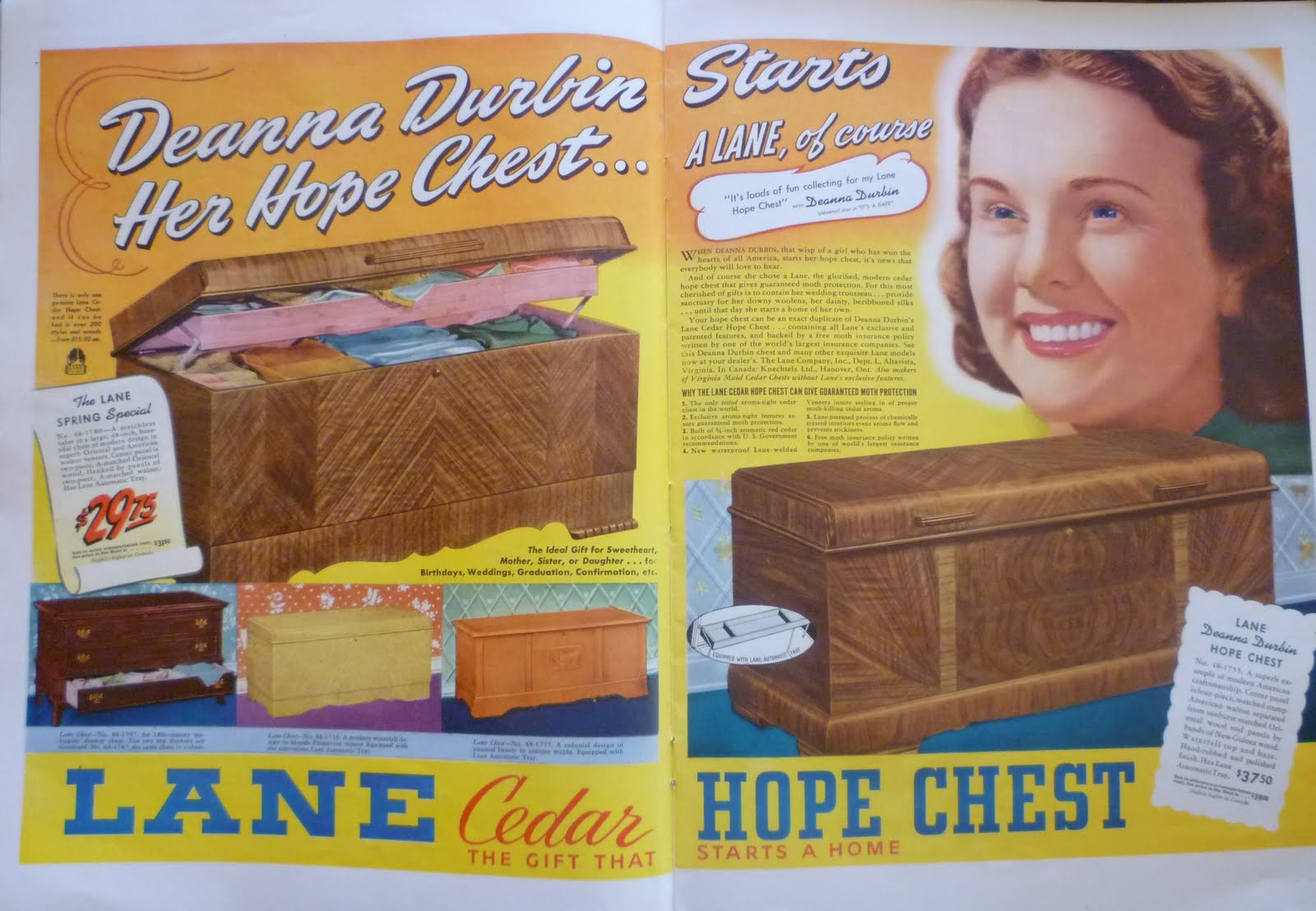
"provide sanctuary for her downy woolens, her dainty, beribboned silks...until that day she starts a home of her own."

“provide sanctuary for her downy woolens, her dainty, beribboned silks…until that day she starts a home of her own.” [Via]

Ladies! You know how when you were a kid you went to school and stuff, and it sort of sucked, and you spent all day wishing you could maybe not do that? Well, what if instead you spent your youth sewing tablecloths and blankets and clothing for your future husband? Childhood solved!

The Trousseau goes by many names–glory box, hope chest, bottom drawer, dowry–but essentially it was a collection of linens ‘n’ things for the bride and groom’s new home and/or clothing to last the bride the first few years of marriage. And for a long time, the bride was expected to make it all herself, and stow it all away until a groom finally appeared. According to Lillian Eichler’s 1921 Book of Etiquette, “The development is most marked in Roumania. Here we find the tiniest girls, some of them as young as five years, working on bridal finery each one striving to outdo the other in beauty and elaboration of work.” In many cultures female relatives pitched in too, and wealthier families simply had the maids do it.  However, once a suitor did arrive, he “had the privilege of examining the trousseau and deciding whether or not it was complete.” So tough luck if you sucked at sewing. Maybe you could find a job as a chaperone?

The whole reason you needed to do this is because your husband just wanted to come home to some comforts, ok?! Part of any western marriage, especially before the 20th century, was the agreement that the woman was the head of the household, and responsible for all the comforts found there. Lots of men looked forward to marriage as a way to finally have some nice things around the house. The irony was that often men were older and more established, so they could buy things like linens and blankets their damned selves.

Here’s an idea of how elaborate these things got. From “Lights and Shadows of New York” by James McCabe, 1872:

The society woman must have one or two velvet dresses which cannot cost less than $500 each. She must possess thousands of dollars worth of laces, in the shape of flounces, to loop up over the skirts of dresses… Walking dresses cost from $50 to $300; ball dresses are frequently imported from Paris at a cost of from $500 to $1,000… There must be traveling dresses in black silk, in pongee, in pique, that range in price from $75 to $175… Evening robes in Swiss muslin, robes in linen for the garden and croquet, dresses for horse races and yacht races, dresses for breakfast and for dinner, dresses for receptions and parties…

Ok, this was Vanderbilt Level Trousseauing, but that shit trickles down.

Thankfully, as time went on, the idea that a girl needed to spend all of her pre-engagement time sewing and collecting things for her household got a little ridiculous. Eichler argues “It seems rather a foolish waste of time for the girl of means to sit for endless hours sewing on rows rows of lace when machine made garments may be at reasonable figures. If she chooses her things carefully they will bear the stamp of her personality almost as as if she had fashioned them herself.” The 1920s were also the dawn of the Department Store in America, and buying pre-made items was a way to show off your middle-class status. So it was out with the homemade trousseau and in with buying one at Lord & Taylor’s…a modest improvement.

Traditional trousseaus fell out of fashion around the 1950s, replaced with the modern idea of the wedding present and registry. Until then, wedding presents were expected to be small, decorative items. It wasn’t until relatively recently that the idea became for all the guests to provide the gifts that would set up the new couple in their home. However, with many more couples living together before marriage, or choosing not to marry at all, the idea of setting up a new home is becoming a little dated, isn’t it? Does this mean there is an opening for the trousseau to make a comeback?!

Thank Goodness Men No Longer Need to Walk on the Right to Keep Their Sword Arm Free

For some reason, it persists among (some) men that to be chivalrous, they need to walk on a particular side of a woman when walking down the street. Historical reasons cited for this include:

  • When knights existed, their right arm was their sword arm and thus is needed to be available to defend the lady.

  • When people used to throw garbage out the window, the woman needed to be on the building side of the street so it wouldn’t hit her.

  • The man needs to be on the street side of the sidewalk in case a car splashes water.

  • Having the lady on the wrong side implies she is a prostitute

This often results in some ridiculous running around the lady to get to the correct side creating awkwardness all around. From a quick Google, men’s dating sites are strongly encouraging this practice though it should clearly die out. The fact of it is there is no really good reason for the man to be walking on the street side, danger is just as likely to come from the other side.

Granted, most old etiquette books (right up through Emily Post) do instruct the man to take the curbside position (or the married lady should take it if walking with a single lady), but they all also say that a gentleman should always defer to a lady’s preference. This means no pouting like a petulant child if a woman refuses to let you act the gallant.

There are any number of acceptable chivalrous practices that you can participate in if you wish to feel like a knight in shining armour:

  • Hold doors (but don’t insist she wait in the car while you run around to open her side!)

  • Offer your jacket (but only because it is likely you are wearing a long sleeved shirt and she is not)

  • Hold the umbrella (because you are likely taller)

  • Go to the door to pick her up instead of honking (or calling/texting) from the car

  • Give the lady (or anyone!) a hand or elbow if they are unsteady on their feet from illness/drunkenness/ill-advised heel heights