 Wedding registries are complicated beasts, and it turns out people have lots of opinions about them! Strong ones! That they will argue about for hours! Today, Victoria and Jaya try to see what the fuss is about.
Official Etiquette:
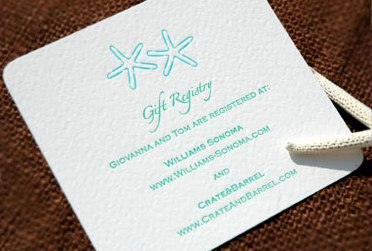
Registries as a concept are completely fine. etiquette-wise. It is the implementation of them that is tricky. One key rule is to never put anything about registries or gifts on your invitation. Invitations are about how much honor someone is doing you by attending the wedding, not what they are going to give you. Save your registry for your wedding website or, traditionally, word of mouth. Wanting cash gifts is fine, as is saying so when asked what you want. The problem is making a list that includes cash or writing dumb poems about it. Cash is the default, it only comes in one color, and the only choice to make is the number, so it is redundant and thus seems greedy to specifically ask for it. As Miss Manners says, the only way to ask for cash is to sit on the street with your hat out (Miss Manners also disapproves of registries of all kinds, so take that with a grain of salt).
The Emily Post Institute says that it is fine to ask for non-traditional gifts but suggests limiting the number of registries to three and making sure to include a wide variety of items and prices.
Remember, also, that registries are always optional and guests can ultimately get whatever they choose.
Our Take:
Victoria: So recently, my sister and my mom had a legit argument about honeymoon registries.
Jaya: Oh whoa, what did they say?
Victoria: Well my mom thought the whole thing was horribly rude. And then my sister was pissed that my mom was calling them tacky, and that lots of people had them, and apparently they finally compromised that asking for specific activities (like snorkeling) was okay while asking for airfare and hotel rooms was not.
Jaya: Interesting.
Victoria: It comes out of the general view that people like to buy a physical gift.
Jaya: I guess for me, the act of coming up with a specific list saying “here is what you should buy for us with your hard earned money” is so strange, that once you’re there, it’s really not that hard to just ask for the money instead. But also some people think registries themselves are tacky. There’s a whole tacky spectrum
Victoria: I think the delicate nuance is that a registry is always a suggestion whereas cold hard cash is a request.
Jaya: Does cash have to be a request? Having a “honeymoon fund” or something jar at your wedding is not equivalent to “put money in here or get kicked out.” It would be so easy for a couple to say that cash is appreciated but not required, the same way they do for gifts.
Victoria: The idea is that cash is kind of a default, so asking for it is somewhat redundant. You do need to know that a couple doesn’t already have a toaster. You don’t need to be told that they could find a use for cash. Actually, what is super interesting is that it took a good FORTY years for registries to even get to be mostly accepted, with a lot of HARD pushing from marketers.
Jaya: Do you think if couples didn’t have registries they’d just get cash? Or people would just buy them other random gifts?
Victoria: That’s another funny thing—a lot of people do read a very small or no registry as a preference for cash, but then you will have people buying you random stuff (though you will probably still get random gifts even with a registry). It is also 100% proper to use word of mouth. So say you tell your mom, dad, and closest friends that you really want cash.
Jaya: But if your parent’s aren’t cool with you asking for cash, you’re kind of out of luck.
Victoria: I guess I’ve never heard of that being a problem?
Jaya: I can imagine some parents saying it’s tacky and insisting you get a fancy china set. Also, I know a lot of people who consider cash a last minute gift if they couldn’t think of anything else. They’d rather give something totally random than cash, even when cash may be more appreciated.
Victoria: I mean, there are always going to be a lot of issues, and some people think giving cash at all is tacky. And if that’s the case, there’s not much you can do about it. Having a line on your wedding website about preferring cash isn’t going to make those people change their minds.
Jaya: Yeah, though that’s the thing. The website. If you have a link to a registry, which is essentially saying “we’d like you to buy us this stuff, if you’re gonna buy us anything” seems less tacky than “we’d like cash, if you’re gonna give us anything,” even though it’s basically the same request. It’s all smoke and mirrors. It’s a conspiracy!
Victoria: I think it all comes down to nuance and what people have decided is right. The nuance is that a registry isn’t a request that you buy us this stuff if you are going to buy us anything, it’s a list of things that you need (and originally it was JUST the names of your china and silver patterns).
Jaya: Uuuuuugh nuance doesn’t help if you just wanna buy a honeymoon ticket. But yeah, I get it. When people needed china, you used to be able to put out feelers for it. Now you sort of need a registry.
Victoria: Personally, I think we are in a transition period. Since people live together and already have a lot of STUFF, they don’t necessarily need all the traditional gifts. But there is still a certain cultural expectation towards that, so you are going to have a lot of resistance to change, especially regarding weddings, which are historically very slow to catch up to changes. But obviously, a lot of younger people think honeymoon registries are great and love to do that for their friends. Although, I guess I sort of agree that experiences are sort of preferable to the basic travel costs.
Jaya: Well I hope that a lot of older people take advantage of honeymoon registries too. And experiences are nice, but are sort of moot if you can’t afford to get there, you know? It’s different for everyone, but weddings are expensive, or we’re all young and poor and it’s a recession dammit, and could maybe use a vacation instead of a set of silver.
Victoria: I think one of the things that catches people up about honeymoon registries is that they don’t understand exactly how they work—like they think that they are actually sending money to a restaurant to pay for your dinner, and so if they find out that you didn’t actually go to that restaurant and spent their gift on something else, they can feel a bit…tricked?
Jaya: True. You sort of have to make a pact with yourself to spend the money as its given.
Victoria: I think the idea is that you are going to hear back about having all these experiences. But with airfare, it’s the couple’s responsibility to plan a trip they can afford—the whole crazy honeymoon across the world thing is pretty recent, so a lot of older people can feel a bit like “Why should I be paying for you to go to Tahiti when i can’t afford to go there myself?”
Jaya: Well duh, you pay for me to go to Tahiti because I’m getting married. And married people are a billion times more important and deserve crazy vacations.
Victoria: LOL
Jaya: I don’t know, in the spirit of gift giving, isn’t the point that whatever you give allows the couple to enjoy themselves and their lives? Whether it’s by hosting a dinner party with their new china, or by using the money to take a once in a lifetime vacation?
Victoria: I think with your registry in particular you have to be pretty sure that you will use the money to pay for the things you said you wanted. And again, I think it’s going to be generational.
Jaya: I think you pay for a vacation because you’re…being nice? Like, that’s why you give any gift. And also with most registries it’s not like you’re buying them 2 round trip tickets around the world. You’re going “here’s $50 to your honeymoon, I hope it helps you have a great time.”
Victoria: Yeah, again, I think its just nuance and social expectations. It just FEELS better to people to buy you something “fun” like a sailing lesson rather than a hotel room, you know?
Jaya: I don’t know, hotel rooms can be pretty fun on a honeymoon. I guess with nuance, I hate people assuming that I have put all this nuance and hidden messages into my registry? I wish there was a big sign I could put like “honestly do not care if you buy us a present, please, just do what you want.” But even if you do that, no one believes you.
Victoria: I know, the whole thing is really a rock and a hard place.
Jaya: Which is why we have to BREAK THE MOLD, VICTORIA. BLOW SOME MINDS.
Victoria: I would LOVE a way to be like, we need knives, a toaster, blue towels, white sheets, blah blah. I just want to prepare our audience for what negative kickback they might get if they throw peoples expectations into the wind. And I’m pretty sure I will have to disagree about asking for cash.
Jaya: I like the idea of a cash registry that has suggestions of what people will use it for. Or word of mouth. But how do you explain to parents that you’d really just prefer cash, if anyone asks?
Victoria: I like word of mouth, it seems classy. I think most parents do understand cash. It’s always been a thing for people’s moms to be all, “oh they are saving for a home, and don’t really need any china or anything.” Or like, “oh they are registered at such and such a place, but they are also saving for a home and I know they would love some help with that.” It just comes more nicely from someone else. People have a visceral reaction to anything that sounds “greedy,” which is not fair, but what are you going to do.
Jaya: What do you do if someone asks you? Tell them to ask your mom?
Victoria: You can totally say a similar thing! The key is that someone asked you. It’s the unsolicited thing that bothers people, especially an impersonal request on a website. Again, visceral reactions and nuance.
Jaya: OMG wait, were you thinking this whole time that some uneducated person like me would be walking up to random friends and going “by the way we really want cash”!?!??!!OF COURSE you let someone ask first!!!!
Victoria: Hahahaha no. But people do put it on their websites or invitations (which is 1000x worse). They even come up with poems about it. Yuck.
Jaya: Invitations is bad. I think website is fine, because website is also where you’d put a registry. So saying something like “your presence is obviously all we need, but if you feel inclined, we’ll be having a honeymoon jar/are saving for a house/etc…”
Victoria: I mean, if you MUST that’s where it would go. But again, I just think that asking for money specifically is redundant and there are nicer ways of getting the word around. And I do dislike jars or money trees at the wedding, because a) if people are sending a gift, they will usually send it ahead of time and b) if they do want to give money they usually put it in a card so you know who it is from and can thank them. So if you have a jar/tree people feel like this is yet ANOTHER gift they must get you, and sure say it is optional all you want, but people will either feel social pressure to put money in even if they don’t want to, or again have a visceral reaction about greed. Plus, if people are just throwing cash in a jar, there’s not really a way to thank them?
Jaya: True. Card boxes are better for that, but if you know on the website that there will be a card box/honeymoon fund BEFORE then you have time to put your money in a card so you can get proper recognition.
Victoria: It is nice to know before, but still people will think you want this in addition to the gift that they were planning on giving you. (Generic you, obvs.)
Jaya: And this is where nuance is annoying and everyone should just take each other at their word. I understand where it’s coming from, but it’s also not my fault if I never said anything about a registry, someone buys me a $200 kitchen appliance I don’t need, and then is insulted when it turns out we are asking for money.
Victoria: I think in the honeymoon fund thing—if you must do it, it’s better to just do a honeymoon registry than trying to have a jar at the wedding or something (plus there is the awful chance that someone might steal money from it).
Jaya: Perhaps in anger that they bought you a $200 kitchen thing and then you had the audacity to rather go on a honeymoon.
Victoria: Yeah, I mean, I don’t think anyone expects you not to return something you don’t need if they buy it for you, or to return doubles.
Jaya: Omg so you’re giving them cash anyway! You’re just making it harder for them to get it! This actually has a super interesting quote about registries: “In the December 1909 Ladies’ Home Journal, for instance, the writer Lou Eleanor Colby said she had found a way to “disguise the money so that it would not seem just like a commercial transaction.””
Victoria: Yes that quote about commercial transactions comes up in various forms, but I think that the commercial transaction distinction IS important for a lot of people. Ideally the perfect gift pleases both the giver and the receiver, and most people try hard to select something they think the couple will like, but people also derive pleasure from this exercise. And when people start talking about how- oh this will just make it easier for the couple, then a lot of people feel like they are treating their guests like purse bags rather than the friends and family that they love.
Jaya: I guess I hope that most people derive pleasure from the idea of the couple being happy, rather than some idea that their gift won out among all the others.
Victoria: It’s not about winning.
Jaya: I know, but there are a lot of guests who probably consider it a show. Or don’t realize that intangible things can bring as much pleasure as tangible things. Like, how wonderful to know that you helped this couple you love afford a home! Or have a trip that they will cherish so much more than a set of knives!
Victoria: Yeah, for a lot of people they are happy to just pick something off the registry and be glad that they don’t have to think about it—but those people probably wouldn’t care that much about a request for cash either. For everyone else, I think it’s an ingrained thing that is going to be very difficult to change for those people.
Jaya: People are set in their ways! And then they’ll die off and new values will take their place. And then we’ll be set in our ways and die, and on and on. The circle of etiquette.
Victoria: Although, weirdly sometimes things die off and then come back viciously later. Humans! What are you going to do?
Jaya: We’re crazy. All I know is that if I don’t get a roomba I’m gonna go fucking bridezilla on everyone.
Victoria: Hahahaha. I mean, to an extent if you think about it—how do you feel about when you go to college and then you graduate and every month like clockwork, someone is calling you up and saying, hey want to donate? And then you buy tickets to the ballet and then they regularly call you up and are like, hey you should become a member. I think the cash thing, and especially honeymoon jars and money dances, brings out that same feeling from as “begging for money” or “schemes.”
Jaya: True, but it’s not like you get married every month.
Victoria: But the whole wedding “thing” lasts a lot longer than just the wedding day—there are shower gifts and bachelorette parties, and the wedding gift and travel, and new clothes, and people just get money/gift fatigue. And yes, no one HAS to participate in any of those things, but they do.
Jaya: See that’s the annoying thing though, I think at least from my side (as an engaged person dealing with this stuff firsthand). Family members keep talking about throwing showers and things like that. And on one hand I want to let them because it’s very generous of them to want to do something for me, but on the other, I know that if anyone starts getting gift/money fatigue they’re gonna direct their resentment to me, not to the people actually planning these things.
Victoria: Yeah, its hard to say no to things that come from a good place. But you get to control the things that you CAN control, and those things are what gifts you ask for, and whether you do money dances/money jars/money trees.
Jaya: Ugh, fuck it. Money pit at the wedding. I wanna swim in it like Scrooge McDuck.
Victoria: I am all for group swim. Also, I personally think it would be cool if we could get to the point where it would be universally okay to ask for cash because yeah—seems easier. I just understand the arguments against it. Though I don’t think I will ever be on board with money dances.
Jaya: Oh no! Yeah, that’s where culture comes in. If it’s your family’s tradition to do this thing, then go for it. But introducing it to a new audience might be strange.
Victoria: I mean, obviously there is a caveat that if you are Philipino or one of the other cultures where this is a long standing tradition and most of the guests know to expect it, that’s fine. They are also probably not sending you a blender, you know? It’s when people are like, well, Philipinos do it, so it’s okay if I do it without considering the cultural context that it exists in.
Jaya: Cultural appropriation is not a good look at any wedding.
Victoria: Oh I thought of another salient point about cash money gifts! The receiver will always know exactly how much you spent, but with a tangible gift, even if it’s off the registry, you don’t know if the person had a coupon or there was a special sale or whatever, so sometimes people are able to get much fancier presents than they could afford otherwise and have a greater “value” than a cash gift would.
Jaya: Ohhh good point. Man this is complicated.



 uncommon-courtesy.com