The Founding Fathers and Etiquette

So distinguished! [Via Wikimedia Commons]

So distinguished! [Via Wikimedia Commons]

While they weren’t busy declaring independence, fighting a revolution, or bringing forth a new nation, the founding fathers were also writing a bit about etiquette!

George Washington

It makes sense that the most famous founding father was the only one to write a whole BOOK of etiquette. Washington wrote his Rules of Civility at the tender age of 15 in 1745, as part of an educational exercise, probably copying from a European manual of etiquette. As a young man, his social prospects were not that high- his father had died when he was a young teenager and had left a lot of land but not much money to support his mother and four younger siblings. Part of his purpose in learning these rules might have been to better his station in life. Highlights:

  • In the Presence of Others sing not to yourself with a humming Noise, nor Drum, with your Fingers or Feet.
  • Kill no Vermin as Fleas, lice ticks &c in the Sight of Others, if you See any filth or thick Spittle put your foot Dexteriously upon it if it be upon the Cloths of your Companions, Put it off privately, and if it be upon your own Cloths return Thanks to him who puts it off
  • Do not puff up the Cheeks, Loll not out the tongue rub the Hands, or beard, thrust out the lips, or bite them or keep the lips too open or too close.
  • Shew not yourself glad at the Misfortune of another though he were your enemy
  • In Speaking to men of Quality do not lean nor Look them full in the Face, nor approach too near them at lest Keep a full Pace from them.
  • Be not tedious in Discourse, make not many Digressions, nor repeat often the Same manner of Discourse
  • Take no Salt or cut Bread with your Knife Greasy.
  • Let your Recreations be Manfull not Sinfull.
  • Labour to keep alive in your Breast that Little Spark of Celestial fire called Conscience.

Thomas Jefferson

Jefferson believed “it would have been better, in a new country, to have excluded etiquette all together.” When he took office in 1801, he took the opportunity to bring his “republican simplicity” (quite the hypocritical statement for someone who brought a French chef and 86 packing crates full of books, household goods, art, and other fine things back with him from France) to the Executive Branch. He described it as suppression of “all those public forms and ceremonies which tended to familiarize the public eye to the harbingers of another form of government [ie monarchy].”

Washington and Adams had had “presidential levees” which were receptions held by the President and First Lady. Levee was a word that came from European courts and so Jefferson abandoned them in favor of small informal dinners. He also made sure to never be mistaken for a king- choosing to shake hands rather than bow, riding out unaccompanied, and dressing informally. He most famously introduced a “pell mell” policy for dinners and public ceremonies- rather than the guests proceeding in according to rank, they came in in no particular order. This angered a lot of important diplomats, but Jefferson stuck firm to it. Some of Jefferson’s more republican policies were later changed back to a more formal etiquette by subsequent presidents.

Alexander Hamilton

I don’t know if you realized, but recently a musical came out about Alexander Hamilton and it’s pretty good! Though it doesn’t specifically speak about Hamilton’s opinion’s about etiquette, there is a great song called The Ten Duel Commandments that outlines all the rules of the code duello that duelers like Alexander Hamilton (and PS that duel with Aaron Burr was not his first time at the dueling rodeo- he was in at least 10 others before!). Hamilton, being a pretty good guy, actually threw away his first shot by trying not to hit Burr- very gentlemanly of him! But that got him killed, so I guess maybe being a gentleman isn’t all that it’s cracked up to be ¯\_(ツ)_/¯.

Hamilton did actually comment on etiquette occasionally (how could he not have? The man wrote NON-STOP!) In fact, he advised Washington on what protocols seemed correct for a new republic. In a letter from 1789, Hamilton recommends three things:

  1. That the President have a levee once a week for visitors (see Thomas Jefferson above).
  2. That the President not accept invitations but give 2-4 formal dinners per year- on Independence Day, the anniversary of his Inauguration, the day of the Treaty with France, and the day of the final Treaty with Britain. He saw these dinners consisting of high ranking US officials and some foreign officials.
  3. That on levee days, the President host informal dinners for members of the legislature. At all these events, the President was not to stay too long.

In addition, as a loving father, he advised his children on etiquette matters, among other things- writing to daughter Angelica in 1793, he says, “We hope you will in every respect behave in such a manner as will secure to you the good-will and regard of all those with whom you are. If you happen to displease any of them, be always ready to make a frank apology. But the best way is to act with so much politeness, good manners, and circumspection, as never to have occasion to make any apology.” Good advice!

Benjamin Franklin

Among many achievements, the polymath composed a list of 13 virtues to live by as a young man in 1726. While not strictly etiquette, they form the basis on which good etiquette is built upon:

  • Temperance: Eat not to dullness; drink not to elevation
  • Silence: Speak not but what may benefit others or yourself; avoid trifling conversation.
  • Order: Let all your things have their places; let each part of your business have its time.
  • Resolution: Resolve to perform what you ought; perform without fail what you resolve.
  • Frugality: Make no expense but to do good to others or yourself; i.e., waste nothing.
  • Industry: Lose no time; be always employ’d in something useful; cut off all unnecessary actions.
  • Sincerity: Use no hurtful deceit; think innocently and justly, and, if you speak, speak accordingly.
  • Justice: Wrong none by doing injuries, or omitting the benefits that are your duty.
  • Moderation: Avoid extremes; forbear resenting injuries so much as you think they deserve.
  • Cleanliness: Tolerate no uncleanliness in body, clothes, or habitation.
  • Tranquility: Be not disturbed at trifles, or at accidents common or unavoidable.
  • Chastity: Rarely use venery but for health or offspring, never to dullness, weakness, or the injury of your own or another’s peace or reputation.
  • Humility: Imitate Jesus and Socrates.

 

How Well Can You Do On This 1922 Etiquette Quiz?

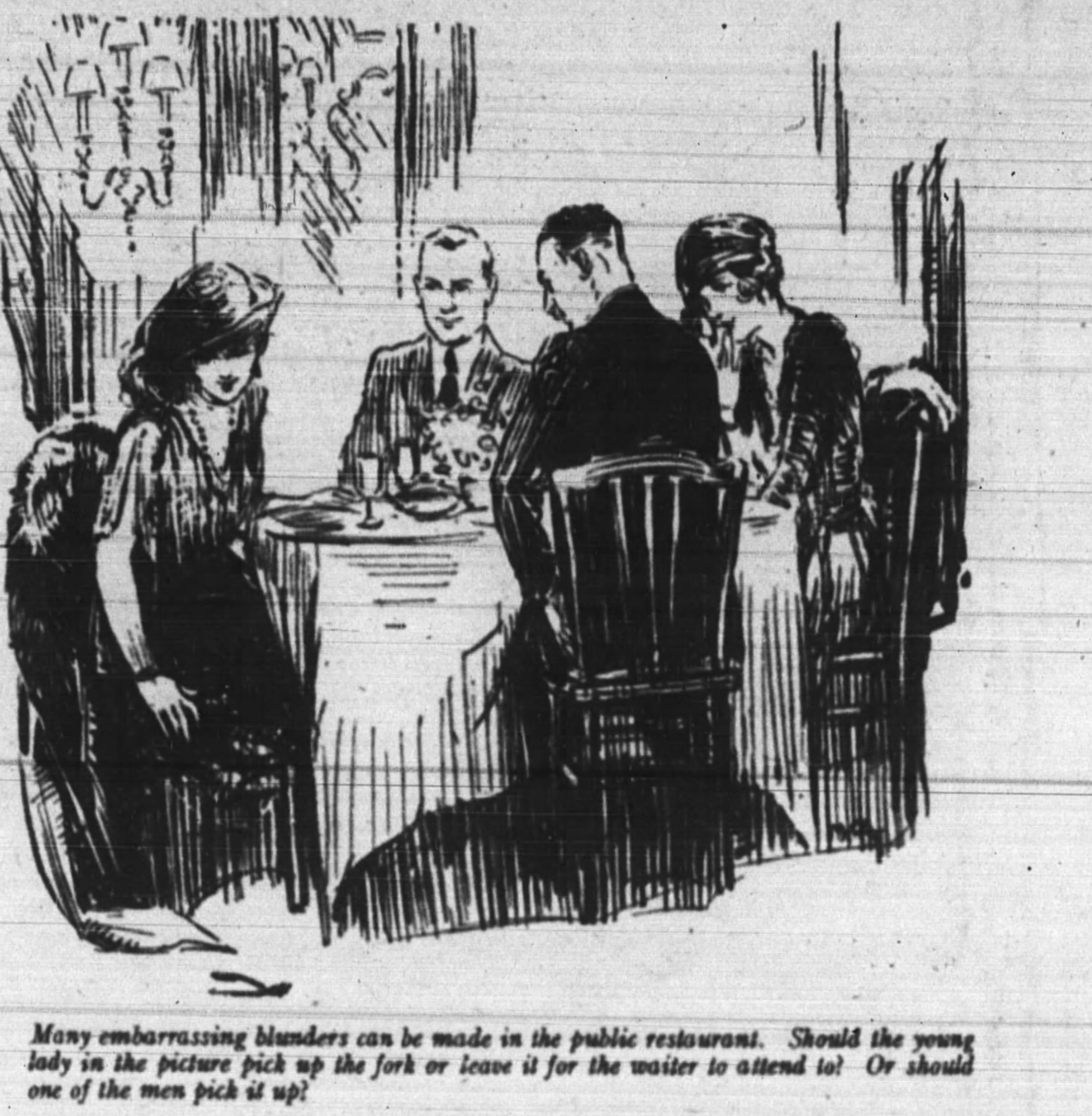
Did everybody in the 1920s have an etiquette book? They seem to have been everywhere. According to one promotion in the New York Times, you didn’t even have to pay! Just send the ad to Doubleday and receive a free copy of “Etiquette Problems in Pictures,” a book showing “mistakes that are constantly being made in public, in the dining-room, on the dance floor, at the theater.” Think you’re too good for an etiquette guide? Well, they’ve included a quiz to see just how much you know. See how many you can answer:

Via the New York Times

Via the New York Times

  • When a man and a woman enter the theatre together, who walks first down the aisle?
  • When the usher points out the seats, does the man enter first or the woman?
  • Should the knife be held in the left hand or the right?
  • Should olives be eaten with the finger or with a fork?
  • How is lettuce eaten?
  • What is the correct and cultured way to eat corn on the cob?
  • Are the finger-tips of both hands placed in the finger bowl at once, or just one at a time?
  • When a man walks in the street with two women, does he walk between them or next to the curb?
  • Who enters the streetcar first, the man or the woman?
  • When does a man tip his hat?
  • On what occasion is it considered bad form for him to pay a woman’s fare?
  • May a man on any occasion hold a woman’s arm when they are walking together?

I think I know the answer to one of these! Man, I would not have survived society in the 1920s.

Thank Goodness, Wait, Worrying About Reputation Is Still A Woman’s Responsibility

Joan-Jett-4The more I read old etiquette books, the more I realize just how much was in the wheelhouse of etiquette. I never thought that “leaning awkwardly when sitting” was a matter of manners, but at its broadest, etiquette is just about how to live your life as nicely as you can. In a lot of ways that’s good, but of course, we are all products of our time, and etiquette rules are always heavily influenced by prejudice and respectability politics.

Take this chapter in No Nice Girl Swears, called “You’re The First Man I Ever Kissed.” It’s a cheekily-written guide for women on how to flirt, date and socialize with men while maintaining one’s reputation. Author Alice Leone-Moats at least recognizes that “petting” is a pretty natural part of human interaction, and that doing it well is a matter of what you can get away with. Still, the fact is that it’s something you have to “get away with.” “Anyone will admit that in the long run a reputation for being a heavy necker doesn’t really add to a girl’s popularity,” she writes, striking a clear difference between giving into romance and “petting for petting’s sake.” Of course, a man’s reputation is never sullied no matter how much he pets or for whose sake.

The etiquette rules here become a woman’s line to walk, finding a way to “keep a man on the string and yet never let him get an opportunity to make a direct pass.” She goes on to explain how to defer a physical pass in the back of a taxi, to rarely dine with married men (even if you have the wife’s permission), and to always act like it’s your first time in a man’s apartment, no matter how many times you’ve been there. Which seems like it would inspire more awkwardness than anything. “Ooh what a lovely home!” “Janet you’ve been here at least a dozen times before.” “HOW YOU JEST, DEAR BOY, MY WHAT A FETCHING RUG.” But it is the woman’s job to ensure nothing bad happens. She is the enforcer of boundaries. A “no” must be pressed rather than a “yes” offered, and if something does happen it’s on the woman. She either should have fought harder or not gotten herself into that situation in the first place. And if this sounds familiar, well, not much has changed.

There’s a wistfulness to the chapter, as if Leone-Moats wishes she didn’t have to write it. “Of course it seems all wrong that in this world appearances count for more than actions, but it has always been so and we can do nothing but accept it.” It’s the ultimate double standard–consent to making out in the back of a cab and your reputation is ruined, don’t consent and you get taken advantage of, and your reputation is still ruined. Better to hold in your desires for the sake of propriety than not and subject yourself to judgment and, possibly, violence. It’s a decision no woman should have to make, and certainly should not be a matter of etiquette. Unfortunately, it’s still a matter of survival.

Regional Wedding Traditions: Cake Pulls

Cake pulls or charms is a tradition that is found in the South, most prevalently around New Orleans. The idea is simple- after the cake is baked, a number of “charms” are inserted into the cake, leaving an attached ribbon trailing out. At the wedding reception, the bride gathers her bridesmaids or other special friends around the cake and each takes a ribbon and pulls out the charm. Each charm has a meaning that will predict that woman’s future. Sometimes if a bride wants a particular person to pull a specific charm, it will be marked in some way. Often, the bride will give her bridesmaids charm bracelets as their “bridesmaid gift” so they can put the charm on the bracelet.

Some examples of charms and their meanings:

  • Baby bottle/high chair: next to have a baby
  • Four leaf clover/horseshoe: good luck
  • Airplane/Eiffel Tower: future travel
  • Heart: love
  • Rocking Chair: long life
  • Thimble/button: Spinsterhood (!!!!!)
  • Ring/bells: next to get married
  • Butterfly: eternal beauty

This can be a really fun and beautiful tradition, but of course has some pitfalls:

  • Do not under any circumstances give someone a charm that says they will be an old maid, WTF, that’s just mean.
  • Try to be sensitive about other problems- like a baby charm to someone who is infertile or is staunchly child-free
  • Leaving people out- try to stick to only bridesmaids lest you hurt someone’s feelings who feels like she is a close enough friend that she should be up there (unless you can get ALL your girlfriends involved- that’s great too!)
  • Make sure they are all out before the cake is served so no one chokes on one!

The Case For Formal Titles?

44099I just started reading a fantastic book called No Nice Girl Swears. It was written in 1933 as a modern etiquette guide for young ladies, by a fabulous debutante Alice-Leone Moats, who managed to trick George Putnam into having her ghostwrite her own book. It’s a crazy story, and you should pick it up, but in the 1983 reprint, Moats walks through a few of the changes that had taken place over the last fifty years. She recognizes some parts sound “positively archaic,” but that others stand as good guidelines.

One thing she does stand by, though, are formal modes of address, “principally because the instant use of Christian names does away with the shadings so important in relationships. It is a leap into intimacy which I would often prefer not to make: I don’t lead a sheltered life and I meet many characters with whom I don’t care to be on terms of intimacy.”

We have spoken before about the issues surrounding formal modes of address, specifically gendered salutations. But it’s true, most people introduce themselves by their first or full names, and do not insist on being called Ms. Lastname by all but close friends and family. I would probably feel incredibly uncomfortable if I introduced myself as Jaya and someone continued to call me Ms. Saxena. However, I’m starting to see what Moats is getting at here.

Have you ever had an experience where someone thought they were closer friends with you than they were? Or you thought someone was a close friend and they weren’t? It’s a really easy thing to happen. For me, it usually is because we have lots of mutual friends, and we see each other at parties and are friendly and chatty with each other, and then suddenly one of us is calling the other to make plans when the other really didn’t see the relationship that way. Of course, meeting through mutual friends and slowly hanging out otherwise is how lots of great friendships happen, but only when both people are into that friendship.

Anyway, there are lots of reasons why this happens, but what Moats argues here is that the form of address helps reflect the level of intimacy. If I’m at a party and someone I’m very fond of asks “may I call you Jaya?” or if I ask her to call me Jaya and she agrees, there is the mutual understanding that this is a closer relationship. However, if I ask her to call me Jaya and she continues with “Ms. Saxena,” I understand that she prefers to keep our relationship cordial but at a distance.

I spoke to my husband about this the other night, and how I think the concept of having these removed relationships is a great idea, and he disagreed, saying that it just comes off as passive aggressive. I wouldn’t call it that, but yes, it is an indirect way to make your point clear. And really, that’s what a lot of etiquette is: a way to make things explicit without the awkwardness that it could entail. Most people do not want to have long, protracted conversations about the state of all of their relationships. Maybe we should, but we don’t. I don’t want to tell every friendly acquaintance exactly where in my hierarchy of friends they stand, I just want it to be understood that not everyone is the closest person to me.

This is making me sound like an unfriendly hag. I love friends! I love turning new friends into better friends into the best friends. But I do think there is a cultural assumption now that everyone has to be friends, and I wish we’d get away from that. There are people I see in larger social circles that I absolutely get along with, with whom I have engaging and fun conversations, who I don’t consider friends. That’s okay! That’s a fine sort of relationship to have. There are many other ways to put up boundaries in a relationship without having an explicit “I see you’re trying to be friends with me so let me stop you and just make this awkward for everyone” conversation. You can decline invitations, or not extend them. You can not initiate conversation, or not seek them out at any social gathering.

At this point, formal address conventions are not coming back. Even my bosses insist I call them by their first names. Plus, I’m sure this worked much better in theory than in practice even when it was more common–it’s not like awkward interactions only started when we dropped honorifics. But what are your thoughts? Is there something else we could do to make this clear? Should we just have really weird, direct conversations about this?