The Care and Keeping of Wedding Attendants

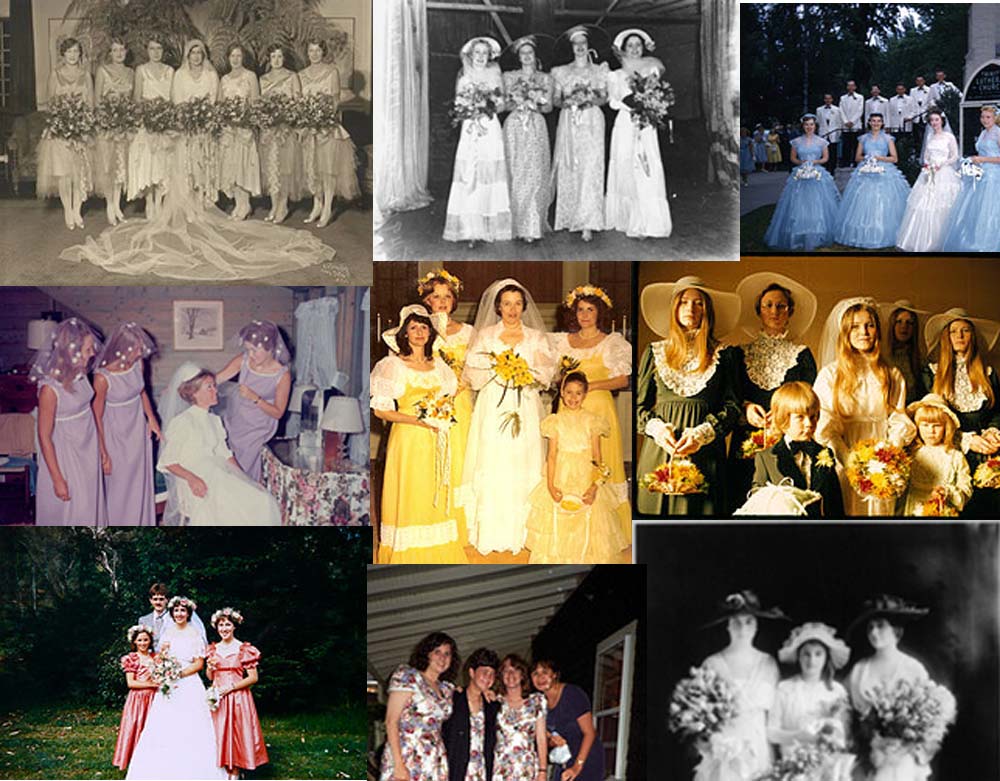
While I appreciate the trend for tasteful bridesmaids dresses, the world seems less rich without dresses like this.

While I appreciate the trend for tasteful bridesmaids dresses, the world seems less rich without dresses like these.

Etiquette has nothing to say about how many wedding attendants you have, whether they are the same gender of the half of the couple they are standing up for, what you ask them to wear, all of that is optional and completely up to you, no judgments.

However, if you do have attendants, here are some things to keep in mind.

  • The only job of an attendant is to wear what you tell them to wear and stand up with you during your ceremony. While showers, bachelor/ette parties are duties that are traditionally and frequently arranged by the wedding party, they are absolutely not required and you can’t throw a fit if your attendants choose not to do so for whatever reason.
  • In the US, you can ask that the wedding party cover the cost of their attire/hair/make up even if you are picking it out. But you should be upfront about the potential cost and be understanding if someone needs to drop out because they can’t afford it.
  • Special gifts for the wedding party aren’t required, but they are very nice. A big thank you IS required.
  • Remember, these people are doing you a huge favor and you need to treat them respectfully throughout the whole process.
  • During the ceremony, you can have them perform certain duties such as holding the bouquet/rings and helping to arrange the dress before walking down and then back up the aisle.
  • Did you know that traditionally the groomsmen other than the Best Man were called Ushers and they would actually help usher guests to their seats before the ceremony?
  • While you can make your attendants wear pretty much anything you want, you should take their thoughts and feelings into consideration.
  • You can expect that you attendants show up on time and ready to go for the rehearsal and on the wedding day itself.

Now it is not unreasonable that you will want help and support from the people who are supposed to be your best friends and that you will want them to go above and beyond what etiquette requires of them. You just need to talk to them before they agree to be part of your wedding party and see what their expectations and abilities are and if they align with what you want and need. See this really excellent post about the management of a wedding party on Offbeat Bride for more ideas.

Olympics Etiquette

If you are like us, you have been glued to Olympics coverage this year, so we thought it would be fun to go over a little Olympics etiquette.

First, Olympians should practice good sportsmanship:

  • Win or lose with grace, don’t gloat or whine.
  • Play by the rules and don’t try to get away with sneakily trying to injure the other competitors.
  • Don’t heckle your opponents when they make a mistake.
  • Don’t argue with the ref or judges over everything, save it for when it’s important.
  • Always shake hands after.

Spectators should also practice good etiquette:

  • Win or lose with grace, don’t gloat or whine.
  • Keep the heckling and trash talk to a minimum, people around you didn’t pay Olympic prices to listen to your opinion.
  • Drink in moderation, no one likes to sit by the drunk buffoon.
  • Be mindful of your seat and the people around you, spaces are small and you need to try not to kick people or spill your snacks and drinks on them.

The Olympics are such a huge international event, it behooves everyone participating and spectating to remember that everyone has different customs and to try not to be offended if someone does something that is offensive in your country but is completely fine in theirs. For the London Games, VisitBritain actually compiled a list of various international etiquette rules to distribute to the service industry to help them serve the many international visitors, check out this great CNN article about it.

And of course, Olympians have been tweeting about the specific rules they are encountering in Sochi, such as this list of bathroom rules from Canadian snowboarder Sebastian Toutant:

Tell us about your favorite Olympians and events in the comments!

Thank Goodness We Don’t Have to Do That Anymore: Glove Etiquette

Jackie Kennedy is, of course, a perfect example of glove wearing. [via Wikimedia Commons]

When I talk about glove etiquette, I am not talking about your winter gloves and mittens. Those you can do whatever you want with, no one cares. But if you choose to wear old school day or evening gloves, you can look at this list and be thankful that these etiquette points are one less thing we have to think about these days.

Men remove their right glove to shake hands on the street, but leave them on when shaking hands at the opera or a ball. If it is too awkward to remove the glove to shake hands, the man must apologize for not removing his glove. Women do not remove their gloves to shake hands, except with the head of a church or a head of state.

Gentlemen only wear white gloves at the opera, a ball, or as an usher in a wedding. Part of the reason men wear gloves at a ball is to avoid putting their sweaty hands on a woman’s bare back (cause, gross) or damaging their gown with the sweatiness. Men can wear gray doeskin gloves on the street. Amy Vanderbilt advises that while going gloveless in winter may make a man feel hardier, it results in chapped hands (again, gross.)

Ladies wear gloves to formal dinners and take them off at the table- the gloves go on your lap and the napkin over the gloves. Women’s formal gloves are white kidskin (this means a very fine, thin, soft leather) and are the most luxurious thing because they must be thrown out as soon as they get dirty (which probably takes about 5 minutes.)

Women remove gloves during church to make it easier to handle the prayer books, and definitely removed them for communion. As with shaking hands, women keep gloves on during a receiving line (except, again, with heads of state and the like).

Stylewise, bracelets can be worn over gloves but rings cannot be. One very old etiquette book mentions that you should be fully dressed before leaving your house and pulling your gloves on in the street is the height of ill-breeding.

Brides who wear gloves either take the left one off before the ring is put on or they split the seam of the ring finger so the ring can slide on.

Sources: Etiquette by Emily Post and Amy Vanderbilt’s New Complete Book of Etiquette by Amy Vanderbilt

Wedding Invitations

Dare I say that this invitation seems more modern than what you would expect for a royal wedding? [Via Flickr user markhillary]

We’ve talked about what to do with a wedding invitation for a guest, so now we have the etiquette of actually sending out wedding invitations.

Save the Dates

Save the dates are a relatively recent invention— a pre-invitation of sorts. They should be sent out as soon as you finalize your date and rough location. These do not have to go out to everyone you think you are going to invite. They should mostly go out to the most important people and especially the ones that live furthest away and will need to make major travel plans. If you send someone a Save the Date, you MUST invite them to the wedding, no take backsies (with a few exceptions), thus you should be judicious about sending them to only the people you are sure you are going to invite, lest you wind up in a position where you invite 100 friends and then realize your parents had a list of 200 relatives and your venue only fits 150. I should note that Save the Dates are absolutely optional, but something that many couples find useful.

Invitations

The style of your invitation should match the style of your wedding. This helps guests have a hint of the style of dress to wear and what to expect. Never include information about gifts or registries, the invitation should be about your desire to have the guest attend your very important day, not about what towels you need. I do like a discreet wedding website URL on an invitation because then your invitation can be simple and elegant and your guests can get all the nitty gritty details online.

The great thing about wedding invitations these days is that the style can really represent your event any way you want. This is a far cry from back in the day when only engraved invitations on white, ivory, or cream paper (with no borders or other decorations!) were considered acceptable and all the old biddies would turn your invitation over so they could check for the slight tell-tale engraving indentation on the back. And don’t even get them started on mechanically-made embossing dies.

Invitation Wording

There are many ways to word an invitation. This is the very traditional formal version:

Mr. and Mrs. Gideon Humperdink

request the honour of your presence

at the marriage of their daughter

Geraldine

to

Mr. Dudley Winklesmith

on Saturday, the fifteenth of March

Two thousand and fourteen

at five o’clock

The Church of the Holy Rollers

New York City

and afterward at

“The Snobby Club”

Now this invitation is worded for the parents of the bride as the hosts and at a church wedding. If the wedding is not at a church, you would substitute “request the pleasure of your company” for the words “request the honour of your presence” (honour is always spelled with a u in formal wedding invitations and is only used for a church ceremony). Also, traditionally in Jewish weddings, you write “the marriage of their daughter Geraldine and Mr. Dudley Smith” (using “and” in place of “to”).  On a formal invitation, you can put RSVP in the lower left corner. Dress code does not belong on a formal invitation, except, Black Tie may be written in the lower left corner. (But please, do find a way to tell your guests what the dress code is.)

The modern formal invitation often acknowledges the joint hosting by the couple and/or their parents and often includes both sets of parents regardless of who is hosting. A modern formal invitation would look more like this:

Mr. and Mrs. Gideon Humperdink

and Mr. and Mrs. Irving Winklesmith

request the honour of your presence

at the marriage of

Miss Geraldine Humperdink

to

Mr. Dudley Winklesmith

on Saturday, the fifteenth of March

Two thousand and fourteen

at five o’clock

The Church of the Holy Rollers

New York City

and afterward at

“The Snobby Club”

If the couple is hosting on their own, the invitation would look more like this:

The pleasure of your company

is requested at the marriage of

Miss Geraldine Humperdink

to

Mr. Dudley Winklesmith

on Saturday, the fifteenth of March

Two thousand and fourteen

at five o’clock

 The Snobby Club

New York City

Of course, these days you are welcome to do almost anything with your invitations! You should, however, include:

  • That it is, indeed, a wedding. (or a commitment ceremony or whatever, just some indication of what kind of event you are having).
  • Who is getting married (including the last names somewhere [in the examples above, Geraldine is used alone only following her parents names—if she had a different last name then them, she would be noted as Miss Geraldine Smith).
  • The date and the time (the time is traditionally listed as when the ceremony starts, but you might want to give ½ an hour or so buffer so everyone is definitely there before you start.) And don’t feel like you have to spell the date and time out, numerals are just fine.
  • The location.

Some informal invitation wordings that I like are:

Geraldine Marie Humperdink

and

Dudley Michael Winklesmith

request the pleasure of your company

at their marriage

etc

Together with their parents

Geraldine Marie Humperdink

and

Dudley Michael Winklesmith

request the pleasure of your company

at their marriage

etc

Please join

Geraldine Humperdink

and

Dudley Winklesmith

at the celebration of their marriage

etc

See many more great examples here.

Addressing Invitations

In the interest of space, please see this post on forms of address.

If you are using both an inner and outer envelope, you can use the formal address on the outer envelope and then just use first names on the inner envelope. The inner envelope is also a great space to include the names of kids you are inviting—parents only on the outer envelope and then everyone by first name on the inner.

Mailing Invitations

Invitations should be sent out 6-8 weeks ahead of time, especially these days with the abundance of Save the Dates, the actual invitation is really more of a formality.

Response Cards

Technically response cards are against etiquette because including them insultingly implies that the guest doesn’t know to RSVP correctly (which is technically with a handwritten response on their own stationery). However, nowadays, many people don’t know how to RSVP “correctly” so I think they are a useful tool. If you do use them, make sure to include a self addressed, stamped envelope. And for your own sanity, make sure to include a line asking for their name so you know who is responding! Email, phone, and wedding website RSVP instructions are all perfectly acceptable as well.

The Wedding Guest List

If you are a princess, everyone wants to come to your wedding. [Via Library of Congress]

As we are coming to the end of “engagement season” and Valentine’s Day, we probably have a lot of newly engaged readers who don’t know where to begin. While we can’t help you pick out your napkin colors (trust us, we are too busy picking out Jaya’s napkin colors), we can help you throw A Perfectly Polite Wedding with our new series of posts on hosting a wedding.

When you begin to plan a wedding, the first two things you have to decide are your budget and your guest list because everything will come from there. The budget is up to you (but just let me say that you can have a beautifully polite wedding on $500 just as easily as you can have a $1 million wedding that is full of faux pas) but when it comes to your guest list there are a few things to remember.

Miss Manners’ advice about guest lists is to decide who you want to invite before you start looking at venues and getting limitations on the number of people you can include. Her opinion is that the day should be more about sharing a special time with the people you love rather than having the perfect venue that can’t hold all the people you love. This is pretty subjective of course. [Ed Note: We decided that we couldn’t handle being at the center of more than 150 people without a lot of social anxiety triggering, so we looked at venues with that limit, which gave us room to invite everyone we really cared about without there being a guest list of 300 4th cousins and “family friends” we’d never met. -Jaya]

Sometimes though, the people you love have people they love and those partners also need to be included. People who are married, engaged, or living together (in a romantic sense) are considered social units and must be invited together. Sorry if you’ve never met your kindergarten best friend’s husband, you must still invite him. Many people also extend this to long term romantic partners who don’t live together.

Luckily, there is no obligation to invite single people with an “and guest” or “plus one.” If you do know that a friend might want to bring some “special” that you don’t really know, you should ask them for the name and address the invitation to your friend and that person by name rather than just as a plus one. This way you also prevent a rude situation where a guest brings a plus one who you didn’t want at the wedding.

Invitations for people you know won’t be able to attend are a kind gesture for people whom you are very close to. However, be cautious about sending them to people who aren’t very close friends or family as wedding invitations often make people feel obligated to send a gift and sending them out willy nilly to far away people can seem greedy.

I used to be very against A lists and B lists, because duh, no one wants to be on the B list and it can be very hurtful if they find out they are. But I encountered a situation where a couple was having a wedding and in their long planning process had made some new friends that they weren’t able to invite as everything had already been set. However, a couple days before the wedding, they heard that a few guests weren’t able to make it, so they called up some of their new friends and explained the situation and said that they would love it if they would be able to come on such short notice. The friends were thrilled and came and had a great time. The moral of the story being that it can work, but it deserves a very personal phone call.