
Wedding Ceremony Etiquette

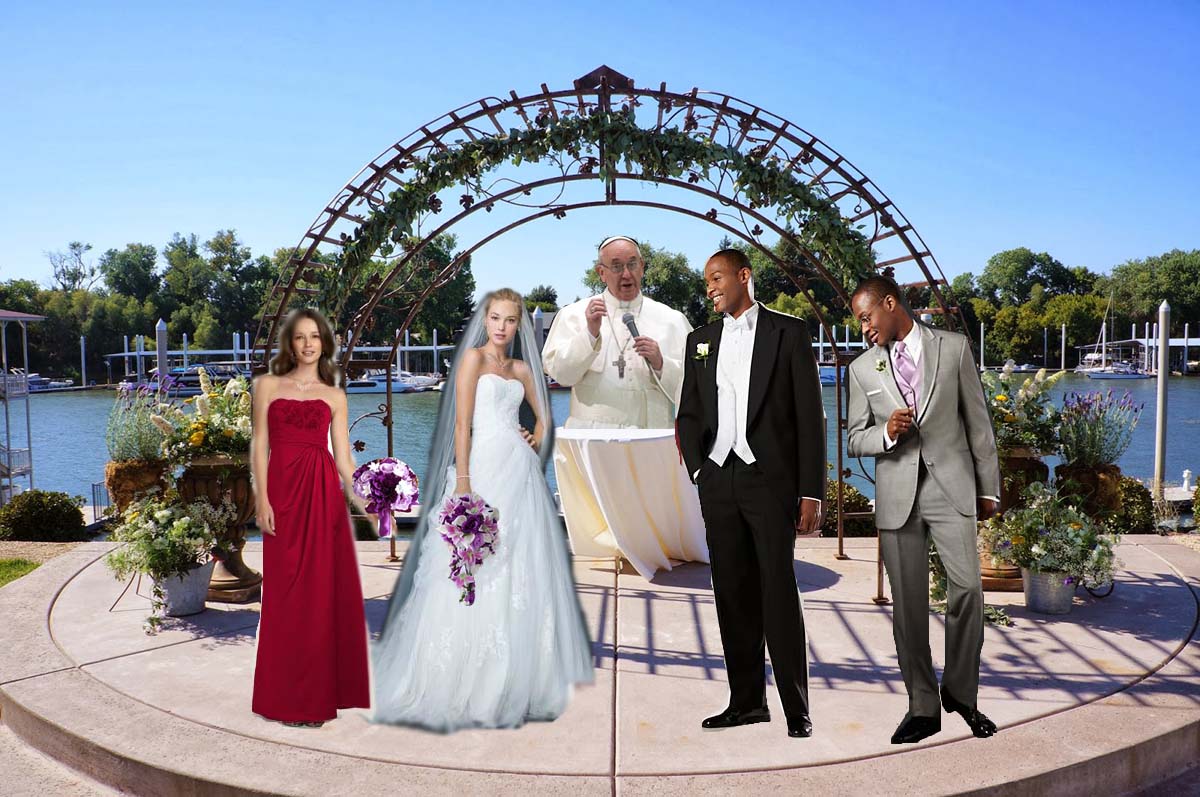
This is what the wedding ceremony set up would look like for a wedding made up of models and officiated by the Pope.

This is what the altar would look like for a wedding made up of models and officiated by the Pope.

For the most part, wedding ceremonies are so personal there isn’t really any official etiquette that will cover all of them. However, here are some traditions and guidelines:

If you are getting married at a religious site, check how much personalization you will be allowed to use. Many religious weddings don’t allow deviation from the ceremony or secular music, for example.

Traditionally in Christian ceremonies the bride’s parents and guests sit on the left of the “altar” and the groom’s family and guests are on the right. For Jewish ceremonies, it is the exact opposite, bride right, groom left.

You can rope off the first couple of rows for specific VIPs. If you use your groomsmen as ushers, they can make sure that the right people get these seats. Back in the olden days, you might receive a pew card with your invitation which would tell the usher which pew you were in. Or at the least, the usher would ask you “bride or groom?” and seat you on the correct side. It was expected that ushers would be able to recognize VIPs and seat them correctly.

Of course, nowadays, people can “choose a seat, not a side” and there is complete seating chaos! (Except not because, surely, grown up people can find a seat for a ceremony without too much hassle.)

In a traditional Christian ceremony, the groom, best man, and officiant would walk in first, from the side of the church and stand at the altar. Then all the ushers/groomsmen would walk down the aisle in pairs and join them. They would be followed by the bridesmaids, also in pairs. The Maid of Honor would follow them alone. She would be followed by the flower girl and/or ring bearer. Then finally the bride and her father would walk down. In Christian ceremonies, both sets of parents are seated in the first row on their respective sides. Sometimes the Mother of the Bride and the parents of the groom or other important VIPs are escorted to their seats by an usher after all the other guests are there but before the “real” processional starts.

In a traditional Jewish ceremony, the Rabbi would be at the front. The best man would walk down followed by the groom and both his parents. Then the maid of honor followed by the flower girl. Finally, the bride and both her parents. In traditional Jewish ceremonies, both sets of parents stand under the Chuppah with the bride, groom, and rabbi.

During the ceremony, the bridesmaids would line up on the side near the bride and the groomsmen would line up on the side near the groom. Bride on the left, groom on the right for Christian ceremonies and the opposite for Jewish ceremonies (just like where the guests sit!)

For both Christian and Jewish ceremonies, in the recessional, the bride and groom would go first, followed by the bridesmaids/groomsmen who are now paired off.

I am including the traditional formats for processionals and recessionals for informational purposes, but to be honest, I’ve never seen any wedding follow those traditions exactly and you can do whatever works for you. And apologies for the Judeo-Christian norms, but that’s all old etiquette books include!

It is ideal to have seats for all of your guests unless the ceremony is VERY short.

Typically, everyone will stand when the bride appears at the top of the aisle. It is a good idea to have your officiant to invite people to sit once everyone is at the “altar” otherwise, everyone might end up standing the whole time, which is no fun for anyone. The whole standing for the bride thing makes some couples uncomfortable, and you can certainly put notices in your programs, or make announcements or whatever you choose, but it’s so engrained that people might do it anyway.

It’s a new thing, but requests that guests don’t take pictures during the ceremony are perfectly fine.

Everyone gets hung up on the idea of the bride’s father walking her down the aisle. Even Miss Manners has always said that the bride should choose whoever she wishes to walk her down the aisle, whether it be a father or stepfather or whoever. If she doesn’t have a father, her mother is the ideal option, no need to find a male relative to walk her. Of course, you also can walk down by yourself or with your partner if you wish.

I have never really heard of anyone actually doing the whole rice throwing deal, and at the weddings I have been to, it wouldn’t have worked logistically, but if you want to do it, the traditional time is as you leave the church. Basically, the newly wedded couple gets back up the aisle and hides somewhere for a few minutes while all the guests are assembled outside in two lines near the door. Then when all are ready and have rice in hand, the bride and groom come running out and are pelted with rice before jumping in a car to take them to the reception. You can see where the logistics fall apart if your reception is in the same place as the ceremony, and your ceremony isn’t in a church-like building, and you don’t have anywhere to hide while the guests get ready. Not to mention the mess (check with your ceremony site if you plan to do this!) No wonder I’ve never seen this happen before. Luckily, the myth that the rice is harmful to birds is not true! (NOTE: after doing some further research after originally writing this piece, I found that people have their guests throw things at them as the walk back up the aisle- still some possible logistical problems, but a good compromise nonetheless.)

Ultimately, as long as your guests are reasonably comfortable, the ceremony is the one part of your wedding day that is literally all about you and you can do pretty much whatever you want. So use traditional vows or write your own, do some kind of unity ceremony if that floats your boat (sorry, but blech), anything goes! Just try to avoid cultural appropriation!

Leprechaun and Other Wee Folk Etiquette

Happy St. Patrick’s Day! Or lá fhéile Pádraig sona dhaoibh if you speak Gaelic, which I do not.

When you think of St. Patrick’s Day, you often think of how crazy it was that your kindergarten teacher made you create leprechaun traps out of construction paper that magically had chocolate coins in them the next morning. In Ireland, they traditional take leprechauns and the other wee folk a bit more seriously.

If you are walking along and hear a gentle tapping, there might just be a leprechaun nearby cobbling some shoes. It is perfectly approved by etiquette to try to catch a leprechaun if you can, but once you catch him, there are three important things to remember:

  1. Always look a leprechaun in the eye, it is polite and it forces him to tell you the truth about where his gold is.
  2. Never take your eyes off of him: leprechauns are extremely fast and if you look away for one second, he will escape.
  3. Don’t be too greedy: if you catch a leprechaun, you can ask for a pot of gold, but just the one.

If you live in a place where there are elves and fairies and such, it is polite to leave some bread and milk outside for them each night.

It is also impolite to build your house on a fairy path- if you do, your whole family will get sick.

For real though, it’s not okay to pinch someone, even if they DO forget to wear green on St. Patrick’s Day. The holiday is no excuse for being drunk and obnoxious in public either, so cut it out and have a happy and safe day!

Victoria Pratt was a competitive Irish dancer back in the day and will dance a reel for you if you ask nicely.

Thank Goodness We Don’t Have to Do That Anymore: Paying Calls

Not this kind of call. [Via FreeDigitalPhotos.net]

Not this kind of call. [Via FreeDigitalPhotos.net]

Jaya has already written a really great post about calling card etiquette that you should check out. But calling cards are only a small part of a larger social nightmare that was referred to as “paying calls.”

Paying calls as a formal social requirement was most popular in the Victorian Period (of COURSE) but was dying out when Emily Post wrote Etiquette in the 1920s. Oddly, my 1967 copy of Amy Vanderbilt still has a chapter on it, though she acknowledges that the practice died out after WWI.

The first thing you need to know is that calls were called morning calls even though they took place in the afternoon. This comes from an earlier practice where any time before dinner time was called morning.

The other thing to know is that paying calls was basically a full time job for society ladies. They would go around almost every day to their friends and acquaintances to keep up with what was going on with everyone and making sure your family was still in good standing. Basically, social networking before the internet. This was such serious business that women would keep ledger books of who they regularly called on, if those calls had been returned, and if they owed anyone a call. Then they would whip out these “calling lists” when it was time to host a party and boom, there is your invitation list.

Fortunately, you didn’t always have to actually talk to all of your friends. You could often just drive around to their houses and leave your card, thus getting your obligation out of the way (and your friends would keep everyone’s cards on a tray in their front hall so everyone could see how important they were!). This was especially important when you came to town after being away (or being at your country estate for a while). You would drive around and leave a card at the house of everyone in your social circle. That way they would know that you were around and they could invite you to parties and other social events. Then when you left town, you would do the exact same circle of friends and acquaintances, but this time you would write P.P.C. in small letters in a corner of your card. This is an abbreviation for pour prendre congé which, for those of you who have forgotten your high school French, means “to take leave” and would signal to everyone that you were leaving.

Aside from paying calls when you arrive in town, when you depart, and just the regular round, there were several situations that REQUIRED a call to be paid. Anytime you were invited to a ball or a dinner or any other kind of social function (whether you actually attended or not), you had to pay a call on the hostess within a week or so of the event. You also had to pay calls when a friend got engaged or when someone died. Men didn’t have to do the regular call paying, but they did have to pay calls after receiving invitations or attending parties. Anyone who didn’t pay these required calls would find themselves never invited to one of that hostess’s events again, so!

Interestingly, men also had a large number of calls to make after he got married. It was assumed that all the friendships of his bachelor days automatically ended when he got married. By paying a call on any or all of them after the wedding, it said that he found them respectable and wanted to remain friends.

When you actually wanted to see someone during a call and not just leave your card, there were additional rules to follow (of course!). You would enter the house and ask the butler or other servant if the lady of the house was at home. If she was out or busy, the butler would tell you straight away that she was “not at home” and you would leave your card and depart (however, if she heard your voice and wanted to see you, she might come out and say “I am at home to YOU, my friend!”). Some women would screen their callers by looking out the window and signaling to the butler whether they wanted to see them or not, but once the butler had taken the card and brought it to the lady of the house, she basically had to see the person. There was no pretending you weren’t home once your servants had acknowledged that you were.

So once you were in, you were brought into the drawing room, which is where guests were received. You would keep your hat on to signal that you weren’t staying long (men removed their hats but kept them in their hands). Conversation during calls was polite and mild. You would stay about 15 minutes and then you would leave. Refreshments were rarely served, but if they were, it was rude for a hostess to insist that her guests take something, as it was possible that they had had tea and cakes at the 6 houses they had previously called on and could not eat anymore.

A particular tradition around paying calls that was definitely common in New York City and likely in other places too, was the New Year’s Day call. This was a very regimented form of calling where all the women of the family would be at home all day with a spread of nice foods and all the men would go out and pay in person calls at the homes of practically everyone they knew. Since the men would be paying possibly 50-100 calls in the day, they would get started by 9 or 10 am, which meant that the women would have to be up, hair done, and in place in the parlor or drawing room by that time (so they would have to wake up by 5 or 6 am, or possibly earlier if their hairdresser was booked!). Then there would be a steady stream of men coming by all day long for just a few minutes at a time. A completely exhausting time for everyone. The practice died out when fashionable neighborhoods in Manhattan spread out and it wasn’t possible to visit all your friends in one day anymore.

Sources:

What Jane Austen Ate and Charles Dickens Knew: From Fox Hunting to Whist-the Facts of Daily Life in Nineteenth-Century England by Daniel Pool

Etiquette by Emily Post

The Gentleman’s Book of Etiquette and Manual of Politeness by Cecil B. Hartley

“New-Year’s Calls,” Harper’s Bazar Magazine January 1, 1870

Complete Etiquette by Marion Harland

Showers, Bachelor/ette Parties, and Rehearsal Dinners, oh my!

All your pre-wedding parties will be in beautiful soft focus. [Via Flickr user tmarsee530]

Despite weddings already being a huge big party that is going to stress you out for a year or more, people like to have other, smaller parties around weddings. Fun! As a soon-to-be-married person, you might have some expectations about these parties from things you have seen from wedding shows and movies. These expectations might be wrong, but we are here to help! You also might find yourself wanting to avoid these parties, in which case see this previous post about how to handle avoiding having a shower.

Showers

  • Showers shouldn’t be thrown by family members or (especially) the couple! However, family members can throw family-only showers. In this instance family members mean your mother, your significant other’s mother, your sibling, or your grandparents. It is okay for aunts/uncles/cousins. The reason for this is that a shower is defined by being all about showering the bride (or couple) with presents. Since, traditionally, the bride’s family was responsible for setting her up with her trousseau, her family requesting presents from other people for her was essentially like asking for presents for themselves to help defray the cost of setting up her home. Though this isn’t really true anymore, family thrown showers still have a tone of “greediness.” However, in many social circles it is completely fine and normal, so just be sure to check.
  • A shower shouldn’t be something that the bride requests or expects but once it is offered, the bride should be the one to provide the guest list and have final veto of activities. (Or veto of the event altogether.)
  • Shower invitations can include registry information as the whole purpose of the party is to give presents
  • You need to write thank you notes for all gifts given at the shower- make sure someone is writing down what came from who (it is not a cute shower game to have guests self address envelopes for their thank you notes, however.)
  • If you have multiple showers, the guests lists shouldn’t overlap (except, parents/siblings and wedding party), but if they do, guests are only expected to bring gifts to ONE shower. A kind bride will acknowledge that duplicate guests gave a gift at a previous party.
  • Often, someone will collect the ribbons from the gifts and create a “bouquet” for the bride to carry at the rehearsal.

Bachelor/ette Parties

  • Bachelor/ette parties are not gift giving occasions. Though some groups will decide to work a lingerie shower into the festivities (but this should not occur if the same group is already throwing a regular shower).
  • Bachelor/ette parties are optional and you must wait until someone offers to throw one. You can’t just assign it to the maid of honor/best man. However, you do get to have input and final say on the activities of the party.
  • You can throw your own bachelor/ette party if you are truly hosting ie paying for everything, such as having a “slumber party” at your house or something. If you expect everyone else to go out to something you plan and cover your dinner, drinks, strippers, whatever, you shouldn’t be the one planning it.

The Rehearsal

  • The rehearsal is important if you have a long or complicated ceremony. Most people opt to have one just so everyone will know where to stand and when. There are a lot of different arrangements of who walks down the aisle in which order and who stands where, so you don’t want to assume that you are all on the same page.
  • Everyone participating in the ceremony should be present at the rehearsal so they all know where to go and when during the ceremony.
  • Superstitious brides don’t participate in the rehearsal but watch from the side with a stand-in walking down the aisle.

Rehearsal Dinner

  • Rehearsal dinners are not a requirement, though they are a nice way to gather with your most important people and thank them for showing up for the rehearsal.
  • Traditionally (except this tradition really only goes back to the 1940s/50s), since the bride’s family was hosting and paying for the wedding, the groom’s family would pay for the rehearsal dinner. Now, you will have to all decide together who is going to pay for it.
  • Typically, you invite both sets of parents, the whole wedding party and their significant others (if applicable), any readers, and the officiant. Many people like to invite out of town guests and close relatives as well.
  • You want to make sure to actually invite your guests to this event, either with a formal paper invitation, evite, or a simple email or phone call. These invitations should be sent fairly soon after the wedding invitation
  • You don’t have to have a fancy sit down dinner; a pizza party or backyard barbeque sound like awesome rehearsal dinners!
  • It doesn’t even have to be a dinner, but can be a brunch or lunch immediately following the rehearsal.
  • People often give spontaneous toasts at the rehearsal, this is perfectly fine.
  • Many couples give gifts to their attendants during this time.

All parties

You can’t invite people to wedding parties who aren’t invited to the wedding itself. An exception would be a shower that your co-workers or other specific group (such as a sports team) throw you.

Thank Goodness We Don’t Have to Do That Anymore: Spinster Etiquette

This subject is very near to my heart, as in doing research on spinsters, I discovered that I have been a spinster for years now and didn’t even know it! So I am very grateful that I no longer have to follow any of these stupid rules.

Spinster is a word that means “one who spins,” like, spins wool for thread because what else could you possibly do if you aren’t married. Interestingly, it was a legal term for any unmarried woman until the early 1900s and you sometimes see it as a designation on marriage documents. From the early 1700s, it’s common use was a woman who was unmarried beyond the normal age for it.

Spinsters created a great problem in etiquette for a long time, because in many ways, they had to be treated like a young girl.

Edith Ordway’s Etiquette of To-day from 1918 instructs spinsters:

Even the spinster of recognized professional standing finds herself somewhat restricted in social pleasures. She cannot go out socially with one man more than occasionally; she has little pleasure in going unattended; she can entertain but infrequently and in a small way, if at all, and never without an older married woman to assist her. She may, however, have her regular afternoon or evening “At Home,” provided she has with her this friend; and with that friend present, she may entertain a gentleman caller until ten o’clock in the evening, but she may not offer him cigarettes, nor any beverage but tea, coffee, chocolate, or lemonade.


However, a 1901 etiquette book, by Annie Randall White Twentieth Century Etiquette gives “elderly girls” a bit more leeway:

When a lady passes the age of thirty and has not yet married she is entitled to a matron’s freedom. This is also in a measure true when one has reached the age of twenty five. She is now considered able to judge for herself and knows when to shun the temptations of the world. She however cannot do everything she might wish to without violating some rules of etiquette. In traveling she should either be accompanied by her father brother or a lady friend and should be especially particular regarding her dress. So many charming women are single from choice either because their sweetheart died young or because of the giving up of one’s life to become the matron of the father’s home that to them should be accorded all respect due to a married woman. Many of our bachelor girls live together and are the happiest people imaginable It takes a very superior woman to be an old maid.

It was actually not uncommon to glorify old maids- an editorial called “Honorable Often to Be an Old Maid” in Peterson’s Magazine argued that marrying a man you do not love in order to have a home, security, and to escape being an old maid was a perversion of the sacred institution of marriage.

Of course, that doesn’t mean that spinsters weren’t stigmatized. A 1932 issue of the Vassar Miscellany News quotes another article from The Forum in which the author Ellis J. Ballinger argues that women’s colleges are “booming spinsterhood, encouraging marriage failures.” He suggests appointing a national marriage bureau to make matches and recommends bringing in beauty, style, and etiquette experts to the colleges to teach those girls how to catch a man. In the end, he says, if after all this, a woman chose to be a spinster “I am sure that she would be a happier old maid than the kind we are turning out today.”

Another fun tradition for friends of spinsters was to throw an “Old Maid’s Party,” apparently a New England tradition in which on a woman’s 25th birthday, all of her friends would come over with tea and cakes and genealogy charts to find the old maid the perfect husband. They might even play the card game “old maid.” Charming.

Thankfully, these days, old maids can pretty much do whatever they want, except avoid questions about when they are planning on getting married.