How to Read Social Cues

This is not the way to behave.

So by now I hope everyone has had a chance to see this excellent street harassment video which shows how many catcalls and looks a woman gets walking around New York City for 10 hours. While there has been much *ahem* debate over whether these were catcalls or just guys “being polite” (um no this is not polite), an interesting thing that cropped up (in my mind) was the complaint by many men that “what, we aren’t ever allowed to talk to a women in public?!?!?!?!” Congratulations, but no, of course you can talk to women (and men and whoever) in public, but only as long as you get social cues that they are also interested in talking to YOU!

The thing about people is that your desire to talk to me does not trump my desire to NOT talk to you (or anyone else). And okay, I get it, maybe that girl who is running to catch the train is clearly your soulmate, but honestly, that is just too bad and you really need to let it go. So here is a nice handy, fun primer on how to read social cues to tell if someone is interested in talking to you (also most people do this intuitively, by what? age 15? It’s not that hard).

Signs Someone is Not Interested in Talking to You:

  • They are reading (caveat, if they keep looking up over their book and making eye contact with you and only you and smiling, etc).
  • Walking fast- clearly on their way somewhere in a hurry.
  • It’s the morning commute (personally I think morning subways should be absolute quiet zones, but I certainly do not want to chat)
  • Sunglasses on, earbuds in.
  • They are actively avoiding making eye contact with you.
  • If you do speak to them and they give one word answers or mmhmms.
  • They shake their head at you (okay this is more for sidewalk canvassers than people wanting to make small talk, but hey, it applies)
  • They are crying (being able to cry in public without anyone questioning it is a New Yorker’s right)

Signs Someone is Interested in Talking to You:

  • They keep trying to make eye contact with you.
  • They smile at you a lot.
  • You say something benign and friendly (see below) and they are pretty chatty in their answers.

Things You Can Say to A Stranger in Public:

  • The train hasn’t come for 15 minutes= “The G train, amirite?”
  • “Excuse me, you dropped this.”
  • “Does this train stop at Canal street?” (I actually had a great chat on a subway with a guy once where the conductor was saying the wrong station name and we were trying to reassure each other that we were in fact on the right train.)
  • Compliments…cautiously- if they really are wearing a stunning dress or whatever, then that’s probably okay? As long as they aren’t exhibiting any of the “seriously, do NOT talk to me signs.”
  • “Hi” “Hello” “Good Morning” BUT and this is seriously important, if you are the friendly type of person who likes to say hi to people, make sure you say it to a WIDE range of people and not JUST people you are attacted to, that makes it more predatory than friendly. Suffice to say, “heeeeeey baby” is not the same thing as a chipper “hi.” And again, don’t do it if it’s pretty clear they aren’t interested in human interaction at the moment.

Things You Cannot Say to A Stranger in Public:

  • Honestly, it’s too long to list.

It’s also really important, especially if you are a man talking to a woman to not use words or talk in a tone that you wouldn’t use to speak to a man.

And please, just be realistic. If you are a kind of average slumpy joe, and you really, really want to talk to that amazing supermodel looking girl who is a good 10 years younger than you, do you REALLY think she is going to be that interested in talking to you? I mean, sure, maybe, but statistically it’s just not that likely

Thank Goodness We Don’t Have to do that Anymore: Gift Giving

Rhett Butler shows he’s a cad by giving inappropriate gifts.

Obviously, people give each other gifts all the time, so this not truly “thank goodness we don’t have to do that anymore,” but there used to be a lot more RULES about these things that we don’t really have to follow anymore. These rules mainly pertain to gifts given by a man to an unmarried woman (because sexism! And maybe women weren’t really supposed to give gifts to men and this was so well known no one even had to write it down.)

Social Life (1896) by Maud Cook gives these rules about gifts to an unmarried woman:

  • The only acceptable gifts for a gentleman to give a lady are flowers, fruits, and candy (despite how expensive these items can be made to be). Since these are perishable items, they leave no obligation upon the lady.
  • However, if the lady and gentleman have been talking about a book or musical composition that she does not possess, he may offer to send her a copy and she may accept.
  • If inappropriate gifts are given, the lady may say “I thank you for the kindness but I never take expensive presents;” or, “Mamma never permits me to accept expensive presents.” Or her mother might discover the gift and send it back saying “I think my daughter rather young to accept such expensive gifts.”
  • After an engagement, the rules would slacken, but real, expensive, useful gifts were supposed to saved until after the wedding.

In the 1920 Etiquette, Emily Post gives a list of rules that an engaged couple must follow about gifts:

  • If the man is saving money so that they may get married, he shouldn’t waste his money sending flowers and other little gifts.
  • A woman may accept all presents except: wearing apparel, a car, a house, or furniture.
  • Basically, a man should not provide his future wife with any real useful objects until after they are married and it becomes his duty to take care of her. For example, a fur scarf would be a fine gift as it is a mere ornament, but a fur coat would not be because it is a useful piece of clothing.
  • If an engagement is broken, all gifts must be returned.

My 1954 copy of Etiquette For Young Moderns is unusual in that it has rules for the girl giving gifts to the boy:

  • For both genders, it is suggested that gifts not be too expensive or too personal.
  • Girls should be especially careful not to give a gift more expensive that what he is giving her AND she shouldn’t give the gift first.

In Sex and the Single Girl (1962), Helen Gurley Brown says: “Don’t give expensive presents to men. Madness!” And also highly encourages women to get expensive presents from men. She also thinks it’s fine to be someone’s mistress, so take all advice with a grain of salt.

In my 1967 copy of Amy Vanderbilt’s etiquette book her rules for unengaged people very strict:

  • A man’s gift to any girl (other than a relative) must be impersonal until an engagement is announced. The idea is to not imply intimacy or be so expensive that people talk about the girl.
  • Acceptable gifts: scarf, gloves, handkerchiefs, small things for the house such as a cocktail shaker or toaster (if she lives alone). Unacceptable gifts: dress, hat, underthings, stockings, or fur. Books are fine, but not a particularly expensive book or set of books.
  • A man who visits a woman’s home frequently might restock her liquor cabinet but would never insult her by trying to pay the grocery bill or anything.
  • If a girl receives an inappropriate gift she should return it to the giver and tell him “I know you didn’t realize it, but I couldn’t possibly accept such a gift from you, much as I appreciate your kindness in wanting to give it to me. A little present would be better.”
  • “To do anything that puts a girl in untenable position is to be less than a gentleman”


Death Becomes Her: Etiquette in the Museum!

IMG_0786It is only rarely that museums have exhibitions that directly reflect etiquette, so I was very excited to see the Metropolitan Museum of Art’s Death Becomes Her: A Century of Mourning Attire, the first fall show of the newly renamed Anna Wintour Costume Institute. We’ve discussed Victorian Mourning etiquette before, but it’s a subject worth revisiting in the context of this amazing exhibition (if you are in NYC, go see it before it closes February 1.)

This particular exhibition covers roughly the years 1815-1915 which spans the growth, peak, and decline of intense mourning clothing traditions in the United States (and a little bit of England). During this period, as the wall text reads: “With the growing circulation of women’s periodicals and advice manuals, along with technical advances that shaped the textile industry and fashion retail, modes of mourning that had been the preserve of the elite were made available to the burgeoning middle class.” With the end of World War I in 1918, formal mourning requirements drop off drastically. Interestingly, the massive casualties of the Civil War led almost to a peak of strict mourning rules whereas the even greater casualties of WWI made death so common and for such a “cause” that public mourning- the wearing of black and so forth was actually discouraged (especially in England). This led to the more current custom of only really wearing “mourning” clothes at the actual funeral services, if even then. The excellent review of the exhibition in the Wall Street Journal points out that the last public hurrah of this kind of “veiled widow” style of mourning was during the political assassinations of the 1960s.

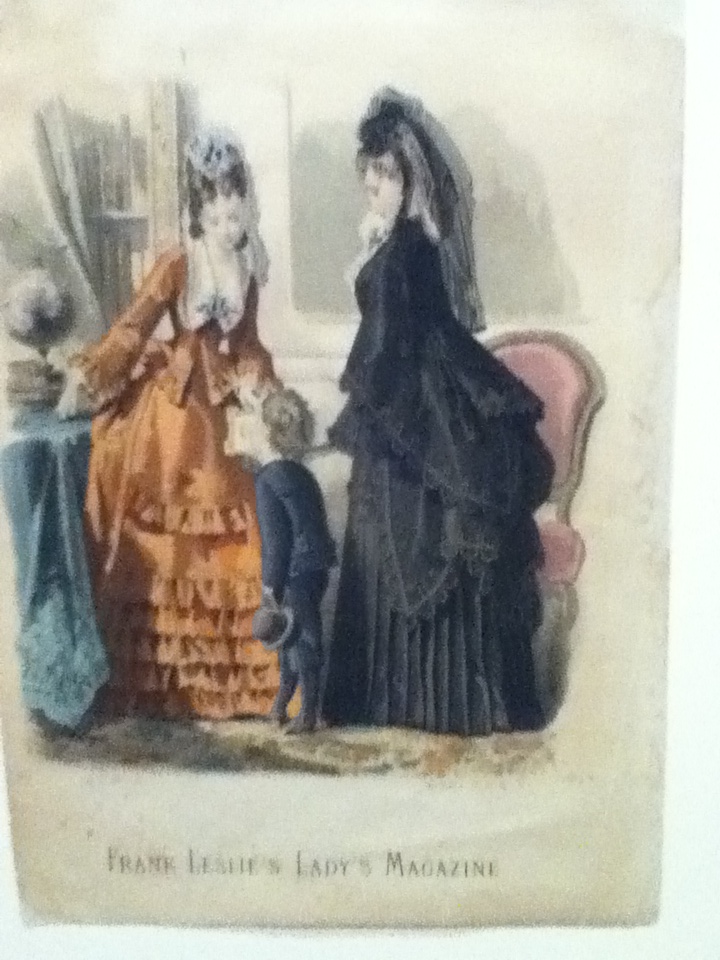
What I really loved about this exhibition was how clearly they linked the etiquette requirements of doing certain things during mourning: first wearing very matte black fabrics with little ornamentations, then getting shinier fabrics, and then introducing whites/greys/purples- and how women still fashioned their mourning attire after the most current styles of the day. There was a whole display of fashion plates which illustrated this, even down to two separate plates showing the same dress- one in “mourning” and one “regular”.

IMG_0761

Sorry for my blurry photos!!

The fashionableness of mourning clothes was quite important to these women, not only because hey, everyone likes to be fashionable, but because a young widow also probably wanted to get remarried as soon as her proscribed two years of mourning were over. There was a great series of illustrations by Charles Dana Gibson (of Gibson Girl fame) satirically illustrating the life cycle of a widow where she is first an object of sympathy, but then as she tries to rejoin society becomes an object of men’s leers and women’s derision. This particular widow ends up joining a convent but not being able to escape the gaze of the priest.

IMG_0767

There is quite a lot of focus on “the widow” as a specific form of female loveliness and object of desire. Some passages from books and etiquette manuals flash on the wall and this one in particular caught my attention: “Black is becoming; and young widows, fair, plump, and smiling, with their roguish eyes sparkling under their black veils are very seducing,”  from The Illustrated Manners Book by Robert De Valcourt 1855.

As with most fashion exhibitions, the show focused mostly on women’s clothing, and there are plennnnnty of beautiful gowns to drool over. Happily, there were a few men’s things as well, with a great text explaining that since men’s clothing during the period was already so somber, there wasn’t much they could do to show that they were mourning in the way women could. Instead, they would do things like wear a black band on their hat, or use black accessories such as cufflinks, gloves, and ties. Of course, men were a lot less likely to be commented on if they didn’t wear mourning properly so they also didn’t have the social pressure to conform in the same way women did.

The smaller gallery, including the works on paper mentioned above, also contains a small sample of mourning jewelry such as the famed Victorian hair jewelry and some jet things. Also a child’s post mortem photograph that is so fragile it must be covered with a black cloth- the image is so hard to see they shouldn’t have bothered. If these morbid-type things are more your cup of tea, it would be better to check out Brooklyn’s new Morbid Anatomy Museum’s nice little exhibit on the more gruesome side of Victorian mourning culture.

The exhibition was accompanied by a recording of Gabriel Faure’s “Requiem, Op. 48,” a nice touch for creating a haunting atmosphere to the underground galleries. It’s a small exhibit, but beautifully laid out and the starkness of the black dresses lended a beauty to the array and also let you really focus on the details and shapes of the designs. Totally worth the $1 you can pay at the Met, and for fashion/textile lovers, there is a bonus exhibition of GORGEOUS kimono in the Asian Art wing.

Group Emails: To bcc or not to bcc

Even Shakespeare was all like “Hey everyone! Apple picking time!”

Sometime in our 20s, we stopped using Facebook to plan events and started switching to group emails. This was great and felt very mature. But sometimes group emails are a great tool and sometimes they are a huge annoyance (or they are great comedy fodder- if you have not yet read Hey Ladies– check it out!). If you really need to plan something with input from everyone, you have no choice but to cc everyone and possibly have a long, unwieldy thread. But if everyone follows a few simple rules, it can stay pretty manageable:

  • Stick to the topic at hand. If you are trying to arrange an apple picking trip, don’t bring up your next hiking trip.
  • Make sure you actually answer the question. If an event is being planned, say yes or no before you start posting wacky gifs and jokes.
  • If you volunteer to do something, make sure you do it.
  • If you agree to show up to something, make sure you show up.
  • If someone asks to be removed from a thread because they aren’t interested in the topic or can’t make it, oblige.
  • Make sure you hit “reply all” so everyone sees your input (unless you really only want to address one person, like the email originator, to make a specific remark.)
  • If you want to talk behind someone’s back to a specific person, make sure you DON’T hit reply all.
  • You don’t have to participate, but don’t get mad about decisions that are made when you haven’t given any input.

Of course, if the organizer only wants input from individuals without any discussion, they are absolutely free to use a BCC so no one can see who else got the email. Personally this is not my preference as I think it is nice to be able to see who else is invited to an event or party, that way a person can choose in advance if they want to avoid drama with another guest by not attending and also avoids the awkwardness of “sooooo, did so-and-so invite you to their party?” where you want to find out if someone is going to something but don’t want to hurt their feelings if they weren’t invited.

Share with me your greatest group email stories!!

Emily Gilmore: Etiquette Hero

We missed the first round of Gilmore Girls thinkpieces because I didn’t even think of doing an etiquette themed Gilmore Girls post until Jaya offhandedly mentioned how rude Lorelei is (she talks during movies at the theater! The worst etiquette sin!) As fun and relateable as Rory and Lorelei are, the older I get the more I find myself appreciating Emily Gilmore. While she does have her many problems, in many ways she reminds me of my own mom (except my mom is loving and wonderful, not so cold) in that as a woman of that generation, she has very specific ideas about what is proper and what isn’t.

Emily must have made an impression on me during my original watch because I even joined the DAR paaartly because of how fun it looked in GG (there are no games of which Founding Father-ILF in real life [because everyone knows it’s Alexander Hamilton, duh- just go look at a $20 bill!]) I think actor Kelly Bishop deserves special recognition because in the wrong hands, Emily could have been insufferable instead of charming and humorous.

So after binging on many hours of Gilmore Girls on Netflix (for research, yo), I have found many instances of Emily Girlmore’s etiquette prowess:

1.9 Rory’s Dance

Rory is getting ready for her first formal. Emily pops by their house to take pictures before Rory leaves. Dean honks and Rory runs for the door:

EMILY: You do not go running out the door when a boy honks.
LORELAI: Mom, it’s fine.
EMILY: It certainly is not fine. This is not a drive through. She’s not fried chicken.
RORY: But I told him to honk and I’d meet him out there. We agreed.
EMILY: I don’t care what you told him. If he wants to take you out, he will walk up to this door, and know, and say ‘good evening,’ and come inside for a moment like any civilized human being would know to do.
LORELAI: Now, Mom, this is silly, I have met him already.
EMILY: Well I haven’t.
LORELAI: Yeah, but–
EMILY: We will wait until he comes to the door.
RORY: He doesn’t know he’s supposed to.
EMILY: He will figure it out.
(Rory sighs and crosses her arms. They wait in silence. A minute or so later, Dean honks again.)
EMILY: He’s not a very bright boy, is he?
LORELAI: Mom, please.
(The doorbell rings. Rory starts to run to the door.)
EMILY: Don’t rush. A lady never rushes.

5.13 Wedding Bell Blues

Emily is going Lorelai’s house before her vow renewal to Richard. She runs into Luke outside the house and they briefly chat. Luke offers her congratulations on the vow renewal and she corrects him: “You congratulate the groom. You offer the bride best wishes.”

5.20 How Many Kropogs to Cape Cod?

In this episode, Rory offhandedly mentions to Richard and Emily that she had had dinner at the Huntzbergers the week previously and Richard and Emily freak out that they haven’t reciprocated:

EMILY: Richard, it’s already been a week!
RICHARD: We need to invite him right away!
RORY: Who?
EMILY: Logan! The ball’s been dropped!
RICHARD: I’ll put an invite in the mail first thing tomorrow.
EMILY: We really should have had him over first. We probably should call him as well.
RICHARD: We could messenger it in by tonight, it isn’t even eight.
RORY: Well, it’s really nice of you to want to have him over, really, but you don’t need to.
EMILY: Rory, if you could mention it to him yourself, preferably tonight, I’ll get a note over to him tomorrow.
RICHARD: He’ll need a choice of dates.
EMILY: I’ll get my book.
RICHARD: I’ll get mine, too.

Later on, Emily chastises the maid for putting fragrant flowers on the dinner table (FYI you aren’t supposed to use scented candles during meals either!): “I don’t know how you think my guests are supposed to enjoy their dinner with this floral reek wafting up their noses! Move them to the living room and bring the peonies in here.”

6.05 We’ve Got Magic To Do

Rory organizes a DAR fundraiser and many etiquette situations ensue. At the beginning of the party, Rory is concerned that no one is dancing, Emily explains that people will dance after dinner but Richard cuts in and says they will dance now, Emily says: “Richard, it’s before dinner. There’s no dancing during appetizers”

Then, the Huntzbergers show up after not RSVPing. Rory and Emily are in a tizzy trying to find them a table, because as Emily says “If we don’t find better seating for the Huntzbergers, it’ll be a major faux pas, and it may be the only thing people remember from this otherwise wonderful event.”

However, Emily and Richard finally find out what Mr. and Mrs. Huntzberger have done to Rory (telling her that she isn’t the right person for their son to date) and Emily commits a major etiquette breech but takes down Mrs. Huntzberger spectacularly:

EMILY: Well, that’s what’s confusing me. They both come from good families, both have good values. Money doesn’t seem to be an issue. We all have money.
SHIRA: Frankly, Emily, there’s your money, then there’s our money.
EMILY: Oh?
SHIRA: And our family has a lot of responsibilities that come with that. An image to maintain.
EMILY: Ah, yes! Well let me tell you this, Shira. We are just as good as you are. You don’t think Rory is good enough for your son, as if we don’t know Logan’s reputation. We do. But he is welcome in our home anytime, and you should extend the same courtesy to Rory.
SHIRA: Emily…
EMILY: Now let’s talk about your money. (she bends over Shira’s chair) You were a two-bit gold digger, fresh off the bus from Hicksville when you met Mitchum at whatever bar you happened to stumble into. And what made Mitchum decide to choose you to marry amongst the pack of women he was bedding at the time, I’ll never know. But hats off to you for bagging him. He’s still a playboy, you know? Well, of course you know. That would explain why your weight goes up and down 30 pounds every other month. (Shira laughs uncomfortably) But that’s your cross to bear. But these are ugly realities. No one needs to talk about them. Those kids are staying together for as long as they like. You won’t stop them. Now, enjoy the event.

7.3 Lorelai’s First Cotillion

This is Emily’s ultimate etiquette episode. She has been charged with preparing a bunch of 10 year olds for cotillion and is thus full of wise etiquette advice (ummm, although, doesn’t cotillion usually happen in late high school or early college?)

The episode opens with Friday night dinner at the Gilmore’s, where one of the little cotillion children is taking a make-up etiquette class at dinner. The child offers to mix drinks for the adults, which Lorelei questions. Emily says “You’re never too young to learn to make a Martini.”(agreed, but in my house it was a Manhattan.) Then they go into dinner:

EMILY: Now, tonight we’ll be dining with service a la Russe, which has nothing to do with Russians — thank god — because in my experience, their table manners are nothing to emulate. All it means is that the servers will be passing each course in turn instead of plopping all the food on the table at once, like some mukluk picnic. Now, it is the duty of the gentleman to help a lady to her seat. Richard.
EMILY: Now, immediately upon sitting, one should place one’s napkin in one’s lap. And, mind you, no need for a flourish. The ability to use a napkin is nothing to brag about.
LORELAI: What’s with all the forks?
EMILY: Every piece of silverware has a purpose. You simply work from the outermost utensil in towards your plate. Can you name each of these forks?
CHARLOTTE: And then the fish fork, and then the entrée fork, and then — is this the dessert? Oh, wait — it’s for the roast course, isn’t it? (FYI, when Charlotte is eating, she takes a bite out of her roll instead of tearing it and no one noticed. Who is the etiquette consultant on this show?!?!)

They chat for a while and it gets awkward:

EMILY: Now, Charlotte, when the conversation lags, a good guest ought to be prepared to introduce a new topic. Keep it light — no politics, no religion. My little trick? Think of things in the middle three sections of the Sunday New York Times — travel, arts & leisure, Sunday styles — and forget the rest of the paper exists.

Emily wants to arrange a tea for the girls, and ends up having to host it at the Dragonfly Inn because:

EMILY: Actually I was going to take them into the city for high tea at the Pierre. But the Maitre d’ at the Pierre apparently believes that proper high tea includes club sandwiches and a juice bar, and I simply couldn’t subject these impressionable young girls to such tasteless effrontery.

The day for the tea comes up:

EMILY: Now, remember, ladies, the dress you’ll be wearing at the cotillion on Saturday will have much fuller skirts. Several of you may be working with a crinoline, so sitting will be an entirely different experience. What is the rule of thumb we can always apply? Tiffany?
TIFFANY: Bottoms out.
EMILY: That’s right. Bottoms, sit. Very good.
MICHEL: Such elegance, such a sense of decorum, manners, grace, charm — everything my childhood could have been but wasn’t. Oh, to go back and do it right.
EMILY: Caroline, we do not grab or grope our dinner partners.
CAROLINE: Sorry, Mrs. Gilmore.
EMILY: Always maintain proper spacing and distance.
LORELAI: [to Michel] Err, it’s all coming back to me. Proper spacing and distance. Other kids were hugged and kissed. I was taught to maintain proper spacing and distance.
EMILY: …In which case, the utensil rule still applies. No utensil, once used, may ever touch the table again. Imagine leaving a ring of raspberry preserves on a set of fine linens. Granted, these linens aren’t the best. But at the cotillion on Saturday, everything will be of the highest quality. All right, ladies, choose your first sandwich.