Regional Wedding Traditions: Cookie Table

Previously: Cake Pulls

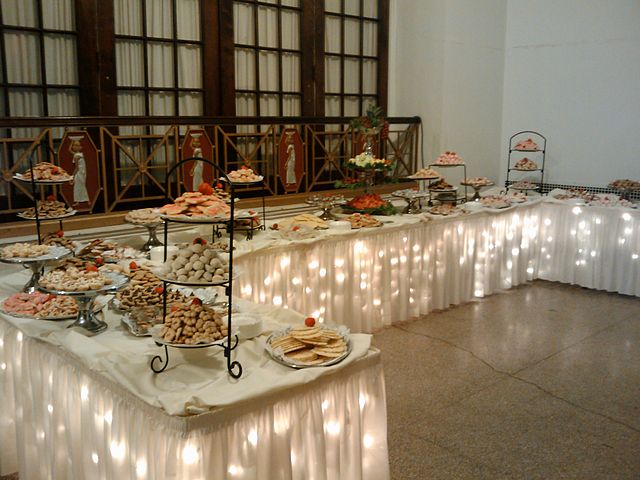
This is a regional wedding tradition I can get behind- a cookie table!

This tradition is regional to southern Pennsylvania/Pittsburgh and some other industrial East Coast cities that have large Catholic populations of Italian or Eastern European groups, says Wikipedia. I can’t remember where I first read about it, but it always struck me as a particularly nice tradition. In addition to your usual wedding cake, there is a table full of cookies at the wedding for the guests to enjoy. The great thing is that the relatives of the couple bake the cookies, giving it a great community feeling and something that hasn’t been totally Pinterestified like it’s cousin (and another favorite of mine- the candy buffet). Supposedly the tradition started before wedding cakes were a big thing and it was a way to spread out the cost of the reception between many family members.

These cookie tables aren’t playing around, either. I read about one wedding that had 500 dozen cookies!  That’s 6000 cookies, and unless these weddings have a thousand guests, that’s an awful lot of cookies per person. This wedding had 200 guests- which is 30 cookies per guest. That’s so many! Even a sweet fiend like me would have a hard time with that. Luckily, you get to take them home to enjoy at your leisure.

There is a bit of etiquette involved- are you really allowed to take them home (apparently these days it’s all good and some families even provide containers)? When can you start eating them, from the beginning of the reception or do you have to wait until dessert time (definitely not until after they’ve been revealed, but it depends on what the couple wants)?

So, let’s definitely bring this tradition to other weddings because unlike cash bars, who doesn’t love a good, homemade cookie?

Genealogy Etiquette

The grave in question in bullet [Courtesy Victoria Pratt collection]

The grave in question in bullet 4 [Courtesy Victoria Pratt]

Jaya and I, in addition to being etiquette experts are really into genealogy. We both have branches of our family trees that go way back in America, both to the American Revolution and the Mayflower. I’m even a member of the Daughters of the American Revolution. Family history can be great fun- like being a detective! And it’s very rewarding in having the opportunity to connect with very distant family members.

However, like anything, there are a lot of rude genealogists out there! So here’s how to be polite:

  • Family trees are not subject to copyright. I had a 3rd cousin of my grandfather’s send me a very nasty email after I put the names and dates of our mutual family members into my Ancestry.com family tree. By all means, if you’re relying on a significant chunk of research from one person or website, cite it. But just because you are the one who told me that Charles Smith was born in 1790 and died in 1840 doesn’t mean I can never use that information for my own publically accessible trees! Of course, don’t plagiarize written stories and things that are original work.
  • Ask nicely- if you believe someone has some information that will be useful, ask them nicely for it, don’t demand it. That goes for professionals such as librarians as well.
  • Be careful with original documents so they will be available for future genealogists as well.
  • Don’t make assumptions! I had set up a Find-a-Grave page for one of my ancestors several years ago. Recently someone emailed me through the site and asked me to transfer the page to him as he was a direct descendant. Well, I am ALSO a direct descendant and I was there first, so no. If he had said, I’m a direct descendant of so-and-so and I would love to take control of the page to do this, this, and this and would you be interested in transferring it to me? The answer might have been different.
  • Always be thankful when people help you. Find-a-Grave does this awesome thing where you can submit requests for people to photograph a particular grave in a particular cemetery for you. (This is a very fun hobby, btw!!) I have submitted a few and gotten the photos I asked for. Of course I immediately wrote to the photographer to thank them for taking the time.
  • Don’t publically list information about living people! Ancestry.com hides all information about living people and you should too.
  • Always be willing to collaborate- don’t take and take information from people without giving any information back.
  • Feel free to reach out to people you might be related to, but don’t get mad if they aren’t interested. As weird as it may seem, not everyone is super into genealogy. You might trace some living relatives down through obituaries and then find them on Facebook or whatever, and that can be awesome! I’ve done it and had a great time chatting with someone who is my 5th or 6th cousin. However, I’ve also reached out to people and never heard anything back. It’s fine and totally their choice.
  • Be specific in your information requests. When reaching out to someone who might have a connection to you, make sure that you are specific in who you are researching and how you think they might fit into the other person’s research.
  • Don’t assume everyone is as fascinated by your family tree as you are. Family history is kind of like dreams- utterly fascinating to you, but a total bore to everyone else. If you must talk about it, keep it short and punchy with good anecdotes. For example, some of my family are buried in a small cemetery in the East Village in NYC and I always point it out to people when we are walking by and tell them about the dramatic suicide of one of my ancestors who is buried there.
  • Take rejection well. I get emails from other researchers occasionally who think that someone in my tree might be someone that they are searching for. After getting more information, sometimes it turns out that there’s no actual connection. Most people are fine. However, I emailed one woman back and said something along the lines of “I don’t think I have anyone by that name in my family tree and it doesn’t look like I can help you. Good luck in your research!” and she wrote back that it was the rudest response she had ever gotten and why didn’t I want to hear more about her family tree?

Also, apparently gravestone rubbing is passe now that everyone has digital cameras. Plus it’s bad for the preservation of the inscriptions. Happy family hunting!

Flag Etiquette

[Via Wikimedia Commons]

It’s the flag, you know what the flag looks like! [Via Wikimedia Commons]

Flag Day is coming up on Sunday and so I wanted to bring everyone up to speed on American flag etiquette!

A few fun facts to begin:

  • The US Flag Code was adopted in 1923 and prior to that there were no official rules governing the US Flag. The different branches of the armed forces all had their own regulations, so the flag code was adopted to make one universal code.
  • It is absolutely not illegal to burn or otherwise desecrate a US Flag in the United States. The Supreme Court decided in 1990 that is it unconstitutional to violate people’s right to free speech (flag desecration counts as free speech) by having laws against flag desecration. (I see people who are unaware of this all the time and it is irksome to say the least.)
  • The Pledge of Allegiance was first written in 1892 and the “under God” bit was not added until 1954 as a way to distant the US from atheistic Communist countries!!  (So maybe we should not make a big deal about people not wanting to say it?) (The pledge was also originally said while doing the Bellamy salute. However, the Bellamy salute looks a lot like the Nazi salute, so it was discontinued during WWII and replaced with the hand over the heart salute.) (Court decisions have decreed that you cannot force anyone to say the Pledge of Allegiance and you cannot also not require anyone to stand during it.)

To paraphrase the flag code:

  • The flag should never dip to show respect to a person or a thing.
  • The flag should never touch the ground or water under it
  • The flag is only flown upside down to indicate distress
  • The flag should never be draped on anything as decoration. To decorate patriotically, bunting should be used with the blue on top, white in the middle, and red on the bottom.
  • The flag should not be used for advertising. It should also not be embroidered on anything or printed on anything that is meant to be casually discarded.
  • The flag should always be fastened securely so there is no risk of it being torn or damaged.
  • There should never be anything written or drawn on the flag.
  • No signs or advertisements should be posted on a flagpole.
  • No part of a flag should be used as a costume or uniform. The armed forces may have a flag patch on their uniforms. Flag lapel pins should be worn on the left, over the heart.
  • When a flag is too worn or damaged to be a fitting symbol, it should be burned ceremoniously.
  • When saluting the flag, whether at a flag raising/lowering ceremony, the National Anthem, or the Pledge of Allegiance, all people should face toward the flag and put their right hand over their heart. Civilians should remove their hats and put the hat over their heart. Military persons in uniform do not remove their hats and salute instead of putting their hands over their hearts. (If you are not a US citizen, you don’t have to do this, but you should stand to be polite.)
  • When displaying the flag from a flagpole, the flag should always go fully to the top unless being displayed at half-mast.
  • The flag is displayed at half-mast by presidential or gubernatorial order. To set the flag at half mast, it is first hoisted to full mast and then lowered. The lower the flag, it is again hoisted to full mast before being lowered fully.
  • The flag is to be hoisted briskly and lowered slowly. It should only be up from sunrise to sunset, if it is to be displayed at night, it should be illuminated.
  • When flown with other flags, the US flag should always be the biggest and fly the highest. It is always the first raised and the last lowered.
  • When the flag covers a casket, the union (the blue section with the stars) should cover the head and left shoulder. The flag is removed before it is lowered into the grave.

Etiquette Links

While we are still out on a little hiatus, enjoy some other excellent etiquette from around the internets.

Etiquette parodies are always great at The Onion.

Or maybe this is the true etiquette for the NYC Subway?

If you like podcasts, you must listen to Awesome Etiquette by Lizzie Post and Dan Post Senning from the Emily Post Institute.

Can you pass a chivalry test? (Doesn’t mean we need to keep these rules!)

Katie Heany at Buzzfeed has been reading vintage behavior guides with hilarious results.

We don’t agree that etiquette faux pas should be ACTUAL crimes.

Differing food etiquette across the world is always fun!

Etiquette Hell is where I first starting picking up modern etiquette. Be sure to check out the outstanding forum where a bunch of etiquette mavens put everyone in their place.

And as always, check us out on Twitter, Facebook, and Instagram.


Regional Wedding Traditions: Cake Pulls

Cake pulls or charms is a tradition that is found in the South, most prevalently around New Orleans. The idea is simple- after the cake is baked, a number of “charms” are inserted into the cake, leaving an attached ribbon trailing out. At the wedding reception, the bride gathers her bridesmaids or other special friends around the cake and each takes a ribbon and pulls out the charm. Each charm has a meaning that will predict that woman’s future. Sometimes if a bride wants a particular person to pull a specific charm, it will be marked in some way. Often, the bride will give her bridesmaids charm bracelets as their “bridesmaid gift” so they can put the charm on the bracelet.

Some examples of charms and their meanings:

  • Baby bottle/high chair: next to have a baby
  • Four leaf clover/horseshoe: good luck
  • Airplane/Eiffel Tower: future travel
  • Heart: love
  • Rocking Chair: long life
  • Thimble/button: Spinsterhood (!!!!!)
  • Ring/bells: next to get married
  • Butterfly: eternal beauty

This can be a really fun and beautiful tradition, but of course has some pitfalls:

  • Do not under any circumstances give someone a charm that says they will be an old maid, WTF, that’s just mean.
  • Try to be sensitive about other problems- like a baby charm to someone who is infertile or is staunchly child-free
  • Leaving people out- try to stick to only bridesmaids lest you hurt someone’s feelings who feels like she is a close enough friend that she should be up there (unless you can get ALL your girlfriends involved- that’s great too!)
  • Make sure they are all out before the cake is served so no one chokes on one!