
In which I have a breakthrough in music-without-headphones-in-public etiquette

Put those headphones on!

You guys. I figured it out. Last night on the bus a woman sat in front of me and was trying to listen to a audio of Fun Home on her phone, without headphones. For the record, I’d estimate she was in her 40s or 50s, so shut up about millennials. She held the phone’s speaker directly to hear ear, but everyone within about 15 feet could hear the audio.

A younger man leaned across the bus aisle and asked if the audio was coming from her, and when she confirmed, he asked her to shut it off. She did, but rolled her eyes, and gestured to my husband and I that that man must be the unreasonable one. “I can’t believe him,” she said. “Well,” I said, “generally you should be using headphones for that.” She responded “If I have to hold it up to my ear I don’t think anyone else can hear it.”

DID YOU HEAR THAT, DEAR READER? PEOPLE WHO DON’T USE HEADPHONES GENUINELY DON’T THINK ANYONE ELSE CAN HEAR THEM.

I sort of refused to make eye contact for the next two stops as she continued to grumble, but my mind was racing. This is the problem! I sort of understand it. I’m extremely guilty of eating/crying/picking dead skin off my lips on the subway, assuming no one outside of my personal bubble is aware of my actions. It’s easy (maybe) to see how that attitude can extend to noise. So let us make it perfectly clear in case you were operating under this assumption: everyone can hear you, cut it out.
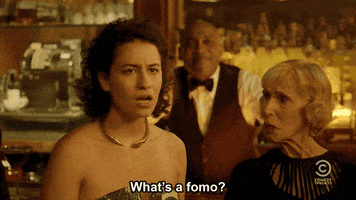
The Etiquette of FOMO

FOMO (fear of missing out) is real. I know a lot of people like to say that it’s just another thing millennials or whatever generation coming up behind us likes complaining about, but it’s absolutely a thing. Two generations ago, if your friends went out without you, you either 1. wouldn’t know about it until afterward or 2. maybe would feel a little hurt but could easily ignore it. Now, often those events you’re left out of are flaunted in your face on social media, or just with people talking about them because they forget it’s sort of rude to talk about shared experiences if not everyone in the circle has shared it. It’s easier than ever to see exactly how much fun everyone is having without you, and your dumb brain naturally concludes that they’re having that much fun specifically because you’re not there. Quit it, brain!


Anyway, let’s talk about how to deal with it, both from the perspective of the person involved and the person feeling left out.

  1. Try to include everyone: This comes with a lot of caveats. Obviously in a perfect world everyone would be welcome and present everywhere, except that wouldn’t be a perfect world because that’d be fucking exhausting. You know when you go to a big party and you’re like “that was fun and now I need to wait a month before I interact with that many people again”? TOO BAD, NO WAITING PERIOD. This is all to say sometimes you just want to hang out with one or two or five people instead of every one of your friends at once, and that’s reasonable. But if you’re planning a party and invite everyone except one person in your friend group, that sends a message, so try to at least keep groups together. This changes if there’s limited space, but you know, do your best.
  2. Ask yourself if you really wanted to be invited:  If you’re feeling left out, try to figure out if it’s because it’s really something you would have enjoyed, or if you just want to be included. Maybe you weren’t invited specifically because your friends knew you wouldn’t like that particular activity, or thought you were busy and didn’t want to make you feel overwhelmed with choices.
  3. Don’t flaunt: This is tricky, because obviously you have the right to post as many picturesque mountain views or selfies with all your friends as you want, but if you know someone wasn’t invited who would have liked to be invited, or has a tendency to feel left out if they couldn’t make it to something, maybe take it easy. Because it is hard to see all your friends enjoying themselves somewhere if you didn’t know about it.
  4. Don’t whine: The temptation to call someone out and go “why wasn’t I invited?” is strong, but generally it is not a good look. Instead, talk to your friends after the fact if you’re feeling raw about it. There may be a reason why you weren’t invited (limited space, other relationship dynamics that have nothing to do with you, email problems), or you could use it as an opportunity to say it’s something you’d be interested in next time around.
  5. Plan your own shit! The easiest way to avoid FOMO is to come up with your own plans. I also think the more people who make plans, the more people understand how tricky it can be. If you email 15 friends, and 5 are gone that weekend, do you change plans for them or forge ahead? If your apartment can only fit 6 for dinner, how do you do it so no one feels left out? It’s hard! And there are no right answers but planning at least makes everyone a little more empathetic to the invitation process.
  6. Mix it up: One great social habit to pick up is to be mixing up which and how many of your friends you interact with, so it doesn’t have a chance to turn into one stagnant “group.” Of course big group parties and outings are great, but plan smaller things too. Get dinner with friends A and B, then next week see a movie with B, C and D, and later invite A and C over for drinks. That way you set a standard of not everyone being invited to everything all the time. People have a chance to get used to seeing their friends doing stuff with out them, knowing that it wasn’t because they weren’t missed, but because sometimes you just hang out in different configurations.
  7. You’re literally missing out on everything all the time: Time to get zen about it! Your friends are probably Gchatting right now. You might be Gchatting or texting or Snapchatting with them too, but they’re having their own interactions every second of the day that have nothing to do with you. And they may even be talking about you! Friends talk about friends, and let’s face it, they’ve probably noticed that weird thing you do (you know the thing). If that makes you uncomfortable, learn to live with it, because just because people you know see each other without you or talk about you when you’re not there doesn’t mean they don’t love you or want to see you. It means they’re people with their own lives and schedules and relationships that naturally look different than yours.

But if it makes you feel better totally brag those vacation Instagrams.

Musing On Future Etiquette: Music With No Headphones

Ahhh, those were the days

I really don’t want to think listening to music in public with no headphones (and not in the carrying around a boombox in the park style, I mean blasting music out of your iPhone in a crowded subway) is going to be a thing, but all signs are pointing to it being a thing. Over the past few years I’ve increasingly encountered people playing loud video games, having FaceTime conversations, or listening to music without headphones, and at this point I believe it’s just something we’ll have to deal with. There’s a silver lining though: A BRAVE NEW WORLD OF ETIQUETTE.

Let’s say you’re sitting on the bus, listening to the Hamilton cast recording (like we have been for the last two weeks) with no headphones. Someone comes on the bus listening to another song at a similar volume, and sits next to you. Who is in the position of power here? On one hand, you can say you were there first, and thus deserve to continue listening to your music while the other person has to turn theirs down. On the other, perhaps the rules should go by turns. You had your time, and now this person has theirs.

I hope it will continue to stand that, if someone asks you to turn your music down or to put on headphones, you will. After all, it is still against the rules on most forms of public transportation or in public areas to play amplified music without a permit. But as much as etiquette is about comfort and being a social lubricant and all that, I also think it’s about having some sort of guidelines for everyday behaviors, and those change often. Fifty years ago pulling out your phone during dinner would be incredibly impolite (largely because you shouldn’t flaunt technology you got via your time machine like that), but now we understand that sometimes it happens, and there are polite and impolite ways to check your email with company. Things change, and etiquette needs to change with them.

But also, please use headphones when listening to music in public.

Your Ultimate Guide to Plus Ones

Bring a boy band to a wedding

People are really opinionated about plus ones (+1s, whatever) at weddings. I’ve heard that it’s mandatory to give every single guest a +1. I’ve heard of friendships torn apart because a guest didn’t get one. I’ve heard of people having an awful time at weddings because the couple told them they had to bring a date and they spent all night babysitting a stranger instead of hanging out with their friends. Like many etiquette issues, it’s a place where people assume there is one rule and that they know what that one rule is.

You do not have to offer +1s to anyone at your wedding–that is a rule. But if you want to, it can get tricky to figure out who should and should not get one. I’ve found that it helps to have a few things in mind when offering +1s to your guests.

  • Is your guest dating anyone? If they’re dating someone seriously, they shouldn’t get a +1, but rather an invitation to their actual significant other. Where to draw the line on significant others, though? Only married couples? Engaged? Living together? Dating for over six months? Whatever you decide, be consistent. No one will appreciate if they couldn’t bring their boyfriend of a year and find another guest got to bring someone they met on Tinder the week before.
  • Does your guest know other people? One of the biggest arguments for +1s is for guests who may not know anyone else, as it’s no fun to show up to a giant party by yourself. Sometimes you need a buddy, and offering a +1 to that friend you know from work who has never met any of your other friends before is a great way to ensure they’ll have someone to talk to. On the other hand, if you have a group of single friends who’ve all known each other since high school, it may be more of a burden for them to bring a date and make sure that date is having a good time than to just come alone and hang out with their friends. This goes double for a destination wedding. It’s one thing to drive an hour to a party where you don’t know somebody, but quite another to fly to Mexico for it. If you’re friend’s not the solo adventurer type, offer to let them bring a friend and make a vacation out of it.
  • How many people are going to be at your wedding? If you’re having a 500 person wedding, you probably won’t a few +1s you’ve never met before. However, if you have a 20 person ceremony and an intimate dinner, cousin Betty’s girlfriend of two weeks might be an awkward addition.
  • Are you comfortable with strangers around? Offering +1s means you’re giving your guest sole discretion as to who they bring. You may give one thinking your college friend will be bringing her new boyfriend, but she may bring another friend, or her mom, or her yoga teacher. The nature of the open offer is that it’s up to her, so make sure you are comfortable with that.

Similar consideration should go into choosing whether or not to bring a guest if the invitation is extended. Is your guest the type to mingle and make friends quickly, or are they going to need to have you by their side all evening? If ten of your best friends will also be at this wedding, is a guest necessary? If you know nobody else there and are bringing a guest, are they a person you can have fun with?

Remember, you should not stand for people demanding to bring guests, or demanding to bring more guests than they were allowed, or asking to swap out one guest for another. And if you RSVP for yourself because you don’t have a plus one, you’re not allowed to add one after the fact, even if your original invitation offered you a guest.

Etiquette IRL: Beach Edition

BEACHBLANKET2I want to tell you a story about a good deed that didn’t go unnoticed! A few weeks ago, I lost my driver’s license and credit card on the beach. I put them in my shorts’ pocket because I didn’t want to carry a purse, and at some point realized they were no longer there, making attempting getting into a bar that night quite an ordeal. Immediately, I called my bank to cancel the card…only to find it had already been cancelled. Who would do such a thing?

Anyway, a few days after I returned home, I got an envelope with no return addressed, containing my cards and a letter with no signature. It simply said that the cards had been discovered on the beach, that they tried to get my bank to give me their phone number so I could contact them, and that they hope I still had an enjoyable weekend.

What an amazing thing!! Of course I would have written a thank you note had they included a return address (a lesson to always include a return address on your mail!), but sadly I can only hope they know how appreciative I am. And I thought it was a wonderful example of how polite actions can really have an impact. It’s really easy to follow etiquette rules because we’re told they make others feel good, but there is often little concrete proof. Nobody gets a thank you note for sending a thank you note. And it’s not like you should be doing these things so you get a cookie and a pat on the back, but it is helpful to know they actually work. Here’s your proof. Go make someone’s day.