
What Is The Deal With Online Registries?

B007UO40LE-1._V149139675_Registries are already a weird thing we’ve agreed upon doing as a society, but after receiving two waffle irons within weeks of my engagement, I begrudgingly signed up and now understand the appeal. But a huge reason for that is because I signed up for an online registry that lets me register for anything from any store, in one place. It’s pretty great!

However, things like online and honeymoon registries have to be navigated carefully, as most people still aren’t familiar with them, so I’m going to break down a few of the common features you can look for and how they should be handled.

Gifts from Anywhere

The main appeal of these types of registries (Simple Registry, NewlyWish, MyRegistry, to name a few) is that you can list gifts from anywhere, on one page, so your guests don’t have to find your bedding at Macy’s and your plates at Pottery Barn and your tech gear at Best Buy. It also means that you can register at smaller or local stores, or stores that don’t have websites, which is fantastic for variety and also supporting small businesses.

One thing to be mindful of is ensuring the things you register for are still in stock. A few times I’ve found that trays, glasses, and decorations I registered for at a smaller store were completely out of stock, and I had to change my registry accordingly.

Also, check out how they work, and whether the registry redirects your guests to purchase the gifts at the specific sites, or whether you just get the cash and it’s up to you to keep your promise and use it to buy the thing you intended. Because you DO have to use the money to buy the thing you said it would be for, which is another reason why it’s good to regularly check that items are not sold out.

Split Gifts

So, you want a KitchenAid mixer, right? We all do, and you registered for one because if you had $600 to plunk down on one you wouldn’t be in this predicament. But chances are many of your friends and family do not have $600 to plunk down on a mixer either! Many of these sites offer ways to split up larger gifts into separate payments, so someone can chip in $100 to your mixer, another person $50, and soon enough it’s yours.

Remember that separate thank you notes are required for everyone who chipped in, no matter how small a donation.

Experience Gifts

Probably the best part of online registries is that you can register for experiences, not just physical things. I have honeymoon activities (snorkeling, sailing), cooking classes, and magazines subscriptions on mine. Most likely these sites will just give you cash to spend on these activities, so it’s doubly important that you actually do these things. To be extra nice, take some pictures and send them to the gift-giver to show them how much fun you had!

Cash

Speaking of cash, many of these websites have a built-in option for a cash gift (something I didn’t notice on mine, and cannot get rid of, which is the one thing that irks me). As we’ve mentioned before, everyone knows that everyone else could use cash, so there’s usually no need to make it explicit.

Many couples these days could really do without matching china, or even cooking classes, and instead would like to save up money to buy a home or make some other significant purchase. And while I am all for saving up money you receive as gifts for something like that, I would suggest against putting a “down payment fund” or “our dream home” on your registry. Here’s the thing I’ve noticed: the people who give cash will always give cash, but the people who give gifts like giving specific gifts. And asking that their “gift” be to throw $50 into a general pile of cash for a home that doesn’t exist yet is sort of cheating them out of their part of the arrangement.

I know, I know, I am always the first to cry about how people should show love the way the recipient needs it, not the way the giver wants to give it. If all the giftee wants is to save up for a modest house and the gifter thinks it’s not good enough, the gifter is the rude one, right? Totally, yes, you can go with that. But just keep in mind that if cash is truly all you want, you shouldn’t even register in the first place. (And that people will buy you gifts anyway, but you can probably just return them for cash.)

A note on honeymoon funds: Many people equate paying for a couple’s honeymoon (flights and hotels and such, not just fun excursions) similarly to paying for a couple’s house–that it’s rude. I’d disagree, because in my mind, a Honeymoon would not exist without a wedding, but a house would. It still feels like an extension of the festivities. However, allow your guests the joy of buying you specific things on your honeymoon, even if it’s just 1 night in a hotel or lunch on your third day there. Throwing a few dollars into a giant “honeymoon fund” just doesn’t feel as good. (See above.)

Also don’t register for a dog. I saw that. It was weird.

Fees

If you register at a site like Amazon or Macy’s, giftees will usually pay the shipping and taxes to have the gift sent to your house, because that’s just built into the way those sites work. However, with many online registries, it’s not that simple. For instance, if a guest buys me a gift that costs $75, their $75 is transferred into a holding fund on the site. I can then have it deposited directly into my bank account, or have a check sent to me, and use the money to buy the item I requested. They haven’t ordered you anything, but that credit card transaction still costs money.

Most sites do not require users to pay to use the service. It seems that most of them run on credit card transactions, fees and ads. Each site has its own way of doing fees. Some have a flat fee, others have fees based on the cost of gifts. Some require giftees to pay the transaction fees, while others allow you to pay it for them. I’m divided on which is the “nicer” way to do things: on one hand, making sure your guests don’t pay extra fees is nice. On the other, if you’re giving a gift and make the recipient pay a fee to receive it that’s not very nice. And if they bought you a gift through Amazon they would be paying shipping and tax fees anyway, so why should it be any different here? And Amazon and other sites make at least some of their money via product markups and such, right? And then you get into this whole conversation about capitalism and corporate greed when really you just want someone to get you a nice salad bowl. So shop around, see what the fee policy is, and if it seems reasonable to you it’s probably ok.

I would also suggest factoring in shipping and tax costs into gifts you put on an online registry. If you say it’s $75 for a set of plates, someone gives you that $75, and you go to the site to order it and find it’ll be $85 with shipping and handling, that sort of defeats the purpose of being given a gift.

Disagreements

There will most likely be someone who thinks having a registry like this is rude. There are people who still think having regular registries are rude. I’m still one of those people sometimes! But just remember that having a registry doesn’t mean that anyone is obligated to use it, which means two things. One, if you are giving a gift and don’t like the couple’s registry or its fee policy, you are perfectly welcome to buy them something else somewhere else. Two, if you are the owner of the registry, you cannot get mad if you guests don’t buy you gifts off of it. Actually, you can’t get mad if people don’t buy you gifts, period. It’s a “gift,” not a requirement.
How To Talk About Death

kermit-mickeyDeath is not common in western society the way it used to be. Infant mortality is relatively low, we have penicillin, and people die in hospitals, not at home. For many, this means that death is a rare occasion in their lives, which is a relief. But the flip side is that familiarity with death means an understanding of how to talk about it or offer sincere condolences. I still clam up when a friend loses someone close to them, unsure of quite how to offer support at a time when most people probably don’t know what they need. But here are a few things to think about when offering condolences.

1. Should I offer condolences?

In most instances, yes, you should, whether you’re the griever’s best friend, boss, or doorman. And if the griever brings it up first, you always should, even if you don’t know them very well.

2. When should I offer condolences?

If the griever tells you, immediately. If you hear it through another party (for instance, if your friend’s husband lets you know her aunt just died, because she’s not in any mood to be calling people), use your discretion based on your relationship. If it’s your best friend then obviously say something soon, but if you’re not as close, maybe give it a day or two, when it would make sense that news had gotten out.

3. How do I offer condolences?

If you can’t do it in person, I actually think text or email is much, much better than a phone call in most instances. When one’s grieving, the last thing most people want to do is get on the phone and interact with someone else, for multiple reasons. They may be making funeral arrangements, and don’t want to take time out of planning to hop on the phone with every relative or friend. They may need time alone, and don’t want to have to talk to anyone. Also these phone calls can quickly turn into the griever comforting those calling, explaining “no really, I’m ok, don’t worry” when they just want to grieve in peace.

An email or text on the other hand lets them know you’re there, but requires no response or effort from the griever (note: do not expect replies for these).

4. What should I say?

If you met the deceased, it’s always lovely to include a word or fond memory about them. If not, focus on the griever. You may say “I know how much he/she meant to you,” but a simple “I’m sorry for your loss” always works. This is also a good time to offer any services with something like “if there’s anything you need, please let me know.” If you’re closer, you can offer something specific, like house-sitting if they need to travel.

“I’m sorry for your loss” doesn’t sound like much. Often times I think I’m being too generic or uncaring when I send that message to a friend, but then I remember just how comforted I was with the flood of messages just like that the last time someone close to me died.

Tell us, what have you found comforting when a close one has died? What did people do that frustrated you?


How To Handle Yourself In An 17th-Century Coffee House

Some notes about the Coffee House, a private club : together with a list of resident and non-resident members : and including the rules of the Coffee House, rule six being that there shall be no rules. New-York Historical Society

Some notes about the Coffee House, a private club : together with a list of resident and non-resident members : and including the rules of the Coffee House, rule six being that there shall be no rules. New-York Historical Society

Are you guys watching Cosmos? I just caught up, and in the episode about Newton and Halley and how humans figured out the stars, Neil DeGrasse Tyson mentions how these young intellectuals often met in coffee-houses. He describes them as places where “a poor man need not give up his seat for a rich man.”

Coffee houses first appeared in cities like Istanbul and Damascus in the 1500s, and popped up in Europe in the 17th century. In the Middle East they had become popular places for political gatherings, but also for social and business causes. In 1883 the Coffee Public-House News published that in Turkey, “Coffee is consumed by all classes at all hours and on sorts of occasions. The little berry is indeed a very factor in Turkish society. Nothing is done without it–no business discussed, no contract made, no visits and civilities exchanged without the aromatic cup, and the accompanying chiboque or narghileh. If a purchaser enters a bazaar to purchase a shawl or a carpet, coffee is brought to him. If person calls at another house, coffee with the tobacco must greet the new comer. There can be no welcome without it, and none but words and forms of general etiquette take place until this article has been served all round. At parting, coffee must still be present, and speed the guest his way.”

Similar rules soon entered English society as coffee houses gained popularity in London. Tyson was correct that one of the main draws of the coffee house was that any man could enter and sit where he like, regardless of social status–as long as he could afford the one-penny fee of entrance, which generally meant the middle class were the “worst off” in any given room. Women, however, wouldn’t be caught dead in one, and according to Public Domain Review, “The fair sex lambasted the ‘Excessive use of that Newfangled, Abominable, Heathenish Liquor called COFFEE’ which, as they saw it, had reduced their virile industrious men into effeminate, babbling, French layabouts.”

Hints on Etiquette and the Usages of Society: With a Glance at Bad Habits by Charles William Day notes, “On entering a coffee house and sitting down take off your hat; it is only a proper mark of respect to your own class towards whom you should pay the same deference you exact from others.”

However, this social class free-for-all worried some.  In 1674 A Brief Description of the Excellent Vertues of that Sober and Wholesome Drink, Called Coffee was published, a broadside that extolled the benefits of coffee, especially in a culture where beer was the popular drink. But the other side of the broadside was the poem The Rules And Orders of the Coffee House, which included monetary penalties for rude behavior:

THE RULES AND ORDERS OF THE COFFEE-HOUSE

Enter, sirs, freely, but first, if you please,

Peruse our civil orders, which are these.

First, gentry, tradesmen, all are welcome hither,

And may without affront sit down together:

Pre-eminence of place none here should mind,

But take the next fit seat that he can find:

Nor need any, if finer persons come,

Rise up for to assign to them his room

To limit men’s expense, we think not fair,

But let him forfeit twelve-pence that shall swear:

He that shall any quarrel here begin,

Shall give each man a dish t’ atone the sin;

And so shall he, whose compliments extend

So far to drink in coffee to his friend;

Let noise of loud disputes be quite forborne,

Nor maudlin lovers here in corners mourn,

But all be brisk, and talk, but not too much;

On sacred things, let none presume to touch,

Nor profane Scripture, nor saucily wrong

Affairs of State with an irreverent tongue:

Let mirth be innocent, and each man see

That all his jests without reflection be;

To keep the house more quiet and from blame,

We banish hence cards, dice, and every game;

Nor can allow of wagers, that exceed.

Five shillings, which ofttimes do troubles breed;

Let all that’s lost or forfeited be spent

In such good liquor as the house cloth vent,

And customers endeavour, to their powers,

For to observe still, seasonable hours.

Lastly, let each man what he calls for pay,

And so you ‘re welcome to come every day.Rulesandorders_coffeehouse

Apparently this was hung on the walls of many an English coffee house. The Printers Devil says, “It is hard to gauge exactly how seriously one is supposed to take these ‘rules’; certainly, contemporary accounts make it clear that nearly all of these were, in practice, openly flouted by the patrons of such establishments. . .There is some evidence that this may represent something of the truth of the actual social mechanisms at work in coffee houses.” Similar to how many coffee shops may say “no laptops” but people just spend the whole time doing work on their tablets. Though really, if we could ban having to overhear the awkward first date conversations in coffee shops we would in a second.

How To Live In A Dorm

typical_hofstra_dorm_roomWe already talked a bit about roommate etiquette, but living in a dorm room is like roommates to the tenth degree. Not only do you have to deal with living with someone in close vicinity, but you most likely don’t even have your own room, you have to share a bathroom with ten other people, and at least one person will vomit in the hallway right outside your door.

  • Don’t vomit in hallways. Or shit. Apparently this needs to be said because multiple people I know have experienced someone taking a #2 in their dorm hallways.
  • Be conscious of each other’s schedules. If one of you has class at 8am and the other regularly works until midnight, do your best to let each other sleep when you need it.
  • Keep tidy. This goes for all roommates but especially when your beds are three feet away from each other.
  • I would say “don’t have sex when your roommate is sleeping” but let’s be honest, it’s going to happen. Try to avoid it if possible, and keep as quiet and still as you can if it comes to it. Same thing goes for shower sex.
  • Speaking of showers! Be quick. It’s good for the environment and for the line of eight people waiting for you to get out.
  • Don’t badmouth your roommate. Not everyone is going to get along, especially if you’re randomly assigned someone to live with. But just because you don’t get along with your roommate doesn’t mean the whole floor should be turned against them.
  • Do not spend all of your time in your dorm room. When you’re given a space that small for two people with no walls between you, personal time is always welcome. Study in the library sometimes. Watch TV in your friend’s room. Give each other some breathing room.

Sports Etiquette Sounds Like A Good Idea

The world of sports and sporting is something I’ve never really felt a part of, even though a decent part of my childhood was spent on various sports teams (soccer, volleyball and softball). I liked being athletic and active, but the word “athlete” always seemed to describe other people who held teamwork through physical strength in much higher regard. Just let me run around and throw things in peace.

(I also may have avoided becoming too entrenched in team athleticism because I am the worst competitor when it comes to board games and the like. My fiance refuses to play air hockey with me anymore because I am a BITCH about both winning and losing. Don’t I just sound darling?)

Anyway, the etiquette of sport was very real when interest in sport=good breeding. In Marion Harland’s Complete Etiquette (1914), she writes that participating in sports is the way for humans to express our primal natures in everyday civilized life, which is why it may be so easy for normally well-mannered people to flip the fuck out if they miss a tennis return. It is because of this that etiquette must be enforced, and really, the rules she lays out are not that complicated: play fair, don’t lose your temper, and remember that the “other fellow has as much right to a good time as you have.” She also writes “no sport in which people of breeding can participate demands loud talking, ill bred language or actions, or the abridgment of any of the small sweet courtesies of life.” And you want to be well bred, right? Like a dog? Yes.

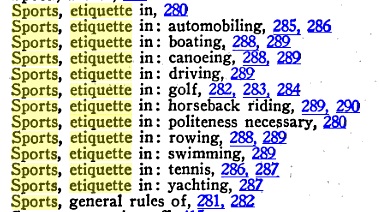
Best search ever

Best search ever

Of course, there are many rules that seem hopelessly outdated. If a man and a woman are playing golf together, the man is not supposed to let himself get too far ahead of her and leave her alone on the field. When “automobiling,” always stop at a disabled car and see if you can be of assistance (on those days when you just drive around for fun because gas costs a nickel). Also, “Do not boast of the phenomenal runs you have made. You are not a record holder. And when you become one, the newspapers will gladly exploit the fact without any viva voce testimony from you.” God I love how catty etiquette experts can be.

Many of the other tips have to do with how to handle a female opponent if you’re a man, so let’s all appreciate that the current etiquette is most likely “just play the dang sport.”

The other part of sports etiquette has to do with sports and business, since many a business deal has been brokered on the tennis court, ringside at a boxing match, or on the golf…field? Business Skills for Dummies (they have good tips!) says that no matter the sport, be honest about your skill level: “Rank beginners and fakes aren’t appreciated. It’s better to decline than to embarrass yourself in a sport you don’t know how to play at least passably well.” However, they miss something here. Think about it: a high level executive makes all his business deals (you know, business deals. I don’t know business speak.) while playing tennis. You cannot play tennis, and say so when you’re invited by him to the court. It is far more likely that you will just not be invited to any more tennis meetings than this executive changing up his routine to accommodate you.

The problem with combining business with sports is that it automatically sets up a system where some people can’t participate. Just because someone doesn’t know how to play golf doesn’t mean they won’t be a good business partner, and limiting your business deals to a club of people with your same interests means you’re missing out on a lot.  Like, remember in Mad Men when they all kept doing business at a strip club and Peggy couldn’t really go, but she decided to “man up” and go anyway and it was super weird but it was her only option if she wanted to get ahead? Don’t make someone be a Peggy, just have your meetings in a damn conference room.

Don't make coworkers sit on your lap either???

Don’t make coworkers sit on your lap either???

But ok, back to sports. In general, I’m for a lot more etiquette in sports, and essentially remembering that it is only a game. This goes for pickup basketball games with friends, or Richie Incognito. Your skill level at a particular sport is not indicative of your character, and your joy should never come at the expense of someone else’s sorrow. That’s not to say you should never compete, just be mindful that after you’ve won or lost, you still have to return to everyday life.

Oh yeah and let women play the same way as men.