
How Do I Get People To Stop Calling Me By My Husband’s Name?

eminem_my-name-is

Tell me you get it

Jaya: Victoria, I have a problem!

Victoria: Tell meeee.

Jaya: I got married. You were there, I assume you remember. He and I both made the decision to keep our own names (not that there’s anything wrong with changing your names, ladies! Post-modern feminism, you do you, etc.). Our parents knew this and could alert any inquiring parties, but we definitely got a lot of cards referring to us as “Mr. and Mrs. HisName.” I totally expected this at the wedding, it’s a common assumption, but now we’re a month past and we’re still getting mail that says this, despite no indication on my end that I’ve changed my  name. A few people have told me I just have to suck it up and deal with it, but I don’t think that should mean I don’t politely correct people when they get it wrong. How does one go about correcting people on their name?

Victoria: I’m so sorry you have to deal with this! Unfortunately, it seems to be a reality of marriage for many women. Firstly, if you’re going to a wedding, asking should be the standard thing. Like, “oh the wedding was so beautiful, where are you going on your honeymoon, are you keeping your name?” (“What are you guys doing about names?” would be BETTER, but I’m going to set a very low bar here).

Jaya: Yes! Especially because it’s not just keeping or changing your name nowadays. Many people hyphenate, or use their original last names as middle names, or use marriage as an opportunity to add or drop other names, or even come up with new names. And same-sex marriage just doubles that, since there’s no “woman takes man’s name” default. As frustrating as fielding a thousand questions would be, I’d much rather answer them than have people just assume. Also, whatever someone’s answer is, don’t judge! I’ve heard of women getting crap from friends saying they must change their name, and crap saying they mustn’t. Neither is cool.

Victoria: A lot of women who keep their name professionally still like to use the married name socially, so that may be where some people are coming from. Or some may think “Mr. and Mrs. Hisname” is more “formal,” but it’s not unless it’s the correct names. MAYBE people are just lazy and it’s easier to write Mr. and Mrs. Hisname than it is to write both your names. Like, that’s a lot of WORDS (jking here, obvs).

Jaya: Curse us for having such letter-ful names! It is interesting though, how quickly “traditional” conventions fall apart as soon as women do anything other than go by “Mrs. Hisfullname.” All of a sudden you have people like “omg she’s a DOCTOR? With a DIFFERENT LAST NAME? Aww jeez how the hell do we put that on an invitation?” I was also wondering how social media plays into this, because it does! I had always assumed that people usually have their real names on Facebook, unless they’re celebrities or something. But I ran into an issue at our wedding where I addressed invitations to women using their original last names because that’s what they had on Facebook, but got cards from them that used their husband’s name.

Victoria:  That should be an easy clue. I actually hate it though, when people solidly change their name and I don’t know who they are now. Facebook lets you do Firstname (Originalname) Marriedname, I know because I set it up for my mom. It makes it easy to show your new last name but also make it easy for people to figure out if you are the Firstname Maidenname that they knew.

Jaya: That’s a good point. I just feel bad because I was also making assumptions without asking.

Victoria: Welllll, you’re making assumptions going off what they’re publicly presenting. If they want to go by a new name, update things to a new name! I have very little sympathy for people who do a thing but don’t tell anyone they did that thing and then get mad when no one knows.

Jaya: So, correcting people. I do not want to Hulk Smash anyone about this, because it’s an honest mistake. I had been thinking that sending an At Home card (when people would send out cards with their new names and addresses after getting married) would be a good solution, but it sort of didn’t make sense for us because we already live together, so it’d just be alerting people that we have the same names and live at the same place. That seems like a waste of paper. Then I was thinking Facebook, but that seemed too aggressive (though I guess I will post this to Facebook. Solution: Have an etiquette blog and use it to figure out your own problems.)

Victoria:  I was kind of against a Facebook announcement at first because people shouldn’t need an announcement, but now I’ve kind of come around to it in that it is the modern equivalent of an At Home card. Although, it might frustrate you even more if people continue to do it after ignoring your lovely message.

Jaya: Yeah, I’m sure some people will just never get it.

Victoria: I definitely don’t think you have to suck it up and not say anything (except maybe with extremely elderly relatives). As for steps you can take, I would ABSOLUTELY correct people when they do it in front of you, or if you have to send back a written response. Like on RSVP cards for written invitations, respond with both of your full names. Maybe get some full name return address stickers (though, I guess people will just think they are outdated).

Jaya: Also, we were gifted some beautiful, beautiful personalized stationery, but it just has our first names on it. For anyone in this conundrum, I’d suggest ordering some stationery with both of your full names on it, and using that to write thank-you notes. Or sign your full name on thank-you notes. Every little bit helps.
Thank Goodness We Don’t Have to Do That Anymore: 1950’s Style Introductions

Be very mature and giggle at the author’s name. We’ll wait.

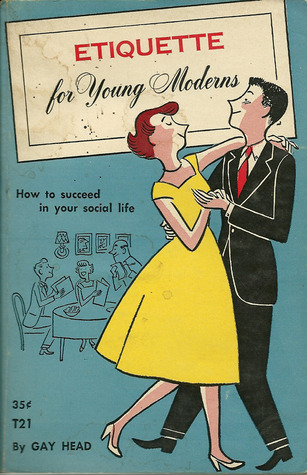
I have this great book called Etiquette for Young Moderns from 1954. It’s exactly what you would expect from a 1950s etiquette book for teens. And it starts out with how to make introductions.

The rules for introductions, according to this book, are pretty simple:

  1. You introduce men and boys to women and girls
  2. You introduce younger people to older people

This means that you say the name of the “socially superior” person first. Their charming examples:

Right: Mother, this is Chad Bowles.

Wrong: Chad, I’d like you to meet my mother.

Right: Mr. Walser, this is my kid brother, Bill.

Wrong: Bill, meet Mr. Walser, principal of Jefferson High.

They also list out acceptable and unacceptable phrases to use during an introduction.

Acceptable:

  • I’d like to introduce
  • I’d like you to meet
  • This is…

Unacceptable:

  • Mostly this has to do with “giving orders” like, “meet” and “shake hands with”
  • May I present is considered too formal for most introductions

When you are introduced to someone, you simply acknowledge it with a “how do you do” or “hello,” but don’t use frilly phrases like “charmed.”

Men and boys must always shake hands when introduced to each other, but when a man is introduced to a woman, it is up to her to extend her hand first!

These rules are very similar to all the rules you will find in older etiquette books such as Emily Post. Like I said before though, I’m just happy if someone introduces people at all, without having to remember who is introduced to whom.

Introductions

Nice to meet you! [Via Flickr user schluesselbein]

Introductions are one of those areas of etiquette that I see otherwise super polite people fall down on. I get it, because we get wrapped up in what we are doing and who we are talking to and forget to notice if we are leaving anyone out. But it’s really really awkward to be standing there while your friend talks to their other friend that you’ve just bumped into without introducing the two of you. Yes, you can and should introduce yourself if this happens, but be the bigger better person and introduce EVERYONE.

How to do introductions:

  • You are in a little group where you know all the other parties and they do not know each other.
  • You say, “Oh by the way, Millicent, this is Evelyn” they say hi and you move on and everyone is fine.

Alternate:

  • You are in a little group where you know all the other parties and they do not know each other. But you are hosting a party and need to mingle with your other guests.
  • You say, “Evelyn, this is Millicent- she went to college with me. Millicent, Evelyn plays on my recreational croquet league with me” And now they know something about each other and you can move on.

I am also a big fan of the walk into a big room of people and someone reels off everyone’s name. At least then you have been “introduced” and can reintroduce yourself later.

Whatever you do, just do something! I will tell you all about the crazy introducing rules that we don’t have to follow anymore on Friday.

Our Best Search Terms

We’ve been going at this etiquette thing for a year already! And it has been a total blast. In that time, we have been found with some pretty crazy search terms. Here are some of our favorites:

  • how to eat french onion soup (notable because of how often it comes up- who knew there was such anxiety about how to eat French onion soup?)
  • body bag bondage
  • polite what is wrong with you
  • cheese pun
  • invited to party dont want to wear a dress
  • erotic victorian chastisement
  • http://www.south african super snuff chewing debate
  • pigeons without toes
  • why is eating pizza with a fork strange
  • uncommon fetishes
  • proper etiquette to eat quail
  • if you’re hooking up with someone just casually how long should you wait to call them
  • i want to be alone on thanksgiving 2013
  • why did women take naps during balls in the 1800s
  • why southern belles didnt wear panties
  • witches email address 2013
  • can you put deviled eggs on a silver platter
  • french onion soup can i eat the cheese
  • assholes in a moshpit
  • http://www.chicken feet curse spell .com
  • what is the ediquette on christmas cake
  • i’m not hot enough to be negged
  • “bachelor party” “in a dress”
  • social nightmares
  • to catch a spinster
  • I don’t want to wear a maid uniform

A Different Way of Teaching Your Children Etiquette

Catherine Howard, the product of being reared by fancier relatives.

Send them away to be raised by someone else! It sounds intense, but during the medieval and Renaissance period in England, it was quite common for families to send their children to live with a different family to be taught things like a trade, but also how to behave. For most people, children were sent away in their early teens, to become apprentices and learn a trade. But for the aristocracy, the children were sent away much younger and in turn, their families also took in children from other families. The thinking was that parents loved their children too much to be properly strict with them. It was also believed that children would obey strangers more than their own parents.

A lot of aristocratic children were especially sent to the households of richer relatives or patrons. There, they would act as pages or ladies in waiting. This was especially done to teach the children how to behave at court and all the very fancy court manners (especially if their parents were not wealthy or noble enough to be part of the court themselves). These placements would also help the child to gain a helpful sponsor who was better placed to find them a good position or make a good marriage than the parents themselves. In turn, the children basically acted as servants (remember, ladies and gentlemen in waiting to the Queen and King actually WERE the servants because actual servants were too lowly to serve the Queen and King directly.)

Boys of course, were also prepared to be knights by passing through the stages of page and then squire. Combat training was a big part of their life away from home. Then, of course, as a squire, a medieval boy would be with the knight he served.

Catherine Howard, King Henry VIII’s fifth wife, was raised in the household of her step-grandmother, the Dowager Duchess of Norfolk, who was much more powerful and influential that her own parents. As a influential duchess, a whole gaggle of girls and boys were sent to live in her household and learn from her. However, the Dowager Duchess was somewhat lax in the supervision of these girls and boys and Catherine Howard had some early romances with the boys in the household which later helped convince the King to chop off her head. However, it was her connection to her uncle, the Duke of Norfolk (a powerful member of court) who got her placed in the Court to be noticed by Henry in the first place. So, you win some, you lose some in this system.