Thank Goodness We Don’t Have To Do That Anymore: Finger Bowls

Dessert place setting- the finger bowl is on the white doily to the left. [via Wikimedia Commons]

Finger bowls are one of those mainstays of snooty etiquette examples, with people focusing on this one obscure bit of etiquette as a reason it is outdated and unnecessary. Obviously, our whole point with this website is to show how etiquette is still useful and necessary. But it is also fun to talk about things like finger bowls!

So what is a finger bowl? It is essentially a little bowl of water that you dip your fingers in to clean them at the dinner table.

Some reference books claim they have been used on and off from medieval times until now, but I can barely find any references to them in etiquette books before 1900. So I believe finger bowls as we imagine them must have been a late Victorian/Gilded Age invention.

Finger bowls are always served with the dessert course. In fact, as the change of plates and silverware for the dessert course is brought out, the finger bowl is actual on top of a doily on top of the dessert plate. The diner then removes the finger bowl from the plate and places it (and the doily!) to the front and slightly left of the place setting. However, if there is no silverware on the plate with the finger bowl, it signals that there is no dessert and then the finger bowl is left on the plate.

To use the finger bowl, you gently dip the very tips of your fingers into the water and then dry them off with your napkin. You may also dab a bit of the water onto your lips with your fingers and then pat dry with the napkin. You are not really supposed to be washing your hands, merely giving a polite impression of cleanliness.

A more serious, soapy bowl of water may be given after eating messy foods such as lobster. Of course, nowadays we have those handy packets of wet wipes that rib joints pass out- not quite as elegant but definitely more practical.

Of course my favorite finger bowl story is the one where the impolite rube is at a fancy society dinner and drinks the contents of the bowl. His hostess (often said to be Queen Victoria) promptly drinks her finger bowl water also, so that he doesn’t feel that he has done something wrong. A perfect example of the spirit in which etiquette exists: to make everyone feel comfortable.

Interestingly, despite the fact that no one actually uses finger bowls anymore, every contemporary book of dining etiquette mentions how to use them. I’ve eaten at a lot of fancy places and have never seen them. If you have, please tell me where in the comments!

Thank Goodness We Don’t Have To Do That Anymore: Not Safe in Taxis

Don’t get into one of these with a handsy guy (unless that’s your thing!) via Wikimedia Commons

A few years ago I was in London and visiting every museum possible, and I saw this amazing exhibit at Kensington Palace called The Last Debutantes which was based on a book of the same title by Fiona MacCarthy about her experience as part of the last group of debutantes to be presented to the Queen of England in 1958 before the ceremony was ended. Among all the exhibits teaching you the proper way to curtsey, balance a book on your head (I am an ace at this, btw), and waltz, there was a strange acronym. NST. What is NST?

Not Safe in Taxis. This was used by debutantes and their mothers to refer to young men who couldn’t be trusted to escort a deb home in a taxi without getting handsy. Apparently some mothers actually kept a list of these young men and the debs themselves would avoid them. Young men of the right pedigree to attend debutante events were apparently in such short supply that these guys would still be invited to things, and would dance with the girls, they just couldn’t escort them home. Dates to debutante parties were charmingly called “deb’s delights” by the way.

Fortunately we live in an age where you can take your own taxi home without having to resort to a creepy guy escorting you. Unfortunately, just because no one keeps lists of the men who might grope you if given the chance, it doesn’t mean that we are beyond it happening. It’s pretty sad that so little has changed in over 50 years. Good etiquette shouldn’t be about avoiding getting groped, it is about being the kind of person who would never grope anyone who didn’t want it.

Thank Goodness We Don’t Have To Do That Anymore: Bathing Machines

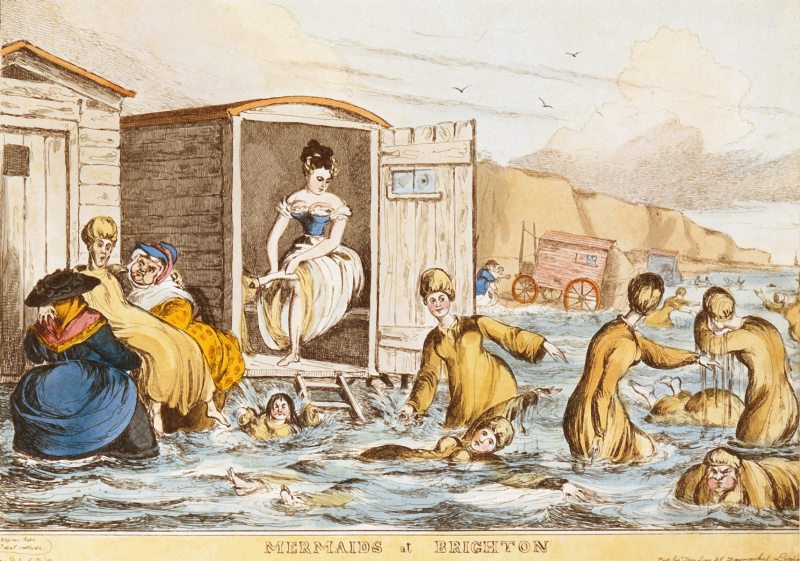
 "Mermaids at Brighton" by William Heath (1795 - 1840), c. 1829. Depicts women sea-bathing with bathing machines at Brighton.

“Mermaids at Brighton” by William Heath (1795 – 1840), c. 1829. Depicts women sea-bathing with bathing machines at Brighton.

I know it’s November, but I think now is the perfect time to talk about some of the eccentricities of beach etiquette in the Victorian era. Because you know that cozy outfit you’re wearing right now? Imagine wearing that on the beach. Summertime fun!

Bathing, whether by spa or by sea, began as a recreational activity in the mid-1800s. Prior to that, prolonged time in the water was assumed to cause instant death (something about water opening the pores so all the disease can get in). But by the mid 19th-century, many doctors began espousing the restorative and medicinal properties of a good soak or swim, and the middle-class began associating cleanliness with refinement, and dirtiness as a sign of disease and immorality. So all of a sudden, everyone wanted to go to the beach, and realized you couldn’t really do this in your everyday clothing.

Beaches have always been fun for men. They could bathe in their underwear, within full view of any delicate woman. But women had to hide their beach bodies and activities. According to Victoriana Magazine (why don’t I have a subscription to this), “Women typically dressed in black, knee-length, puffed-sleeve wool dresses, often featuring a sailor collar, and worn over bloomers trimmed with ribbons and bows. The bathing suit was typically accessorized with long black stockings, lace-up bathing slippers, and fancy caps.” This just goes to show you that even though we still argue about abortion and health care and intersectionality in feminism, things have changed. I am wearing a more revealing outfit right now, and I’m at work. Also I am a woman at work.

As you can imagine, these bathing outfits were not really easy to swim around in. In Extraordinary Origins of Everyday Things, Charles Panati mentions that there were a number of fatalities in Europe and America due to “waterlogged bathers caught in an undertow.” But, y’know, modesty.

Now, these outfits were only appropriate for the beach, so how did a woman get into them? Surely you couldn’t just hop in the car with a sarong around yourself. No, for this, we had bathing machines! These devices first showed up in England in the 1750s and lasted until the early 20th century. W.C. Oulton in The Traveller’s Guide; or, English Itinerary, Vol II describes them as “four-wheeled carriages, covered with canvas, and having at one end of them an umbrella of the same materials which is let down to the surface of the water, so that the bather descending from the machine by a few steps is concealed from the public view, whereby the most refined female is enabled to enjoy the advantages of the sea with the strictest delicacy.” Once in the water, a “modesty hood,” sort of like an awning,  hid her activities from male bathers.

As you may have expected, these were incredibly uncomfortable to use. Women would get in, change and store her street clothes in a little shelf up top so they wouldn’t get wet, and then get yanked into the water by horses. Sometimes other, stronger women would be hired to throw and retrieve the bathers to and from the sea, and if you couldn’t swim they’d tie a rope around your waist and let you bob there for a while, until a wave banged you around. (These “dippers” were also in charge of getting rid of male gawkers, and can we please get some erotic fiction going about them.) In The Hand-Book of Bathing, the author writes “if, therefore, the good effect of the bath is to be immediately counteracted by what must inevitably follow in a common bathing-machine, the patient had better totally refrain from sea-bathing.”

Like with most practices of modesty, we got over it, probably faster because of that whole drowning thing.

Thank Goodness We Don’t Have To Do That Anymore: Dance Cards

“‘Here comes Ned Moffat. What does he want?” said Laurie, knitting his black brows as if he did not regard his young host in the light of a pleasant addition to the party.

‘He put his name down for three dances, and I suppose he’s coming for them. What a bore!’ said Meg, assuming a languid air which amused Laurie immensely.”

-Little Women

Dance cards are one of those things people are always referencing in regards to how stuffy etiquette is. They are a common trope in literature and movies about the “olden days” but how common were they really? And how were they used?

Before we get into dance cards, it is important to know a few things about balls from the early 1800s to the early 1900s. Hereby follows a brief history of social dance: In the early period (think Jane Austen times), social dancing was very formal with all the dancers dancing in a big group, moving around in figures, similar to square dancing (rent any of the many versions of Pride and Prejudice to see examples). Because of this, all the dancers had to be in place at the beginning of the dance and had to dance the whole dance.

A dance card is simply a card that was provided at large balls and dances with a list of the dances for the evening with a space beside it. The ladies would each have a card, sometimes with a small attached pencil, and when a gentleman asked her to dance, he would write his name in for a particular agreed upon dance. This was to help the lady remember who she agreed to dance with and to avoid the embarrassing situation of promising to dance the same dance with two different men. (Though I have always been confused about how the men were supposed to remember who they promised to dance with!)

Dance cards were common in Vienna for hundreds of years, but didn’t come into use in England or the US until the 1830s or so. The Viennese custom was probably introduced to the rest of Europe during the Vienna Congress of 1814/1815, which was a big meeting to settle Europe after the Napoleonic Wars. Right around this time was also a shift in dance styles from longer formal dances like the minuet to shorter dances like the waltz, meaning that there would be many more dances in an evening and more partners to remember. Because of this, ladies started taking it upon themselves to write down the names of their partners in small notebooks or on the backs of their fans. Later on, the ball organizers would have cards preprinted with the names of the dances with a space for your partner to write in his name.

Upon consulting a dozen or so etiquette books from the mid-1800s to the 1950s, it is unclear exactly how common dance cards were at any given point in time. The majority of etiquette books do not mention dance cards specifically and if anything simply allude to “being engaged for a dance.” By the time Emily Post comes along in the 1920s, she says that they are used at public balls and college dances but laments that they are unheard of in fashionable society. It seems as though when dance cards were used, they would be used to arrange to dance in the future, but if a gentleman asked a lady at the beginning of a dance if she was engaged for that dance and she was not, it would be perfectly fine for them to dance without having to write it down.

Dance cards clearly fell out of use when society, for the most part, stopped having formal, set dances. They aren’t particularly useful when you don’t have to know when the waltz, foxtrot, or rhumba are coming up. I think that later on in the early 20th century they were more of a keepsake, being highly decorated and with a list of all the dances and perhaps even the menu of refreshments, than a true way of keeping track of dance partners. Afterall, in the more modern form of social dancing, it’s much easier to quickly ask to dance than it was when dancers were set up in lines and figures that needed to be organized more in advance.

Some related ballroom etiquette:

  • If a gentleman other than your father or brother escorts you to the ball, you must give him the first dance and go into supper with him.

  • If you do accidently agree to dance with two different men for the same dance, it is better to dance with neither to avoid hurt feelings

  • You shouldn’t dance more than 2 or 3 times with the same person as the purpose of balls is to be social and mingle

  • You shouldn’t agree to dance dances when you don’t know the steps

  • If you accept an invitation to a ball you should be prepared to dance, not hang around the edges

  • A gentleman must ask a lady if she would like a refreshment after a dance, she may accept, but if she does, she shouldn’t keep him too long which might prevent him from being timely for the next dance he has promised to another

Many common sayings are derived from the use of dance cards. “To pencil someone in” comes from this practice as well as the more obvious use of “my dance card is full” to indicate a full schedule.


Bonus image because this dance card is a fan. via Wikimedia Commons

Thank Goodness We Don’t Have To Use Visiting Cards Anymore

You know, like this.

You know, like this.

The first thing I found when beginning research on Calling Cards (aka Visiting Cards) was this line from Lillian Eichler’s 1921 Book of Etiquette, which says “The origin of the social call dates from the Stone Age,  when the head of a family used to leave a roughly carved block of stone at the door of another as an expression of good will and friendship.” THIS CANNOT BE TRUE, RIGHT? Let’s just take a moment to picture that, a caveman thinking to himself “You know, I really should call on that eligible girl Kathleen,” and carving his name into a rock and then leaving it with her chaperone. It’s beautiful.

A calling card was essentially a proto-business card, and was used in far more social situations with far more rules. You know how awkward it is to admit you’ve been networking and hand your card to somebody? (If not, you’re a better, confident person, teach me to be you.) Imagine doing that with someone you wanted to date, and there were set hours in the day with which to do it, and guardians had to be involved. Yeah.

Half of the rules of dating cards are about fonts, sizes, and card stock. Men’s cards were longer and narrower than Ladies cards, and Emily Post notes that a “fantastic or garish note in the type effect, in the quality or shape of the card, betrays a lack of taste in the owner of the card.” However, Marion Harland’s Complete Etiquette mentions “the styles of calling cards change from year to year even from season to season so that it is impossible to make hard and fast rules as to the size and thickness of the bits of pasteboard or the script with which they are engraved. Any good stationer can give one the desired information on these points.”

The rest of the rules concern when to leave or send cards. The basic idea was that Person A would not expect to see Person B in her own home (unless already invited or introduced) without Person B first leaving his visiting card at the home of Person A. Cards are left for bereavement, used to RSVP to events (bring the card a week before if you’re attending, earlier if not), and absolutely must be left “within a few days after taking a first meal in a lady’s house; or if one has for the first time been invited to lunch or dine with strangers.” Turning down the corner of a card meant that more than one person from the family name on the card had arrived.

There’s also this great anecdote from Emily Post. So (new money) Mrs. Vanderbilt was having a super lavish ball and everyone wanted to go. (Old Money) Mrs. Astor waited and waited and didn’t receive an invitation, so finally she sends around a note asking where her invite is. And Mrs. Vanderbilt responds: Mrs. Astor has never called on her and she wouldn’t be so presumptuous as to invite someone who had never called on her to a ball. So Mrs. Astor sends her card, Mrs. Vanderbilt invites her and they eventually become great friends.

It all sounds pretty exhausting, and involving a lot of footwork. For instance, this is an excerpt from Naval Ceremonies, Customs, and Traditions on how Naval Officers should conduct themselves with calling cards: “In formal calls, both the officer and his wife left a card in the tray provided for such a custom near the front door. In the most formal situations, the husband would leave two cards, one each for the senior being called upon and for his wife, while the officer’s wife would leave only one, since the inviolable rule of polite society was that ladies did not call on gentlemen. If the senior was unmarried, only the officer himself left a card.” The book also notes that this etiquette was far more rigid in Europe.

However, there is one aspect of this whole circus that I wish still existed: “Not at home.” If you are not available to entertain a guest when the guest calls, your servant (ha) would simply say that you are “not at home.” That could mean you’re out, it could mean you’re taking a nap, or it could mean that you hate the person calling and don’t care to hang out with them right now. It doesn’t matter, because they just leave their card and try again later. Only if you’re in your drawing room do you officially have to accept anyone, and you never have to explain yourself.

I DREAM about this lifestyle. I mean besides having a drawing room and lots of people to do my bidding, I dream of a life set up structurally so that I don’t make myself feel guilty about turning down social engagements. If you want to be social, you either had to go to someone’s house, or essentially set up office hours, and if you didn’t feel like it someone else could just say you weren’t there. It’s a perfect, cowardly move and I want it. But maybe we should all learn from this model and work on setting boundaries in our lives. I can’t be the only one who struggles with that, right? Let’s meet back here to discuss how that’s going for us. If I’m not available, leave your card.