Thank Goodness We Don’t Have to Do That Anymore: Bundling

Bundling is another fun and folksy tradition that seems pretty strange today.

Bundling: because people have different mating practices than pigeons.
By Aomorikuma (あおもりくま) (Own work) [GFDL (http://www.gnu.org/copyleft/fdl.html) or CC-BY-3.0 (http://creativecommons.org/licenses/by/3.0)%5D, via Wikimedia Commons

The basic idea is: a boy and a girl like each other and want to get to know each other better. However everyone lives in tiny houses with tons of people so there is no privacy. Also it’s winter and the house is cold. So what do you do? You throw those two crazy kids into bed with a board between them for propriety’s sake and let them chat all night. (It also helped to conserve candles and firewood- practical!)

An alternate version was tying each person up in a sack to their necks so that no hanky panky could happen.

How well the practice actually worked at upholding good American morals is anyone’s guess- Washington Irving noted “that wherever the practice of bundling prevailed, there was an amazing number of sturdy brats born” so maybe it didn’t work so well after all.

There were even popular songs about it:

Nature’s request is, give me rest,

Our bodies seek repose;

Night is the time, and ’tis no crime

To bundle in our cloths.

Since in a bed, a man and maid

May bundle and be chaste;

It doth no good to burn up wood

It is a needless waste.

Let coat and shift be turned adrift,

And breeches take their flight,

An honest man and virgin can

Lie quiet all the night.

It seems to have been most common in colonial America and had pretty much died out everywhere by the 20th century, after being practiced by the Amish for some time beyond everyone else.

It seems like a kind of warm and cozy first date- maybe I will add it to my OkCupid profile. What do you think, would you like to bundle up with someone this winter?


You can read a LENGTHY 1930’s treatise on the practice here if you are interested.


Thank Goodness We Don’t Have to Do That Anymore: Shivaree

This isn’t really a shivaree [Via Flickr user greenmelinda]

Shivaree (charivari) is a practice in which people serenade a newly wedded couple in a cacophonous manner by yelling and banging pots and pans outside their window in the middle of the night.

The traditional European custom of charivari (shivaree is the common American spelling) was a way to punish those who had married against the community’s wishes- older men marrying too young women, new widow/ers getting married too soon, etc.

As the custom migrated to America, it became more celebratory than punitive, though sometimes it was considered a minor hazing for those who had gone against the norm in their marriage. Often it was a bawdy celebration, designed to interrupt the consummation of the marriage. Like trick or treaters, the revelers wouldn’t leave until offered some kind of refreshment.

I first encountered the custom in one of the Little House on Rocky Ridge books- the sequel series to Little House on the Prairie about Laura Ingalls Wilder’s daughter Rose. In the book, one of their farmhands gets married and that night all the neighbors go to the newlywed’s house and bang on pots and pans until the couple comes out and gives them snacks.

Shivarees mostly took place in the early to mid 1800’s and mostly in small, rural communities. I have, however, found records of the practice continuing in Canada well into the 1970’s. By that point, the practice was used to make a new bride feel welcome to the neighborhood if she had come from far away. Sometimes it was used  as a “reception” if there hadn’t been one for the wedding.

The expectation that the couple have enough food for the revelers was part of the gendered expectation of a wife to have refreshments ready at a moment’s notice for all who might drop by- definitely a less festive aspect of the custom.

Sometimes the shivareers would play pranks on the couple instead of making noise- filling their drawers with rice for example.

There is some evidence that the custom has evolved into the practice of kidnapping the bride at the reception and making the groom pay to get her back. Though I think that this custom is completely different and comes from a different ethnic tradition entirely. The pranking custom is still common among some social groups, I believe (did anyone have pranks played on them on their wedding night or while they were on their honeymoon? Tell me in the comments!). You would think that tying cans and shoes to the “get away” car would be part of this, but that comes from a more superstitious tradition of scaring away evil spirits.

So tell me, who else has heard of a shivaree??

Thank Goodness We…Oh Wait We Still Sort Of Have Chaperones

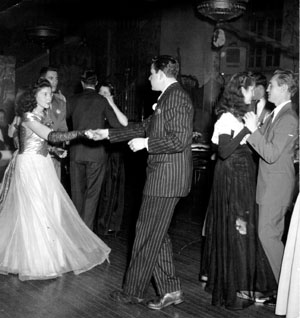
1940sDance

But where is the supervision!? [Via]

We’ve already spoken about how no girl of good breeding would be caught dead at a bachelor’s apartment past 10 pm, or ever at dinner alone. But let’s say you’re a man. You’ve been introduced to a lady of good breeding from your own class and she has “meaning intentions” and you want to get to know her better, outside of her home. For that, you’d probably need a chaperone.

Often times, a mother would be the chaperone for her own daughters. But if that wasn’t possible, an outside chaperone could be enlisted. These were typically older, widowed or unmarried women who ensured that a young woman’s virtue remained intact throughout an evening of interaction with men. In Europe in the late 1800s, it was the chaperone’s job to introduce her “protege” to the hostess and other important people at any social gathering. And if a man wanted to call upon the protege, he had to ask her chaperone’s permission first. Chaperone’s had permission to accept or decline invitations from young men on behalf of their proteges, especially if they could not be present, and would often leave their own calling cards along with those of their proteges.

As we hit the 20th century, chaperones were not nearly as omnipresent in America as they apparently were in Europe. Putnam’s Handbook of Etiquette (1913) mentions the “Spanish law which says no unmarried woman may go out unaccompanied whatever her age and mission.” This largely has to do with European rules of class and society. “ In Europe, where social lines are distinctly drawn, a young woman either belongs in ‘society’ or else she does not,” writes Agnes H. Morton in 1909’s Etiquette: Good manners for all people, especially for those who dwell within the broad zone of the average (what a title). “In the former case she is constantly attended by a chaperone. In the latter case she is merely a young person, a working girl for whom ‘society’ makes no laws.” This was the case in America at the turn of the century, where many young, single women held jobs.

Morton agrees that, for these working American girls, enlisting chaperones to take them to and from work every day would be “burlesque in the extreme.” However, just because you work doesn’t mean you’re still not a delicate flower that needs constant watch around men.  “The girl who is thus allowed to go alone to an office in business hours sometimes thinks it absurd for any one to say that she must not go alone to a drawing room and she does go alone. Right here this independent girl makes a mistake.”

Morton suggests the solution is “intermittent chaperonage,” because while at work, a young woman is “shielded from misinterpretation.” This idea of misinterpretation is basically what chaperonage is about–the idea that young people, especially women, needed a social translator, lest they say something risque and their reputation ruined.

As time went on the rules relaxed a bit, and chaperones became more like teenage watchdogs instead of personal attendants. In 1948, Vogue’s book of etiquette mentions teenage dates where young women couldn’t go out without a chaperone if they were going to be out past 7. It also mentions college dances, where male guests must first greet the chaperone or the house mother before entering the party, or cut in to introduce themselves if the chaperone is dancing.

Today, chaperones are mainly relegated to school dances and other organized, nighttime gatherings of teens, though there definitely are still regions where supervision on dates is required (*cough* Big Fat American Gypsy Wedding *cough*). And honestly, how different is the assumption that a boy must ask permission of the father to take a girl on a date than asking permission of a chaperone?

Thank Goodness We Don’t Have to Do That Anymore: Dueling Etiquette

Alexander Hamilton and Aaron Burr fight their famous duel
(Alexander Hamilton is the hottest founding father, please discuss.)

Duels were a popular way of hashing out ones differences from the Middle Ages to the late 1800s. During that period, guns became much more accurate and thus you were more likely to actually DIE during a duel. Also, people started going to law school when they didn’t know what to do after graduation, leading to more lawyers who could resolve our differences in a courtroom rather than on a field of honor.

Dueling worked like this:

A gentleman insulted another gentleman and that second gentleman challenged the first to a duel. Each chose a “second,” a person to act as their representative and make sure the fight was fair. The seconds would actually do a lot of the work. They did all the negotiating and trying to calm everyone down, then when that failed, they loaded the guns, counted out the paces, and signaled to fire.

There were several ways to end a duel which had to be agreed on before beginning. It could end at first blood, when one party was too injured to continue, death, or after each man had fired one shot. They could even agree to purposefully miss- apparently in their famous duel, Alexander Hamilton  purposefully missed (or deloped) Aaron Burr. Either Aaron Burr didn’t get the memo or was a true cad because he (obviously) shot to kill. Though, some duelists felt that this practice  implied that you thought the other guy was not worth shooting and was thus even more of an insult.

Some fun dueling etiquette facts:

  • There were several published codes of dueling. The Code Duello in Ireland in 1877 and the Wilson Code by a South Carolina governor in 1838

  • Duels usually took place at dawn in some hidden location like an island in a river to help avoid arrest because you a) can’t be seen and b) the jurisdiction over strange locations is often hazy.

  • Only gentleman were allowed to duel, because you had to have a certain level of honor before it could be insulted. “Lower class” men had different ways of resolving their differences.

  • If a man refused a duel, he might be “posted” meaning a poster would be placed in a public place calling him a coward or some other foul thing until he was SO insulted that he would have to accept the duel.

  • The goal of a duel was not necessarily to kill but to gain satisfaction and show that you were brave enough to face death for your honor.

  • One statistic says that between 1700 and 1845, in England, dueling had a 15% death rate.

  • Back when duels were fought with swords, women would fight topless. The reason for this was so that if they were stabbed, the sword wouldn’t push any of their clothing into the wound, causing infection. Men had never thought of this and many wounded duelers died of sepsis.

Thank Goodness We Don’t Have To Follow These Crazy Dating Rules

Via Random_fotos

Pheasants make very romantic gifts Via Random_fotos

I think I have only been on one date in my life. I was 16, he was the 19-year-old half-brother of a friend, and we saw Master and Commander and then got pizza. It all happened because he asked me. He straight up asked me. Ok we had been making out on my futon at a party, but afterward he asked if I wanted to go out sometime, and I said yes, and then we went on a date. And even though that was the only date, how fantastic is it that he could just ask and I could just go? Obviously this was not always the case because if not for an elaborate system of rules, someone might get the wrong impression.

Dating as we know it did not even really exist in more western culture until the 1920s, when first-wave feminism and cars collided to pretty much invent the modern teenager. You could get a lot more necking done in the backseat of a model T than on your parent’s porch, and young people in general were rebelling against the Victorian models of etiquette and decorum solidified by their parents. Furthermore, with more women entering the workplace, the idea of what marriage meant was beginning to change. Women began looking for a friend and companion with sexual chemistry in a potential husband, not just someone to provide a house.

But we’re getting ahead of ourselves. Before the radical drunks of the ‘20s, there was courtship. You’ve probably read about it in a Jane Austen novel. A man and a woman of the same social circle are introduced formally, the man makes clear his intentions to woo this woman, and after some supervised interaction they agree to plan a wedding. Romance was not really in the picture the way we experience it today. Cassell’s Hand-Book of Etiquette (1860) states “According to the strict code of our forefathers a gentleman should ask the consent of the parents or guardians before he endeavours to win the affections of the young lady.” Because of that, “parents should be very careful whom they receive as intimate friends,” especially if they have daughters. (However, it was not just men who were in danger. Men should “beware the lady of unmeaning attentions.”)

Once a man decided he wanted to woo a lady, there were a few options. He could hang out at her house. He could hope to run into her at a ball. He could take her out with a chaperone (more on that later). He could also send her gifts of fruit and flowers, though according to Cassell, “in fashionable life, game is almost the only present that acquaintances make of each other.” For the love of god, why has nobody brought me a “Thinking of You” pheasant?

Later, if he wanted to propose, he could do so in a handwritten letter, provided he had received permission from her father first.  However, Gertrude Elizabeth Campbell mentions in her 1893 book Etiquette of Good Society that “it is said in the olden times of [England], the women made the advances, and often became the suitors.” She also mentions that “In the twelfth and thirteenth centuries it seems to have been the height of gentility to hold the lady by the finger only.” In case you wanted to go retro on your next date.

Anyway, back to the more modern age of 100 years ago, when “dates” began to be a thing. How do you know when you’re ready to date? How do you ask someone on one? How do you know when it’s over. Various etiquette books over the years had advice, though some rules are unbreakable. Putnam’s 1913 Handbook of Etiquette says “is it necessary to state that a young lady who desires to hold an enviable position in smart, ceremonious society does not, whether motherless or not, go to restaurants alone with young men for any meal?” Surely it is not!

By the 1950s things had changed even more. Amy Vanderbilt says that parents know when their boy is ready to date when “his shoes will be shined to a glassy polish” and he starts paying attention to all of his ties. However, Vanderbilt offers no advice on just how this boy will ask a girl on a date, saying they “bungle through somehow in the early years of dating, eventually acquiring a certain polished technique only experience can bring.” Great. Once he does ask her on a date, it is the girl’s responsibility to signal when the night is over. To do this, “She places her napkin unfolded at the left of her plate, looks questioningly at her escort and prepares to rise. If he suggests they linger she may do so if she wishes. However, her decision must be abided by.”

Even if you were an adult with a career and your own place, some old rules still applied. Vanderbilt wrote in 1952, “A career girl, from her twenties onward, can accept such an invitation [to a single man’s house] but should not stay beyond ten or ten-thirty. An old rule and a good one is ‘Avoid the appearance of evil.’” No word on what to do with your napkin if you’re a career girl in a bachelor’s pad; we’ll get back to you on that.