What Is An Epergne?

First you have to have a table big enough to hold this thing!

First you have to have a table big enough to hold this thing!

Welcome back! We hope you had a safe, happy, and polite holiday! Please send us any etiquette questions that cropped up while you were visiting family and having big dinners! Also, wedding season is coming up, so get your questions in now! Send them to: info@uncommon-courtesy.com


This is really just a fun bit of household decoration trivia, but it will help you impress your friends and win at Jeopardy, so!

An epergne is simply an object used as a centerpiece on a dining table. Usually it has a slender base with a bowl or bowls coming off of it to display fruits, candies, or flowers. Traditionally made of silver they can be extremely ornate or more simple.

Epergnes first appeared in the early 1700s and in its early incarnations was really a way to serve expensive little delicacies to the whole table rather than plating them individually and risk them being wasted if the diner chose not to eat them. So people could serve themselves nuts and candies and such and the ones that weren’t taken from the epergne could be saved for later.

By the Victorian era, the style of dining had changed. In the earlier period, all of the food for the meal was set out on the table from the beginning. The Victorian’s changed to service a la russe where each course is brought in individually, so the role of the epergne changed to be a more decorative object than a real serving device.

Quaker Plain Speech: The Anti-Etiquette

My high school

I went to a Quaker (or Friends) high school, and despite not being religious in the slightest, there were a lot of things I liked about it. I enjoyed the mandatory silent meeting, and learning to be quiet with myself as a teenager. I enjoyed how they taught us about conscientious objecting at the beginning of the 2004 war with Iraq. I enjoyed their simple architecture. And though it was never directly employed to the students, I love the concept of Quaker “plain speech.”

The Quaker movement grew out of a break from the Church of England, which many believed was too ostentatious. They believed in a direct relationship with god, and universal priesthood, and they valued living a simple, non-materialistic life so that that relationship could be focused on. This was called the Testimony of Simplicity, and manifested itself in a lot of ways. Quakers in early American settlements were known for making things like apple butter and scrapple, foods that utilized leftovers, and that tasted good but were not particularly indulgent (Quakers disliked gluttony). Their dress was plain, and their meeting houses often featured white walls with no stained glass or other decoration.

What was also plain was their speech. Plain speech is used to “refuse to give into the vanity of the world and the unspiritual, conventional order. It naturally involved strict honesty, a lack of artificial elaborations, and directness.” Many Quakers rejected honorific titles, and the common English names for days and months that referenced paganism. They also didn’t refer to any single with plural pronouns like “ye,” which was customary in 17th century England when addressing the rich or noble.

As we’ve said before, at its best, etiquette is the language of good behavior. It doesn’t matter who you come from or where you are–treating people well is what matters above all else. However, at its worst it’s a tool used to make class distinctions and judgments, arbitrary rules that separate those who know them from those who don’t. Plain speech does away with that. There’s no worry about making sure you have the right title if everyone is known by their first and last name. There is no class distinction between style of dress or language used. Plain speech puts everyone on an equal playing field.

What’s also valued in plain speech is truth and directness, which can rub some people the wrong way. A negative truth can be hard to hear, and really, about 75% of etiquette is about how to say something negative in the smoothest way possible. I’m sure there have been many Quakers who never learned or cared how to say things directly but tactfully, but we can certainly learn from the best case scenario of plain speech. Remember that directness does not equal rudeness (in most western cultures, anyway). You can be direct while still having care for people’s feelings. And it would probably behoove us all to learn that no, most people aren’t motivated by an evil desire to hurt our feelings with everything they say. Sometimes it can just be what you say, and not how you say it.
What Are Hostess Pajamas?

Do any of you remember this lady from What Not To Wear (aka my favorite show when I was in college)?
https://www.youtube.com/watch?v=hQEgnqT6wbk

She showed up with these “hostess pajamas” that her mother-in-law had given her because every Southern woman needed a pair. Stacey and Clinton trashed those gold leggings and matching top in a hurry.

It turns out that hostess pajamas are a real thing! As the name states, they are pajamas you would wear when you were hosting. Of course these aren’t a ratty flannel pants matching with a holey tee-shirt sort of affair, but rather wide comfortable pants and a loose blouse. And you would wear them for more casual types of hosting, in your home. The reason you could wear these “pajamas” in your home was that the hostess was almost always more casual that her guests. For example, in the hat wearing days, women would always keep their hat on when visiting, but the hostess would never wear a hat in her own home.

An alternative thought about hosting pajamas is that they would be what you would wear around the house in the daytime so you could be comfortable but still presentable to any guests that happened to drop by. We should really bring this back- I don’t know about you, but I hate running to the door to accept a package from UPS when I am in something old, with no bra, and ratty hair.

Is It Polite to Use a Napkin Ring?

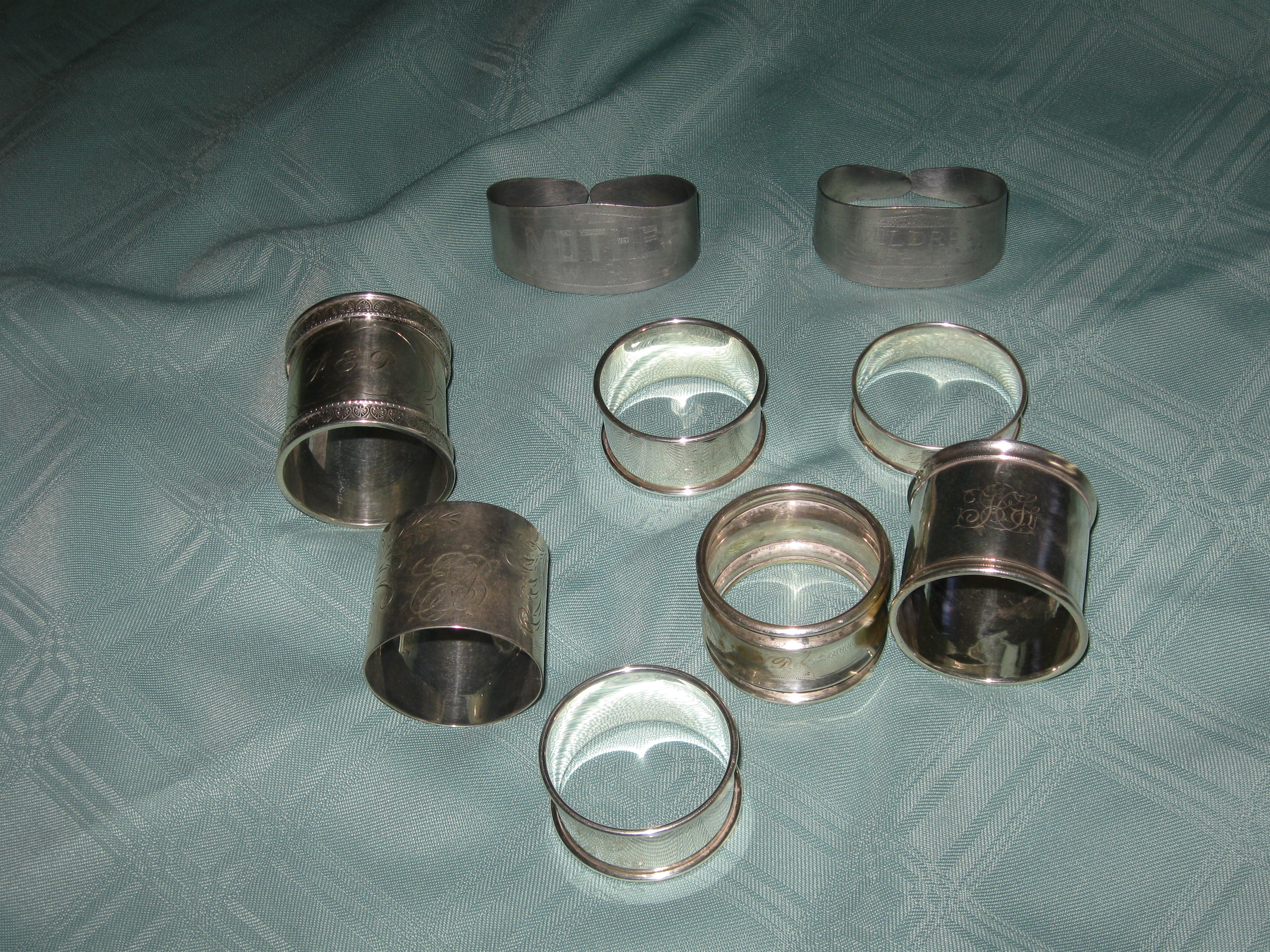
Luckily I happened to have a photo of some of my family napkin rings.

Luckily I happened to have a photo of some of my family napkin rings.

A napkin ring is a simple thing- some kind of shape with a hole in it that you put a napkin into. These days, people use them for decorative purposes and have matching ones all up and down the table. Of course this is completely fine.

However, in the past, napkin rings were soley for family meals and used to identify each person’s napkin (as they were reused for several meals before being washed.)

In 1922, Emily Post said in Etiquette: “Napkin rings are unknown in fashionable houses outside of the nursery. But in large families where it is impossible to manage such a wash as three clean napkins a day entail, napkin rings are probably necessary. In most moderately run houses, a napkin that is unrumpled and spotless after a meal, is put aside and used again for breakfast; but to be given a napkin that is not perfectly clean is a horrid thought. Perhaps though, the necessity for napkin rings results in the achievement of the immaculate napkin—which is quite a nice thought.”

This is why engraved silver napkin rings were a popular present- everyone’s ring had their initials, making them easily identifiable. My family is WASPY enough that I have a monogramed napkin ring of my very own even though the practice of using napkin rings was dying out by 1985 and we mostly used paper napkins anyway.

Did your family use napkin rings and/or reuse cloth napkins? Is it very common to have monogrammed napkin rings or is this another ridiculous thing that I think is normal?

What Is a Stirrup Cup?

It sounds like…a cup shaped like a stirrup?

Actually, it is a time for drinks before a hunt (like the fancy kind on horses with top hats), when everyone’s feet are already in their stirrups, hence the name! The traditional thing to drink was port or sherry. Remember how I wrote about how Scarlet is basically an etiquette manual? She goes to a hunt and participates in the stirrup cup in the book.

Apparently, even further back, anyone setting off on a journey on horseback would get a drink before departing.

It is also the name for the type of cup used for the event, often shaped like a fox or other animals. Commonly, the cup would end in a point because it was for drinking, not setting down! And servants would carry the cups around in a special tray with holes in it to pass them out to the guests.