What Do You Say Dear?

I recently acquired a copy of a 1958 children’s etiquette book called What Do You Say Dear by Sesyle Joslin and illustrated by Maurice Sendak (who did Where the Wild Things Are, if you didn’t know). And it is GREAT!

It gives really fun situations as examples to children of what polite thing to say:

You are flying around in your airplane and you remember that the Duchess said, “Do drop in for tea sometime.”

So you do, only it makes a rather large hole in her roof.

What do you say dear?

“I’m sorry”

And of course the illustrations are great:


Apparently it was part of a series of similar books about etiquette for kids, which is lovely. I feel like these kinds of lessons in a fun book really stick with kids and it’s a shame they are out of print. But I thought it would be fun to show everyone and then you can all track it down for your own kids if you want!

Separating Couples at Dinner Parties

I recently bought a copy of the incredibly fascinating The Rituals of Dinner by Margaret Visser, which is all about the origins of our customs surrounding dining and meals in Western culture, and I have great plans to share bits and pieces from it over time.

A tiny thing that Visser mentions is an intriguing piece of etiquette, which in my experience can be very controversial, the “rule” that at dinner parties couples (married ones, traditionally), should be split up in the seating arrangement. Previously my understanding of the reasoning for the rule was that couples talk to each other all the time and that it’s more fun for them to get to talk to other people for an evening (which, I think, is a totally fair interpretation of the rule).

However, Visser says that:

It has always been a rule of politeness that people in groups should show no favouritism. There must be no whispering in corners, no sharing of private jokes or blatant preferences for particular company; attention should be given to everyone present, as equally as possible. This is the reason why it is customary to separate engaged and married couples at table. Etiquette manuals remind us that dinner parties are for opening out towards other people; pairs or groups who do not want to do this should stay home.

Now, I’ve been to events where this was practiced, and been seated with the “outsider” (to the hosting group) spouses, and honestly, I think being separated from one’s partner really does make one stand on their own feet and have a conversation of their own rather than simply listen to their partner talk. Of course, this absolutely demands that everyone acknowledge the social contract of the dinner party to really give it your all in making conversation and trying to draw everyone in speaking distance into the conversation and not leaving anyone out. And as a somewhat anxious person (who has literally turned around at the door of an event and gone home because of nerves), I totally understand the urge to cling to the one person you know. But it really is a useful skill to be able to make “dinner party conversation” with anyone, on your own, because these situations do come up!

It should be noted that hosts also have the obligation to seriously look at their guest list and try to match up people who will have a good time talking to each other and hopefully will be able to draw useful social and business connections from the meeting. (Though the New York Times says that that particular kind of dinner party is dead and buried.)

Tell me in the comments if you’ve ever been separated from a partner at a party!

Some Things I Learned About WWII Etiquette

I’m horribly late to the party with regards to the BBC Show The Supersizers Go, but if you haven’t checked it out (which, if you’re in America, you might not have), I highly recommend it. Giles Coren and Sue Perkins (who you might recognize from GBBO fame) spend a week at a time eating and living as if they were in different eras of British history, and recording the results. Often they get close to getting gout.

The last episode I watched they put themselves in the shoes of a middle class family in WWII. According to the show, 60% of the UK’s food was imported before the war, so citizens were subject to strict rationing. And with rations came some new rules about food etiquette.

Most of it had to do with waste. It was extremely frowned upon, and in some cases legally punishable, to waste food. Both in the US and the UK, the government encouraged people to be thoughtful about consumption. Posters like these from the US Navy remind citizens “When you take more than you can eat you cheat your buddies in the fleet!”

In the UK, there were also etiquette suggestions regarding getting used to new diets. “Don’t tell the family what the dish is made from until they have tasted–and liked–it” said the government. You were also not to moan about the food you couldn’t get, but instead praise your food in advance of serving it to basically convince everyone it wasn’t so bad.

WWII was also the first time many servicemen had ever left the country, and thus they had to be taught how to conduct themselves with people of other cultures (or sometimes manners that they should have had already). Americans were taught to remove their shoes in Japanese homes, and were given this book of manners for life in Britain. Tips included to never make fun of royalty, never rub it in that the American GIs make more than the Brits do, and “Don’t criticize the food, beer or cigarettes to the British. Remember they have been at war since 1939.”

What Is The Role Of Godparents?

Growing up, I was a little jealous of people who had godparents who were friends of their parents. My godparents were an aunt and uncle, so I didn’t get any additional gifts or attention. And that sums up my understanding of godparents.

Just kidding. Though, in this day and age, a present at Christmas and maybe a fun outing or two is the most anyone expects out of a godparent after the baptism happens.

The most important role of a godparent, traditionally, is to participate in a child’s baptism. They participate to act as the voice of the child, since infants and small children cannot speak. They generally promise to oversee the child’s spiritual upbringing as well. Usually, one godparent of each sex is chosen: a godmother and a godfather, but sometimes more are chosen. Among the aristocracy, it was very common to ask members of the royal family to be godparents to a) show respect b) hope they will be helpful in the child’s life. This still continues- Queen Elizabeth has 29 godchildren, Prince Charles has 28 (Camilla’s son…), and Prince William has 4 already.

Some religious denominations have rules- Episcopalians must have a baptized Christian as a godparent and Catholics are supposed to have a baptized Catholic in good standing as godparent. Catholics are also not supposed to serve as godparents to non-Catholics (ha- tell that to my Catholic godmother. I was baptized Episcopalian.)

Some other expectations of godparents in the Christian faith:

  • Participation in or recognition of the other sacraments (first communion, confirmation, marriage, etc)
  • Modeling good Christian life
  • Helping support the parents in religious education

So, theoretically, you should choose someone who will really do this, rather than just a friend or relative you are close to. Of course all of this is moot if you are baptizing your child for tradition’s sake and aren’t actually interested in raising them actively Christian. Then, you and the godparents can decide what kind of relationship you are all interested in having with the child.

Many people assume that the godparents are also those who will care for the child in the event of the parents’ deaths. This can sometimes be the case, but the parents must site the guardians in their will, it isn’t automatic (especially if you have multiple children with different godparents!)

Amy Vanderbilt says that “once asked to serve as a godparent, a friend is virtually bound to accept.” Though, I would update this to say if there was no religious (or anti-religious) reason preventing you from accepting. Then she says that the godparent should present the child with an heirloom-type gift that can be passed down- her example from one of her own children was “an engraved Sheffield hot-water plate, fine for keeping his baby food hot but also fine for the time he begins entertaining in his bachelor quarters. The plate will be excellent for hot hors d’oeuvres.”

Do you have godparents? Do you want your children to have godparents? Tell me more in the comments!

How to Pee In Regency England

Francois Boucher "La Toilette"

Francois Boucher “La Toilette”

There is nothing that demonstrates the change in etiquette over time like the etiquette around bodily functions. To a great extent, this is because of practicality. It is only the technology that allows us to distance ourselves from our excretions that allows us to be squeamish about them, in the past they were a fact of daily life that people had to see up close.

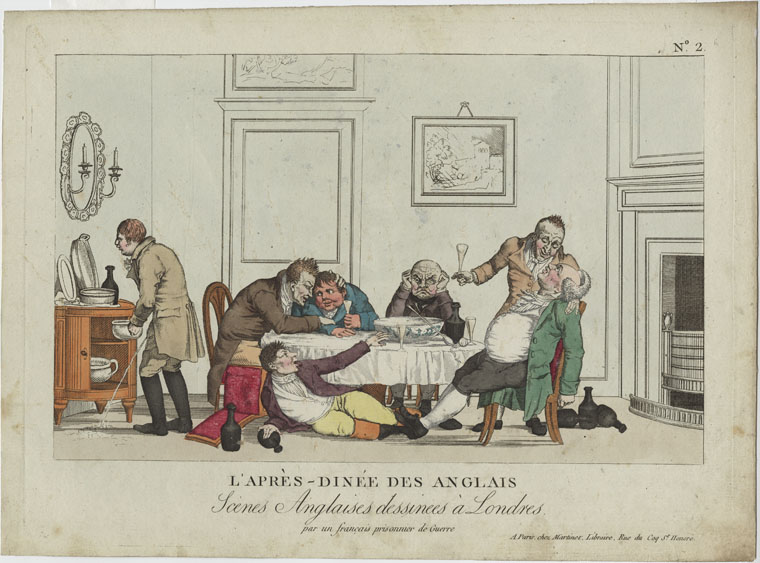
For example: during a dinner party, once the men and women had separated, a man might pull out a chamberpot and use it without even breaking the flow of conversation.
The French were appalled at the uncivilized behavior of the English.

The French were appalled at the uncivilized behavior of the English.

What did people use?

There was actually quite a variety of privies (what toilets were called). Some London houses had a kind of toilet like we have today, with water that flushes the waste. However, they didn’t have the technology to trap the smells, so they could be a bit unpleasant. Some homes had ‘earth closets’ which used a fine dirt to contain smells.

Most common people used a privy/outhouse, a hole in the ground with some kind of seat over it. These emptied into cesspools, which were ideally emptied regularly by “night soil men,” but in poorer areas, they were allowed to overflow and were a large contributing factor to disease.

Of course, at night, you wouldn’t want to go too far from your warm bed, so people would use a chamberpot. A chamberpot is a bowl or container (as plain or fancy as your circumstances would allow) that is kept under the bed (or sometimes in a special stool to conceal it and provide a seat) to be used during the night. You (or your maid) would empty it in the morning.

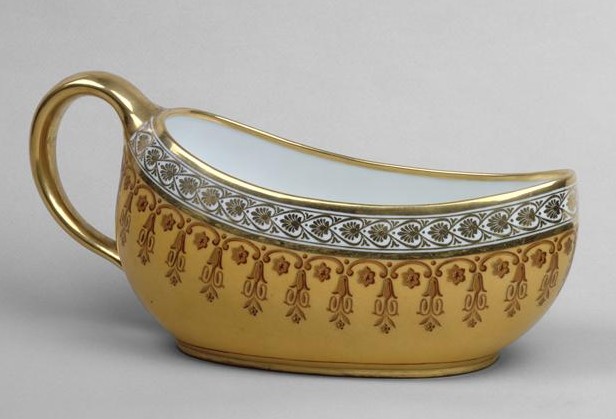
But what about when you were out and about? Many places didn’t have public toilets back then, so a well of lady would travel with a bourdaloue, a very small chamberpot that she could discreetly put under her skirts and then hand to a maid for disposal. Of course, men could always use a handy wall or alley.
Bourdaloue (don't mistake it for a gravy boat in an antique shop!)

Bourdaloue (don’t mistake it for a gravy boat in an antique shop!)

How did they go?

If you’ve ever helped a bride to the bathroom, you know that it can be difficult to maneuver when you are wearing a fancy dress. However, we have difficulties because we don’t do it every day! Women in the Regency period didn’t wear underwear (well, they didn’t wear confining underwear like we do), so they didn’t have to futz around under their skirts. And with a chamberpot, you could just move it under you rather than trying to fit yourself around a stationary toilet.

For wiping, there might be scrap fabric, moss, or straw. That one ply toilet paper in public restrooms doesn’t seem so bad now, does it?