
Opening Lines for Online Dating

Dear Uncommon Courtesy,

Here’s a good idea for an etiquette post: how to send a good first message on a dating site (have you guys covered this already?) Here’s a good example of what NOT to say:

Okc Convo

Sincerely,

Online Dater

Official Etiquette:

Miss Manners is not a fan of online dating, but recommends being vague and not unkind when declining future dates (after dates have already happened). In this case I believe she would advocate for not responding at all.

Our Take:

Jaya: Omg

Victoria: I mean, the key thing is to not engage with people who send you messages that you find offensive.

Jaya: That’s true.

Victoria: But it is definitely rude, also, to start off a message calling someone out for something- I mean, do you even want to date them? Where is that even going to go?

Jaya: Yeah! That’s the most confusing thing, like, I thought you were here to get a date?

Victoria: Haha yeah. I guess maybe some people think it’s their job to call out things they think are racist?

Jaya: But he continues the conversation! He’s not trying to be Mr. Social Justice Warrior, he’s trying to neg her and then flirt about yoga? The etiquette point is why would you contact someone on a dating site and open with an insult?

Victoria: Let’s say she contacted him first and he thought this tattoo was offensive–you can still be polite about it, like, “oh, I see you have a dreamcatcher tattoo- that seems offensive to me, so I can’t see it working out between us.” If you MUST say something. I mean, the beauty of online dating is that you do not have to respond to anything.

Jaya: Haha yes, but again, that’s if you contact him. You don’t just randomly email someone and insult their appearance.

Victoria: For sure. That would only be in response to a first contact from someone. As to what is a good and polite first message- I am generally a fan of something like “Hi! I really liked your profile. I see you like _____, I like _____ too. [Insert question about something in the profile].” Just like….be normal.

Jaya: Why is that so hard for most people? “be normal”

Victoria: Don’t use lines. Don’t insult people. Do NOT say sexually harassing things. Don’t neg. I would recommend not commenting on their appearance, but a short “you’re cute/beautiful” amidst an otherwise thoughtful message isn’t the worst.

Jaya: Right. Like, it can be one of many things, but not the only thing. In a larger sense, if you’re looking to really date someone (not just fuck them), you should be looking at their whole profile and not just how cute you think they are. If that’s the only thing you’re attracted to you’re just not doing dating very well. And if you are looking to just fuck them, omg please make sure they have something on their profile saying the same thing.

Victoria: Hahahah, yeah, on OkCupid, you can sort for people looking for casual hookups, so do that.

Jaya: So much of this is part of that whole PUA thing, turning it into this game and strategy. And I realize yes, you have to put some thought into talking to a stranger, but most people can tell when you’re trying to be genuine.

Victoria: Yeah, and I mean, when you are “meeting” someone for the first time, it’s really best to keep things fairly light- small talk, as it were.

Is Staying Up Late Rude?

Maybe people are afraid they will find their guests hiding under the bed while they sleep. Via

Dear Uncommon Courtesy,

So my dad kept getting in trouble for staying up late at my grandmother’s house and reading at night. Nana would see him, just reading and get angry and start yelling at him.

Tonight my other Nana mentioned that she hates being awake in a house that everyone’s sleeping in. That it is rude- people will think you’ve been nosing around.

So! Is this a generational thing? Are you not supposed to stay up while others are sleeping? Not even, like, staying up making noise, but just staying up in general? My parents hadn’t heard of it- but this was an apparent learned thing for my grandparents.

Sincerely,

Wide Awake

Official Etiquette

There is no official etiquette because this is nonsense.

Our Take

Jaya: What on earth is Nana talking about?

Victoria: Made up nonsense! So basically, shes saying that its rude to stay up later than everyone else in the house even if you are just in your room and being quiet because it seems like you are being sneaky?

Jaya: Yeah, which, I don’t understand how you practically apply this if you’re not the only person in your house. Even if you’re in your room, some people like to stay up and read! Or are just not tired yet! The first searches for this on Google bring up like, hostel etiquette.

Victoria: Seriously. Although, I do find it weird when I am the only person awake and I feel like I am in some kind of post apocalyptic world where I am the last human on earth…but maybe that’s just me.

Jaya: No I totally get that.

Victoria: I do think that if you are a guest in someone’s home, you should retire to your room or couch or something when the hosts go to bed. Though you don’t necessarily have to sleep- as long as you are ready to wake up whenever you need to be awake for the next days activities. I also think, as a house guest, you should try not to sleep in toooooo much longer than the hosts- unless the host knows they get up ridiculously early and tells you to sleep til whenever.

Jaya: Yeah, and obviously that depends on your relationship to the hosts. This sort of addresses it. It is sort of awkward if I wake up way earlier than everyone and am wandering around.

Victoria: And yeah, obviously depending on your relationship. I mean, in your parents house, even if you are visiting, you are still family and can do what you want.

Jaya: But I cannot imagine freaking out if I had a guest, said I was going to bed, and they were like “ok I’m gonna stay up and read a bit.”

Victoria: Hahah yeah! For sure, that’s kind of rude. You want to make your guests comfortable!

Jaya: Also, if you as the host are asleep, how would you even know others are awake and nosing around? You’re sleeping!

Victoria: Yeah! Although, my mom claims she could tell when me and my sister were home or not when she was asleep.

Jaya: Unless you’re pretending to sleep to see if your guests also sleep and then surprise them when they don’t sleep, which is just creepy.

Victoria: Yeah, although, if you live in a small place, it’s conceivable that you can see a tiny bit of the light or sense movement, but still, who cares?

Jaya: True. And obviously you shouldn’t be up partying or watching TV loudly or whatever. Man, most etiquette things I can see where they come from, and this one I really can’t. Unless you live in a mansion and have strangers as guests all the time. It’s another case of like, weird etiquette rules when, generally, you know and like the people you have at your house. Your son is not trying to steal your silver.

Victoria: I mean, it probably comes from a time when people had more house guests or some weird derivation from the English country house party. I mean, Emily Post is full of etiquette for visiting people in the country, who you don’t really know super well. But yeah, still even there, there’s not really anything about this.

Musings On Religion, Holidays, and the In Laws

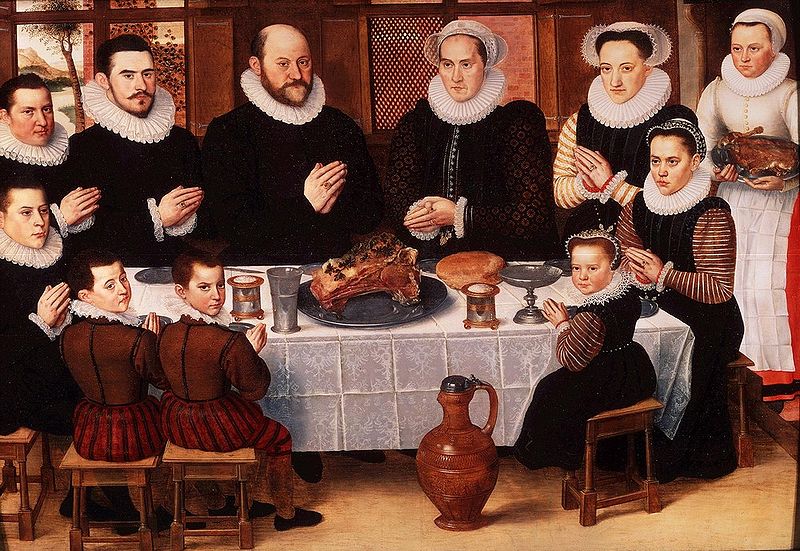
Family Saying Grace, 1585

Family Saying Grace, 1585 [Via]

We’ve spoken a bit about etiquette in places of worship already, though the idea is pretty simple. Be respectful, dress conservatively to be on the safe side, and ask if there’s anything you’re unsure about. However, most of us aren’t just popping into random religious services all the time. What’s more likely is that you’re invited to participate in a service or tradition by your close friends and family, especially your In Laws, and with 45% of marriages in the US between people of different faiths, this probably happens a lot!

While my relationship is not interfaith, our families are. My husband’s family is Jewish, and mine is a combination of vaguely Christian, Hindu, and “have you read the new Sam Harris book?” As such, there are occasions where we’ll be asked to participate in services and traditions we don’t believe in, which can be difficult depending on your view of religion.

Here’s my thing: I have a hard time participating in a religious ceremony or tradition if I know I don’t believe it, no matter how welcome my hosts have made me feel. To me, it feels dishonest to fake it while everyone around me earnestly believes what’s being said. I’ve been told many times throughout my life that I just need to go with the flow, and there are times where I have been able to ignore it  and have a good time. But usually I feel like it’s not my place to be there and participate, even if I’ve been explicitly invited. I am a crazy person and maybe you shouldn’t be turning to me for etiquette advice. Oops.

There’s also a difference between a ceremony taking place in a place of worship, or in a more private setting. In a church I can stand and sit along with everyone else, and no on will notice if I don’t say “amen.” However, there are certain rituals that take place in the home, and it’s a lot more obvious if I’m not participating.

Okay, so what does this mean in terms of practical etiquette? Well, if you get the sense that someone is not comfortable practicing your religion, do not ask them to “go with the flow.” That’s like telling an anxious person to “just calm down,” like really, you don’t think they tried that already? Also, be up front about what’s expected, and be gracious if they cannot meet those expectations, even if they seem minimal to you. If you’re the one being asked to participate, ask questions and participate where you can, and if anyone asks why you’re not participating in a certain ritual, explain that you don’t feel comfortable doing so. If they try to pressure you, they’re the rude ones. Also, see if there are other places you can help out, such as cooking some of a meal or helping set things up. It’ll show you’re grateful for being invited and included, even if you don’t feel like fully participating.

It Was A Wedding Gift, Not An Engagement Gift!

Dear Uncommon Courtesy,

I recently came across your post on giving wedding gifts, which advises sending a gift “around 1-3 months before the wedding.” What happens when I send the gift two months out (because theres not a lot left on the registry), and they very quickly follow with a Thank You note saying it was a “VERY generous engagement gift.” But, it was their wedding gift! So obnoxious! How do I handle this?

Sincerely,

Not So Gifted

OFFICIAL ETIQUETTE

The Emily Post Institute says engagement gifts are neither “obligatory nor expected,” but that if they are given, they’re often given at an engagement party. The Knot also specifies that these parties should happen no more than three months after the couple has gotten engaged, likely to avoid confusions like this.

OUR TAKE
Victoria: HAHAHAHA omg. People are dumb is the answer. You don’t get an engagement gift, and if you were to get one, it would be immediately.

Jaya: This is totally a symptopm of long engagements right? Like, this would not happen if we had 3-4 month engagements.

Victoria: Yeah, although, I suppose that would be more confusing if there’s less time between the wedding and engagement.

Jaya: Maybe. I don’t know, it just seems like now engagement gifts are an expectation. I got a few, and they were all lovely, but I also had it in my head that if this was the only gift I got from that person it’d be totally fine!

Victoria: The point is engagement gifts are not to be expected- like you said, you got a few- that’s an exception rather than a rule.

Jaya: The writer certainly does not have to explain themselves. You bought them a generous gift, and now just go to the wedding and have fun. If they ask about an wedding gift that is incredibly rude, but if that happens you can explain the gift you got them was the wedding gift.

Victoria: Yeah, they will figure it out when they don’t get another gift. I suppose, if you were close to the person, you could call them up and be like “oh darling, how droll, you thought your wedding gift was an engagement present- too funny! See you at the wedding.” (I have been reading a British book about the 20s so this is how I speak now.) (Ed: It’s Life After Life by Kate Atkinson and it’s amazing!)

How Do I Punish Bad Service?

luis-guz-man-waitingDear Mesdames Courtesy,

The etiquette of tipping has been covered in multiple places, but those are more for rewarding good service. What is the polite way to punish bad service? Say, for a waitress that ignores you for an hour, or a cab driver who has no idea what he’s doing and gets lost before you have to get on your phone and figure out how to get home?
Sincerely,
Where’s My Waiter?

OFFICIAL ETIQUETTE
Amy Vanderbilt says that you can reduce a tip in a restaurant if “service is minimal or unbearably slow.” She also says that, although a tip is a reward for good service and not required, it usually ensures better service in the future. Mr. Pink also has some strong ideas about this.

OUR TAKE
Jaya: I definitely think you can tip less/not at all for bad service, though it really depends. The only time I’ve not given a tip at all was when a cab driver spent the entire ride complaining that I was going to Queens (from Manhattan), and that he’ll never find a ride back, and it’s gonna cost him so much money and time to do this, and basically implying that I was a real bitch for wanting to take a cab home.

Victoria: I would definitely not tip the driver in that situation.

Jaya: I was even trying to convince him to go to the airport (not far from my house) to pick up a fare! I was trying to help! And I was all ready to tip him nicely for a long ride, but nope.

Victoria: For bad service in a restaurant, you want to call the manager and really let them know that the service is bad rather than tipping poorly.Then they have a chance to fix it or make it up to you instead of you stiffing someone out of their already low wages.

Jaya: Yes, because it’s often so hard to figure out whether it’s actually your server’s fault, since there are so many moving parts. Maybe your server put in the wrong order, or maybe the kitchen messed it up. Talking to a manager will usually result in the right person being reprimanded, instead of you giving a waitress a 10% tip when it’s not her fault.

Victoria: I feel like i see a lot of server complaints that are like, “they left a 10% tip and I don’t know if I did something wrong or they are just cheap.”

Jaya: When I was a waitress that happened a few times, and I asked the people dining if I had done anything wrong, and it turns out they were just bad at math and thought they left a 20% tip.

Victoria: Hahahaha! That’s why tipping should be abolished- Americans are becoming increasingly bad at math and can’t calculate a proper tip even though there are apps for that!

Jaya: I’m trying to think of other tipping situations.

Victoria: Getting your hair done. But if you’re not happy with a cut, you can ask them to fix it rather than tip poorly.

Jaya: Yes, and usually you can see what’s going on, so if it takes a turn you can speak up.

Victoria: Changing your tip only works if the person you’re tipping has complete control over the situation.

Jaya: I’d add that they should have complete control and don’t seem to be trying very hard. What if your bartender is slow because the other person didn’t show up for their shift? Or a machine broke in the coffee shop? Always try to be understanding first. But yeah, do not tip your cabbie if he gives you shit about a totally legal request to take you home.