How Do I Get People To Stop Calling Me By My Husband’s Name?

eminem_my-name-is

Tell me you get it

Jaya: Victoria, I have a problem!

Victoria: Tell meeee.

Jaya: I got married. You were there, I assume you remember. He and I both made the decision to keep our own names (not that there’s anything wrong with changing your names, ladies! Post-modern feminism, you do you, etc.). Our parents knew this and could alert any inquiring parties, but we definitely got a lot of cards referring to us as “Mr. and Mrs. HisName.” I totally expected this at the wedding, it’s a common assumption, but now we’re a month past and we’re still getting mail that says this, despite no indication on my end that I’ve changed my  name. A few people have told me I just have to suck it up and deal with it, but I don’t think that should mean I don’t politely correct people when they get it wrong. How does one go about correcting people on their name?

Victoria: I’m so sorry you have to deal with this! Unfortunately, it seems to be a reality of marriage for many women. Firstly, if you’re going to a wedding, asking should be the standard thing. Like, “oh the wedding was so beautiful, where are you going on your honeymoon, are you keeping your name?” (“What are you guys doing about names?” would be BETTER, but I’m going to set a very low bar here).

Jaya: Yes! Especially because it’s not just keeping or changing your name nowadays. Many people hyphenate, or use their original last names as middle names, or use marriage as an opportunity to add or drop other names, or even come up with new names. And same-sex marriage just doubles that, since there’s no “woman takes man’s name” default. As frustrating as fielding a thousand questions would be, I’d much rather answer them than have people just assume. Also, whatever someone’s answer is, don’t judge! I’ve heard of women getting crap from friends saying they must change their name, and crap saying they mustn’t. Neither is cool.

Victoria: A lot of women who keep their name professionally still like to use the married name socially, so that may be where some people are coming from. Or some may think “Mr. and Mrs. Hisname” is more “formal,” but it’s not unless it’s the correct names. MAYBE people are just lazy and it’s easier to write Mr. and Mrs. Hisname than it is to write both your names. Like, that’s a lot of WORDS (jking here, obvs).

Jaya: Curse us for having such letter-ful names! It is interesting though, how quickly “traditional” conventions fall apart as soon as women do anything other than go by “Mrs. Hisfullname.” All of a sudden you have people like “omg she’s a DOCTOR? With a DIFFERENT LAST NAME? Aww jeez how the hell do we put that on an invitation?” I was also wondering how social media plays into this, because it does! I had always assumed that people usually have their real names on Facebook, unless they’re celebrities or something. But I ran into an issue at our wedding where I addressed invitations to women using their original last names because that’s what they had on Facebook, but got cards from them that used their husband’s name.

Victoria:  That should be an easy clue. I actually hate it though, when people solidly change their name and I don’t know who they are now. Facebook lets you do Firstname (Originalname) Marriedname, I know because I set it up for my mom. It makes it easy to show your new last name but also make it easy for people to figure out if you are the Firstname Maidenname that they knew.

Jaya: That’s a good point. I just feel bad because I was also making assumptions without asking.

Victoria: Welllll, you’re making assumptions going off what they’re publicly presenting. If they want to go by a new name, update things to a new name! I have very little sympathy for people who do a thing but don’t tell anyone they did that thing and then get mad when no one knows.

Jaya: So, correcting people. I do not want to Hulk Smash anyone about this, because it’s an honest mistake. I had been thinking that sending an At Home card (when people would send out cards with their new names and addresses after getting married) would be a good solution, but it sort of didn’t make sense for us because we already live together, so it’d just be alerting people that we have the same names and live at the same place. That seems like a waste of paper. Then I was thinking Facebook, but that seemed too aggressive (though I guess I will post this to Facebook. Solution: Have an etiquette blog and use it to figure out your own problems.)

Victoria:  I was kind of against a Facebook announcement at first because people shouldn’t need an announcement, but now I’ve kind of come around to it in that it is the modern equivalent of an At Home card. Although, it might frustrate you even more if people continue to do it after ignoring your lovely message.

Jaya: Yeah, I’m sure some people will just never get it.

Victoria: I definitely don’t think you have to suck it up and not say anything (except maybe with extremely elderly relatives). As for steps you can take, I would ABSOLUTELY correct people when they do it in front of you, or if you have to send back a written response. Like on RSVP cards for written invitations, respond with both of your full names. Maybe get some full name return address stickers (though, I guess people will just think they are outdated).

Jaya: Also, we were gifted some beautiful, beautiful personalized stationery, but it just has our first names on it. For anyone in this conundrum, I’d suggest ordering some stationery with both of your full names on it, and using that to write thank-you notes. Or sign your full name on thank-you notes. Every little bit helps.

Rude Things You Will Do While Planning A Wedding

We talk a lot about weddings here, because for many adults it’s the first time the World of Etiquette descends on them in such a massive way. I’m having a wedding tomorrow. I’m sure it will be lovely, and I used much of Victoria’s and my own advice in planning it in as polite a way as possible.

But I have a secret for you–even if you’re the editor of a minor etiquette blog, you will fuck up. You will do some tactless things and commit some faux pases. Some will be out of thoughtlessness, and some will come after you’ve thought everything through and said “fuck it,” and you will not know if it goes unnoticed but you also will not care. Here are a few things we did:

  • Got overexcited and emailed a bunch of friends for their addresses with the hint that it was for invitations, before we were solid on how many people we could invite, and then didn’t invite some people on that list.
  • Threw an impromptu “engagement party” by inviting a bunch of local friends to a bar, including people who were ultimately not invited to the wedding. (I justify it in that it was clearly not an Official Wedding Event.)
  • Had an engagement party thrown for us (by my grandmother) which included guests not invited to the wedding. (This was an Official Wedding Event, but we did not have control over it.)
  • Asked people to turn of their phones/not take pictures during the ceremony (which some people think is rude but Victoria assures me is not.)
  • Invited people and not their spouses or long-term partners.
  • Invited some people within one “tier” of relation and not others.
  • Had a B-list.
  • Not had seating charts, which is apparently Not Done if you have over 50 guests. The justification is that we went to a wedding of 120 with no seats and everyone figured it out just fine.
  • Not realized we had to actually tell people our plans about day-after breakfast or afterparties or anything.
  • Ignored emails with helpful “suggestions” from family members.

More than the actual rude actions though, there have been rude feelings, which I hope you know are okay to have. It’s okay to wish that you could spend the day drinking and partying and not having to say hi to every person. It’s okay to realize that after a year of planning, if you had to do it over, you might not have a wedding in the first place, but accept that that would be impossible feel that way without having planned it already. It’s okay to not have a vegan cake option (sorry, Steve). Make every effort to ensure people have a nice time, but remember that you can’t please everyone. Just don’t apologize for not having wedding favors.

Registries, Wedding Gifts, and Thank You Notes

Because we all know what weddings are really about. [via Wikimedia Commons]

I’ve saved my post about gifts and gift registries for last because they are the least important part of your wedding. Yet somehow they get quite a lot of attention on etiquette sites and in the news.

Here’s the thing, yes you are going to get gifts because that is what is done. However, gifts for weddings are completely optional, the amount a guest spends on their gift is up to them (I don’t ever want to hear the words “cover your plate” coming out of the mouth of a couple about their own wedding), AND what a guest chooses to give you is also up them.

Registries

Back in the day, a bride would go down to the department store in her hometown and pick out a china pattern and a silver pattern (this means the design on your knives and forks, btw). The store would note it down and when people came in to buy the bride a gift, the store could tell them what patterns she had chosen and they could select a place setting or two and be on their way. And that was the beginning of registries.

Now, you can register for anything your little heart desires. This is great! Not everyone needs 12 settings of Wedgewood china and Waterford crystal. However it also creates some confusion about what a registry really is.

A registry is a list of IDEAS. It can also be somewhat helpful in preventing a couple from receiving 5 toasters (has this really ever happened? Why is the example always toasters? ED NOTE: I got two waffle irons! No toasters yet -Jaya). A registry is not a list of demands or a shopping list for guests to pick from. Guests can absolutely get you things that aren’t on your registry.

Now if you are going to set one up, try to come up with items in a range of prices and try to come up with enough items that guests feel like they have some options.

Alternative Registries

Every day it seems that a new entrepreneurial has created a new way to do online registries. A popular version is the honeymoon registry. While many of your elderly relatives might be heartily offended by these types of registries, they are growing in popularity and are now generally accepted even by etiquette experts (such as the Emily Post Institute). However, there are good ways and bad ways to do a honeymoon registry.

A good way is to list a number of experiences you want to enjoy on the honeymoon- things that feel like real gifts, not just chipping in for airfare. Then, if you receive your “massage on the beach” or whatever, you should do you best to actually do that activity, even though the honeymoon registry company basically just gives you a big check at the end.

A bad way to do it is to just have a general fund that all the guests deposit money into- feels more like you are collecting cash rather than receiving gifts. You should also do what you can to make sure any fees are paid directly by you rather than passing them on to your guests.

Another new registry type is where you list the things you want and guests contribute money to those items through the site. For example, you want a KitchenAid Mixer (it’s not a registry without a KitchenAid, amirite?), but you know that no one will be able to buy you one for $400. So you split it up and ask for 4 gifts of $100 each for the mixer. This is pretty cool! Just like chipping in for a group gift but with less hassle. However, if you are asking for all this stuff, you should do your best to actually buy the things you are asking for when you get your big check at the end. If you are using these registries to trick your guests into giving you cash when they think they are buying you a mixer that you will bake Christmas cookies for years with, then that is extremely shady and you shouldn’t be doing it.

Asking For Cash

That brings me to my next point, cash. Cash is great, everyone loves it! It’s so great that everyone already knows you might like it, so you don’t need to ask for it. I mean think about it, here’s this list of items you might like for your newly wedded home and then at the bottom, you are like, “cash is good too!” Umm, duh.

However, you don’t have to despair. You can get the word around by word of mouth- tell your mother, tell your partner’s mother, tell your bridal party. And if someone ASKS you what you want, it’s totally fine to say “oh we are saving up for a house, so we would really love some money for that, but anything you want to give us is great!” It just doesn’t belong on a list. And if you don’t make a registry, many people will infer that you would prefer cash (though you might end up with some really hideous and/or memorable gifts as well.)

Getting the Word Out

So you’ve made this carefully curated registry. Now how do you let everyone know about it? Traditionally, it was all spread by word of mouth. Your aunt would call up your mom and ask her where you were registered and your mom would tell her. This still works! And again, if someone asks you where you are registered, you can tell them.

The one thing you do not want to do is include any mention of gifts or registries on the invitation. The invitation is all about wanting the guest to come share your day, not about what they are going to give you. This includes “no gifts please,” the point is to not talk about gifts, even not wanting them.

A really excellent place for registry information is on your wedding website, under its own discreet link. This creates a polite layer in which the guest is seeking out information that they want, you are not waving it in their face telling them to buy you stuff.

The Gifts Start Rolling In

It might surprise you at how soon after you announce your engagement that gifts start showing up at your door, so be prepared.

It is traditional that you don’t use your wedding gifts until after the wedding. The reason for this is that, if something should happen and the wedding is called off, those gifts must be returned to the giver!

Make sure you keep track of who sent you what- spreadsheets are great for this! This way makes it easier to send thank you notes.

Thank You Notes

Handwritten thank you notes are absolutely mandatory for wedding gifts. Even if you called them or thanked them in person, you still need to send a note. Wedding gift giving is a sort of formalized gift giving tradition that is basically required of all your guests. Therefore it deserves a formal thank you in return.

For gifts that arrive prior to your wedding, you want to send out a thank you within 2-3 weeks of receiving the gift (so they know it arrived safely!). DO NOT wait until after your wedding to send these notes. You are going to want to break up the note writing as much as possible so you don’t have to do 100 at once!

For anything that arrives shortly before your wedding, on the day, or afterwards, you only have 3-4 months tops to get them done. A year is a MYTH. Just do it and you can enjoy married life without the Sword of Thank You Notes Yet To Be Written hanging over your head.


I hope you all have enjoyed my series on How to Throw a Perfectly Polite Wedding. Be sure to check out all the earlier posts as well!

The Wedding Guest List

Wedding Invitations

The Care and Keeping of Wedding Attendants

Showers, Bachelor/ette Parties, and Rehearsal Dinners, Oh My!

Wedding Ceremony Etiquette

Wedding Reception Etiquette

Wedding Reception Etiquette

Is it just me or do these intense wedding reception setups make you feel kind of nervous and claustrophobic? [via Wikimedia Commons]

Receptions are the really fun part of weddings but they can also be the most complicated and fraught with etiquette conundrums. Etiquette doesn’t care about what your decorations are, your colors, how many people you invite, whether you have a band, a DJ, or an iPod, or which of the zillions of traditions you want to include. There are a million websites and books out there to help you decide on the style of your reception. But there are a few etiquette points that are important to keep in mind.

Reception Timing and Meals:

Often, your ceremony venue will have specific times that you are allowed to be there, this is especially true for churches. What do you do when your ceremony has to be at 2pm and you want to have an evening dinner reception?

Typically, you should do your best to avoid a gap, but they can be unavoidable. If you must have a gap and your wedding site is too far away for most guests to return to their homes/hotels, you need to have something for them to do in the meantime- many couples will have a longer cocktail hour at the reception venue to fill the time. Gaps are especially rude if you use them as a way to avoid paying for a meal for your guests- for example, having a wedding at 3pm and then having a “cocktail reception” starting at 8pm.

This leads me to my next point, you need to provide a proper meal if your wedding takes place over a mealtime, or be ready to expect some grumpy and hungry guests who order pizza and eat it in a parking lot (it happened on an episode of Four Weddings). If your ceremony starts at 4 or 5pm and is immediately followed by a reception that goes until 9, 10, or later, you need to provide a full meal of some kind. It is very poor hospitality to expect people to be spending 5, 6, or more hours on your wedding and not eat a real meal in that time. Now, very very heavy finger foods and appetizers can certainly count, but only if it is truly enough to fill up hungry bellies.

If you can’t afford to provide a full dinner for your drinking and dancing late into the night reception, then you need to consider other options:

  • A ceremony followed by a simple 2 hour cake and punch reception is a perfectly proper celebration for a wedding on a budget. Have the wedding at 2 and everyone is gone by 5 and you have no etiquette faux pas.
  • A morning wedding followed by a brunch or lunch reception gives you the ability to provide a nice meal which is usually much cheaper than a full dinner.
  • A very late evening wedding with the ceremony starting at 8 and followed by snacks, cake, drinking, and dancing late into the night.
  • A dinner reception with more casual foods- you don’t need to serve a choice between plated rubber chicken and filet mignon. Why not try a big pasta buffet, catered barbeque, takeout Chinese, food trucks, or big sandwich platters? Think outside the box and you will find something that will suit your budget and satisfy your hosting requirements!

It is smart to include a hint of what your reception will be like on your invitation so guests know what to expect ie cocktail reception to follow, dinner and dancing to follow, join us for cake and punch after, etc.

Toasts:

Traditionally, the Best Man and Maid of Honor give toasts at the wedding. Please ask them well in advance if they feel comfortable giving a toast at all. Check out Jaya’s post on toasting etiquette for more!

Seating:

If you are serving a meal, you need to provide seats for all your guests.

You don’t have to have a seating chart or assigned tables, but it can take the pressure off your guests and prevent the “school cafeteria” feeling of “where do I sit?” It also prevents the problem of large groups pulling in chairs to overfill one table and leaving another table with only two chairs for a couple of guests to sit awkwardly.

If you have assigned tables but not assigned seats, you can either have a list posted somewhere or “escort cards,” these are little cards (or something else more creative!) that have the guests’ names on them. They pick them up before going in to dinner and see what table they are at. If you have assigned seats, just use normal placecards at each person’s seat.

Receiving Lines:

You don’t often see receiving lines anymore (or at least not in my circle!). Most couples have opted to skip them in favor of going around to each table during the reception. Whichever you choose, you must do something to ensure that you speak to each guest for at least a moment during the wedding. Even though it seems like it would take a long time, the receiving line might actually be faster and allow you to enjoy more of the reception than trying to greet each person while they eat and reduces the risk that you will miss someone.

For the logistics: you either have the receiving line immediately after the ceremony and guests go through it as they exit the ceremony and go to the reception or you have it at the reception as everyone goes into dinner. Obviously, the couple needs to be in the line, but usually their parents and often the attendants will stand in it as well.

You needn’t do more than greet each guest and thank them for coming. After that, move them right along to the next person to keep the line moving.

Cash Bars:

I am going to take a very strong stance here and say that at American weddings, cash bars are always against general etiquette. Think about it: a wedding reception is essentially a thank you gift for your guests for taking part in your Important Life Event, and you shouldn’t ask anyone to pay for part of a gift. Also, it has always seemed strange to me that alcohol is the one area people feel comfortable asking others to chip in for. If you wouldn’t ask someone to pay for their dinner or their share of the cake, you shouldn’t have a cash bar. You are the host; you have to pay for everything associated with your event.

That being said, you are not required to serve alcohol at your wedding. You are also not required to have a full open bar; beer, wine, and soft drinks are a perfectly acceptable and cheaper option. Anyone who complains about your hospitality is being rude.

Another problem with cash bars is that it creates a situation in which some guests have something that the other guests do not because they can afford to pay for it. All of your guests should receive exactly equal food and drink and it is extremely rude to flash differences in their faces.

If you even THINK of having a cash bar for ALL drinks including soft drinks, then, I don’t even know what to do with you. (I have never seen this in real life, but it happened once on another episode of Four Weddings. That show is a mess.)

Of course, you are welcome to do what works in your community and if every single wedding you have every attended has had a cash bar, then you are probably okay.

Money Dances/Wishing Wells:

In a few cultures, money dances are traditional and therefore acceptable. General American culture is not one of them. In traditional American culture, your guests have already purchased a present or given you a check, so why are you asking them to give you even more?

Reception Activities:

Weddings have many fun traditions such as special dances, cake cutting, and bouquet and garter tossing. You can choose to have these as you wish, and don’t let anyone pressure you either way. However, some thoughts:

  • If you decide to do a garter throw/bouquet toss, do NOT force people to participate and don’t let anyone drag all the single people out onto the floor. Personally, I would also recommend keeping the retrieval of the garter tasteful, but you should do what works for you. And if you want your groom crawling up under your skirt to porno music in front of your grandma, that’s your business.
  • I have seen the first dance/father daughter dance occur between the cocktail hour and dinner, but traditionally they happened immediately after the dinner and toasts and opened up the floor to dancing. I have also been to weddings where there was dancing between each course of the dinner, so in those cases, you don’t really need to open the dance floor. Just be thoughtful about how you are scheduling activities and how they will help your event flow.
  • Some modern couples are opting to do a “marriage dance” where all the couples dance and the DJ has them sit down in order of how recently they have been married and then the couple who has been married the longest gets the bouquet. This can be a nice alternative to a bouquet toss which makes single people feel put on display, but at the same time, it excludes single people entirely. Basically you can’t win, so go with what works for you. Or start a new tradition where the whole reception has to try to catch the bouquet? Or you hide the bouquet and there is a search for it? So many possibilities.
  • If you are Jewish, you might want to dance the Hora. Presumably, you already know how to do this, but if you are having a lot of people at your wedding who have never done it before there are a couple things you might want to remember:
    • Everyone is allowed to join in! But your gentile friends might not know what to do, so make sure there are enough people around to show them the ropes.
    • Only the bride and groom go up in the chairs (though we’ve been to Jewish weddings where the parents went up too). Make sure the people lifting you know to keep you close enough together that you can both hold onto the napkin (“schmatta”).
    • Don’t use folding chairs for this activity unless you want to lose a finger!
    • (H/T to my good friend Rachel at whose wedding I had my first Hora experience and who was kind enough to answer my questions.)
  • Cutting the cake: this is pretty simple- the couple goes over to the cake, hold the knife together and cut a small slice. Then they feed it to each other and pose for pictures. Smashing the cake into each others faces is a thing in some places, and it’s totally at your discretion, but definitely don’t do it if one half of the happy couple doesn’t want to! Icing on that $4,000 dress!!
  • Reception activities should happen fairly quickly after dinner and end with the cake cutting. If you are having a “sending off” you can do the bouquet toss/garter throw immediately before you leave. (This is actually more traditional than having the bouquet toss randomly in the middle of your dance- originally it was more of a “just toss the bouquet in the direction of your girlfriends as you head out the door” type of thing than an event that everyone gathered around to watch.)
  • Have your MC announce when these activities are taking place as people will want to watch.

Ending the Reception:

Back in the day when parents hosted the wedding and the couple was the guest of honor, the couple would be expected to leave the reception before it was completely over. They might even change into “going away clothes” and there would be a big sending off as they left on their honeymoon. Then the guests would know that they could leave and everyone would start clearing out.

Now, often, the couple has paid good money for this party and they want to enjoy it until the bitter end. This can create a conflict with some older and more traditional guests who feel like they absolutely have to stay until the bride and groom leave. Nowadays, most people know that the cake cutting signifies the end of official reception activities and that people are free to leave anytime after that, so you might consider making sure that it is the end of official activities or even having your DJ or band leader announce that it is “the last activity but to please enjoy the music and dancing until [end time].” You might also want to consider having it (and your other “official” activities) fairly early during the reception in consideration of guests who might need to leave.

Other Things:

  • Apparently it is a tradition for guests to take home the centerpieces? If this doesn’t bother you, that’s great. If you have plans for your centerpieces, warn your caterer/wedding coordinator/family members/etc or maybe put a note under them saying not to take them.
  • Tip your vendors! Make sure either someone is assigned to handle this or you’ve prearranged the tips.

Wedding Ceremony Etiquette

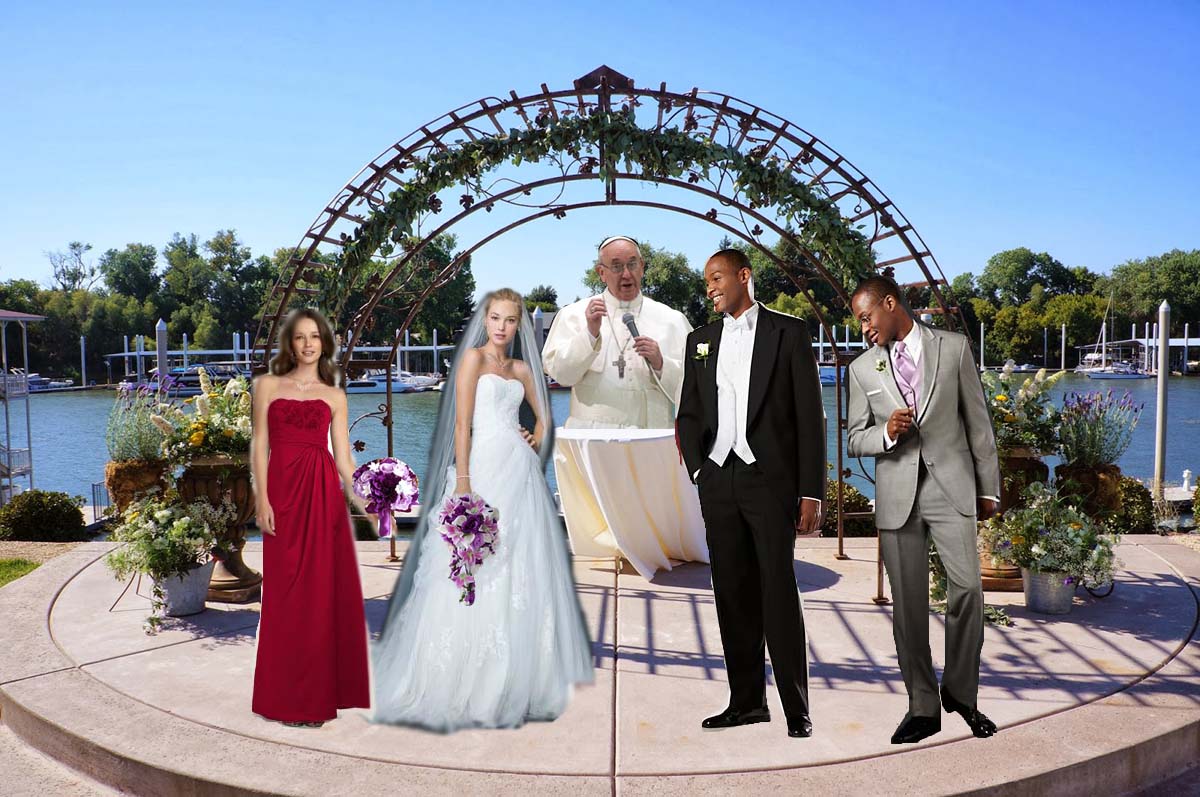
This is what the wedding ceremony set up would look like for a wedding made up of models and officiated by the Pope.

This is what the altar would look like for a wedding made up of models and officiated by the Pope.

For the most part, wedding ceremonies are so personal there isn’t really any official etiquette that will cover all of them. However, here are some traditions and guidelines:

If you are getting married at a religious site, check how much personalization you will be allowed to use. Many religious weddings don’t allow deviation from the ceremony or secular music, for example.

Traditionally in Christian ceremonies the bride’s parents and guests sit on the left of the “altar” and the groom’s family and guests are on the right. For Jewish ceremonies, it is the exact opposite, bride right, groom left.

You can rope off the first couple of rows for specific VIPs. If you use your groomsmen as ushers, they can make sure that the right people get these seats. Back in the olden days, you might receive a pew card with your invitation which would tell the usher which pew you were in. Or at the least, the usher would ask you “bride or groom?” and seat you on the correct side. It was expected that ushers would be able to recognize VIPs and seat them correctly.

Of course, nowadays, people can “choose a seat, not a side” and there is complete seating chaos! (Except not because, surely, grown up people can find a seat for a ceremony without too much hassle.)

In a traditional Christian ceremony, the groom, best man, and officiant would walk in first, from the side of the church and stand at the altar. Then all the ushers/groomsmen would walk down the aisle in pairs and join them. They would be followed by the bridesmaids, also in pairs. The Maid of Honor would follow them alone. She would be followed by the flower girl and/or ring bearer. Then finally the bride and her father would walk down. In Christian ceremonies, both sets of parents are seated in the first row on their respective sides. Sometimes the Mother of the Bride and the parents of the groom or other important VIPs are escorted to their seats by an usher after all the other guests are there but before the “real” processional starts.

In a traditional Jewish ceremony, the Rabbi would be at the front. The best man would walk down followed by the groom and both his parents. Then the maid of honor followed by the flower girl. Finally, the bride and both her parents. In traditional Jewish ceremonies, both sets of parents stand under the Chuppah with the bride, groom, and rabbi.

During the ceremony, the bridesmaids would line up on the side near the bride and the groomsmen would line up on the side near the groom. Bride on the left, groom on the right for Christian ceremonies and the opposite for Jewish ceremonies (just like where the guests sit!)

For both Christian and Jewish ceremonies, in the recessional, the bride and groom would go first, followed by the bridesmaids/groomsmen who are now paired off.

I am including the traditional formats for processionals and recessionals for informational purposes, but to be honest, I’ve never seen any wedding follow those traditions exactly and you can do whatever works for you. And apologies for the Judeo-Christian norms, but that’s all old etiquette books include!

It is ideal to have seats for all of your guests unless the ceremony is VERY short.

Typically, everyone will stand when the bride appears at the top of the aisle. It is a good idea to have your officiant to invite people to sit once everyone is at the “altar” otherwise, everyone might end up standing the whole time, which is no fun for anyone. The whole standing for the bride thing makes some couples uncomfortable, and you can certainly put notices in your programs, or make announcements or whatever you choose, but it’s so engrained that people might do it anyway.

It’s a new thing, but requests that guests don’t take pictures during the ceremony are perfectly fine.

Everyone gets hung up on the idea of the bride’s father walking her down the aisle. Even Miss Manners has always said that the bride should choose whoever she wishes to walk her down the aisle, whether it be a father or stepfather or whoever. If she doesn’t have a father, her mother is the ideal option, no need to find a male relative to walk her. Of course, you also can walk down by yourself or with your partner if you wish.

I have never really heard of anyone actually doing the whole rice throwing deal, and at the weddings I have been to, it wouldn’t have worked logistically, but if you want to do it, the traditional time is as you leave the church. Basically, the newly wedded couple gets back up the aisle and hides somewhere for a few minutes while all the guests are assembled outside in two lines near the door. Then when all are ready and have rice in hand, the bride and groom come running out and are pelted with rice before jumping in a car to take them to the reception. You can see where the logistics fall apart if your reception is in the same place as the ceremony, and your ceremony isn’t in a church-like building, and you don’t have anywhere to hide while the guests get ready. Not to mention the mess (check with your ceremony site if you plan to do this!) No wonder I’ve never seen this happen before. Luckily, the myth that the rice is harmful to birds is not true! (NOTE: after doing some further research after originally writing this piece, I found that people have their guests throw things at them as the walk back up the aisle- still some possible logistical problems, but a good compromise nonetheless.)

Ultimately, as long as your guests are reasonably comfortable, the ceremony is the one part of your wedding day that is literally all about you and you can do pretty much whatever you want. So use traditional vows or write your own, do some kind of unity ceremony if that floats your boat (sorry, but blech), anything goes! Just try to avoid cultural appropriation!