Help, I Got My Hands All Over Everything In Chipotle

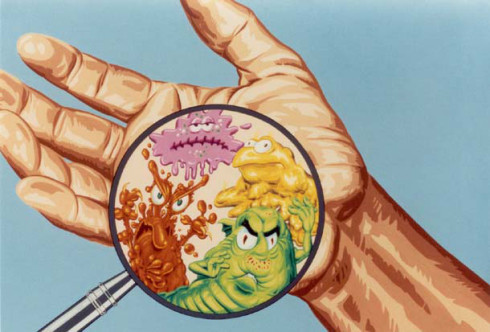
This is definitely what your hands look like (via)

This is definitely what your hands look like (via)

Dear Uncommon Courtesy,

I’m in Chipotle today and I accidentally pick up two drink covers. Which of the two should I take and which should I leave? Is it more polite to leave the top or the bottom? Essentially, I guess, is how much of your hand ends up disturbing whichever side?

Guide me, and the internet, through this difficult dilemma. Also, please god tell me Emily Post has something in this vicinity because that would own.

Sincerely,

Germy in Chipotle

OFFICIAL ETIQUETTE

Unfortunately, Emily Post hasn’t covered this particular issue yet- all the more reason for us to do so! The closest she comes is telling you to leave a dropped fork on the floor for the waiter to clean up later.

OUR TAKE

Victoria: I think if you have only touched the top lid and can manage to shake off the bottom one without touching it, that’s good. I bet the restaurant (and some germophobes I know) would prefer if you just took them both if you really have touched them and throw the extra out.

Jaya: I generally assume everything I touch in any fast food establishment is covered with other people’s hands. I think that’s just how it works? But also yeah, put back the bottom one. Or recycle it! Go green!

Victoria: There’s a difference between assuming it and potentially seeing it. Restaurants are also generally trigger happy in just throwing away anything that might be a problem. I, personally, would still leave the bottom one.

Jaya: Though also, is this a soda lid? Because your mouth would never touch that, so I don’t think it’s a huge deal if someone’s finger was on the side of it? If it’s a coffee lid where you’d put your mouth too it that’s different. Also depending on where he touched it, maybe put back the top one, since the only way germs would get in your soda with that kind of top is if he touched the underneath, which the bottom lid would be blocking. So the top one would still be “safe.” Omg this is so intense.

Victoria: That’s true, but the straw goes through the top of the lid dragging the germs down into the soda! I’m kidding because that is crazy talk. Maybe this is more one of those “this is how you peel an orange with a fork” type questions. Avoid the situation by gently grasping the side of the lid and lightly shaking to make sure you only pick up the top lid.

Jaya: Remove the soda lids with a fork. Wear gloves everywhere. Never touch anything. Die alone.

Am I Rude For Not Doing All The Dishes?

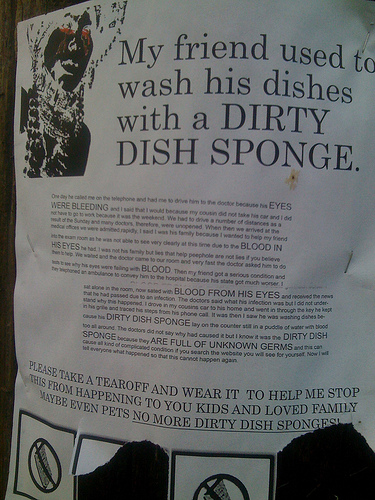
Just don't use a dirty sponge or your will BLEED FROM YOUR EYES. (Via MrGluSniffer)

Just don’t use a dirty sponge or your will BLEED FROM YOUR EYES. (Via MrGluSniffer)

Dear Uncommon Courtesy,

So, my question involves good guest etiquette. I stayed with friends recently and they cooked me a meal when I arrived. Afterwards, I offered to do the dishes. There were already dishes from earlier in the day stacked near the sink, but I decided to leave those and just washed ours from the dinner.

Then, last week my boyfriend and I stayed with a friend and again, a dinner was cooked for us. My boyfriend however, did ALL the dishes around, including some dirty pots from way before our arrival. Now I feel guilty, should I have washed all the dishes at my friend’s place before? Is that good guest behaviour? My boyfriend says he did it to be nice and he doesn’t think anyone should have to do extra dishes, but am totally paranoid now.

Help!

Sincerely,

Dishwashing Dilemma

OFFICIAL ETIQUETTE

The original Emily Post book and other similar books assume all houses have servants, so would never even think to cover such an issue (though, if there are servants, definitely don’t volunteer to do dishes!). The current Emily Post Institute doesn’t go into such detail, but they suggest volunteering for very specific tasks in the kitchen and not hanging around trying to pounce on chores.

OUR TAKE

Victoria: Okay, so at first I thought that this was a one-off dinner, in which case I would say it’s kind of weird to offer to do the dishes instead of bringing a bottle of wine or other hostess gift. But, she seems to have been staying with these friends.

Jaya: Right. So I get the “If you let me sleep on your couch, I’ll do chores” thing. Which is a great thing to do if you’re staying with someone.

Victoria: Totally! And I think it was okay and understandable to just do the dishes from that meal.

Jaya: Especially since the dishes were stacked “near” the sink. If you removed dishes from the sink, didn’t do them, and put them back later, that is weird. But this seems fine.

Victoria: However, personally, I think if you are going to do something, you might as well complete the task. And that means doing all the dishes that are around, wiping down the counters, etc.

Jaya:  Yeah! So based on that, I don’t think this is that strange. She shouldn’t feel guilty. But yeah, I would probably have just done all of them.

Victoria: And you could always ask—especially if they are pots or pans that might need special care, you know?

Jaya: Oh yeah. Perhaps they were on the side for a reason. But I don’t think this is necessarily good guest behavior v. bad guest behavior. She still sounds like a good guest. She did dishes!

Victoria:  Yes!

Jaya:  So she shouldn’t feel guilty. No one would fault her on this. But maybe in the future, just do all the dishes. It’s just easier and more considerate to get it done in one swoop.

How Do I Tell Someone They Smell?

2540896414_e8565f89e8_o

Chalk is one way to tell someone they smell [Credit: Tracy O]

Welcome to our advice column! Write to us at info@uncommon-courtesy.com with your sticky etiquette problems and we will give you the official etiquette answer and then our take on the situation.

Dear Uncommon Courtesy,

How do you tell a friend or acquaintance that they smell terrible? I was standing next to a friend the other day, and I thought I was going to suffocate from holding my breath so long. But I didn’t want to say anything lest I offend them. How do you (gently? harshly?) let a person know they smell terrible (this is as much for their sake as your own, too) and they need to learn how to bathe better (or more often, or twice a day, or thrice a day)?

Sincerely,

Dealing With Smells

OFFICIAL ETIQUETTE

Most etiquette experts agree that the direct approach is best. Someone close to the person should gently mention that they’ve noticed a smell and would want to be told if it was them. Too much perfume/cologne is a common complaint and is easier to bring up than body odor, but they are handled the same way.


OUR TAKE

Victoria: So Jaya, how would you like for me to tell you that you smell?

Jaya: I always like that scene in Wet Hot American Summer where Michael Ian Black just tells that kid that he stinks and needs to take a shower. But then again, you know me well, so we can say things like “Omg please find deodorant” to each other. I know you’re not trying to make fun of me.

Victoria: Yes, I think considering the relationship is super important. I am going to approach things much differently with you than with an acquaintance or a boss. I don’t think you can tell your boss they smell?

Jaya: Probably not! Though if it’s a repeated, awful thing that makes it hard to work, you may want to tell your HR person. Get someone else to deal with it! Always a solution.

Victoria: Yeah, but verrrry discreetly. I also think that with kids or people you are “mentoring” you need to be very straightforward–for their own good. I remember my 6th grade teacher telling the whole class to wear deodorant because we collectively stank.

Jaya: Aww! And that is just at that weird age where you are starting to stink. You’ve gone your whole life just stinking of dirt and food, and now the stink is coming from inside your body.

Victoria: And you just forget to put deodorant on in the morning! Someone shamed me publicly around that age and I haven’t missed a day of deodorant since!

Jaya: Oh no! So maybe sometimes a little public shaming is good?

Victoria: Kids are cruel, but they are also kind of enforcing social expectations.

Jaya: As adults, I think the shaming can be even more soul crushing. Which brings up the idea of telling someone if it’s a one-time thing versus repeated offenses.

Victoria: Yes! I think if it’s clearly a one time thing, you just need to breathe through your mouth and deal.

Jaya: Yeah, people forget deodorant all the time. Or they play sports or step in dog poop or fall in a bog. I forgot deodorant just last week, and who knows, maybe my whole office was trying to find a way to tell me. However, if someone is always stinking, either because they haven’t washed their clothes or they sweat a lot or whatever, they need to know.

Victoria: Definitely.

Jaya: Though now we come to the hard part: how do you tell them? Being frank with your friends is ok, but what about someone who is just…around? Someone you aren’t close enough with to be like “Yo, you smell”?

Victoria: I think what you want to do in that situation is find someone who is close to them and kind of suss out whether this is just you, or something everyone is noticing and then figure out who is the best person to break the news. Verrrry discreetly, again.

Jaya: Yeah. And then maybe try to blame it on something else? Even saying “Your shirt smells” can come off better than just “You smell.”

Victoria: Yes! Or something like “I’ve been noticing that you sometimes smell, maybe your deodorant brand isn’t strong enough?”

Jaya: Also, bring it up at a time when the person can actually do something about it.

Victoria: Yes! Not on the subway, or when you get to a bar, etc.

Jaya: Exactly. Because then you stink and you’re self-conscious about it.

Victoria: If you’re getting ready together or something, though, that’s the perfect opportunity to say “Oh did you forget your deodorant? Here, borrow mine!”

Jaya: What about medical issues? Is smelling something that can be cause for a doctor?

Victoria: Absolutely. So maybe, if you notice someone, or yourself, smelling a lot, go to a doctor. Depression can also make people less likely to bathe- that’s why I like the idea of saying, “I’ve been noticing that you smell strongly lately, is everything okay?”

Jaya: Nice.

Victoria: And then, they can just mention if it’s a medical issue. And you can just deal with it until it gets better.

Jaya: Also, I would like to take a moment to mention that if someone tells you you stink, don’t freak out! It’s no big deal! People stink all the time.

Victoria: Yes! It happens.

Jaya: And then if you deal with it well, you set a good example to the other stinkers of the world for how to take the news. It’s the circle of etiquette.

What is etiquette and why should I care?

When people bring up etiquette, they often refer to knowing which fork to use and other minutiae and ask why should they bother learning all these silly rules. While it is true there is somewhat of a rule book of details like which fork to use and which way to pass by people in the theater, etiquette is MOSTLY about making people comfortable and smoothing over social situations. So all those silly details come from a place of: if we all know the rules, then you will know what to expect in any given social situation and no one will be awkward or embarrassed. Because left to our own devices, let’s face it, we’re all incredibly awkward.

But in our modern world, the official rules are changing. Tradition is being left behind, while at the same time technology and a widening world have increased the number of kinds of tricky social situations you may find yourself in. There are some official rules, but since not everyone knows them, we aren’t on the same page of knowing what to expect. And to a certain extent, the official rules don’t always take into account the lightning quick ways social expectations can fluctuate in different circles.

We wanted to create this site to introduce people to the official etiquette rules but also provide a reality check about the reasons these rules exist and how you might adapt them or break them to fit your life. As a former art teacher of mine once said “when you know what the rules of art are, then you can break them with a purpose.” It’s the same thing with etiquette: if you fully understand the basics you can choose when and where to break them, and you’ll know why you are doing so, what the consequences are, and why that could actually be a good thing.

Please share your own thoughts and opinions on etiquette in the comments, we would love to see views and experiences outside our own!