A Vague Guide To Maybe Hitting On Someone

when-you-try-to-flirt-with-someoneI’ve attempted to write a How To Hit On Someone post for a while now, and man, it is impossible. I now fully understand why the only options out there are either the dangerous “physically pull a woman into your lap and make her push you away” or the vague “say hi, see if you have anything in common, and then move on if there’s no spark.” It’s because any middle ground is so personal and circumstantial. Some people like having drinks bought for them, others consider it an insult. Some people enjoy being approached, while others prefer to do the approaching. There’s almost no way to write something for everyone. Which is a shame, because neither “SEX IS A CONQUEST” nor “I don’t know, do what you want?” is helpful for anyone.

So, knowing that I can’t speak for anyone else’s experiences or tastes, I want to relate some times where I have been approached by a stranger in a bar, at a concert, or in another public setting  and how it worked out, since when you’re single the general idea is that you’re supposed to meet people in public settings. Many of these were in the successful range, others were not. Take from this what you will.

Do ask what I’m reading: Once I was at a bar alone, reading a book, waiting for my boyfriend. A guy came up to me and asked what I was reading, and at that particular moment I was feeling conversational, so I started talking to him. Within 15 minutes I was drinking beer with him and all his friends at his table. If he was sincerely hitting on me it didn’t work out because, duh, my boyfriend showed up, but all in all I think we had a pretty good time.

Don’t neg me about my race: If you’re not familiar with negging, it’s the process of insulting/ignoring the person you want to woo in the hopes that they will be confused enough to sleep with you. Yeah, I don’t get it either. But once a guy outside a bar kept saying out loud to his friends while pointing at me “She’s so hot, I don’t care if she’s hispanic.” 1. I’m not hispanic 2. It doesn’t even matter what race I am because holy shit what are you talking about?? I was drunk enough to get pulled into a conversation (argument) with him, in which later he insulted my friends’ intelligence and looks (“They’re not smart like you”), and was then baffled when I wouldn’t go home with him.

Do find common interests: When I was 22 I found myself in a weird bar in New Zealand (I mean, on purpose, I did not wake up on my 22nd birthday unable to remember how I got to this country), and everyone was dancing to really clubby music and it just wasn’t my scene. A guy apparently noticed this, and began talking to me about how it wasn’t his scene either. We got some drinks, sat in a booth in the back and talked for a really long time, and then made out for an even longer time. Common interests doesn’t have to be boring!

Don’t be surprised that we have common interests: I once was with a guy who basically sent flirting into overdrive once he discovered that I could quote The Blues Brothers and agreed that the best Guinness I ever had was in Ireland. The night went well, but in hindsight I find it sort of disturbing that his reaction was less “wow, I love that thing too!” and more “you’re so cool because most girls don’t like that thing!” Lots of people like lots of different things. Girls like video games, guys like fashion, gay men like football…etc. It’s a great moment of luck if you find out someone shares your tastes, but it shouldn’t be surprising because of their sex.

Do be honest if you’re attracted to something: If you find something attractive about someone, tell them! This can be physical, like telling them they have a nice smile or you like their hair. The whole point if this dating thing is that you’re supposed to find something attractive in the other person, so that’s nice to know! In early-on flirting situations I’ve had guys compliment some aspect of my body, and it’s usually felt pretty nice. If I’m starting to become basely, lustily attracted to someone, it’s nice to know it’s mutual.

Don’t focus entirely on the sexual: If you think this person has beautiful eyes, great, but for the love of god do not make that the entire thing about them. Feeling lusted after is nice, feeling like everything you’ve been saying for the past hour has been ignored because your partner cannot ignore their attraction is another.

Unfortunately, there is an infuriating key to this, that I cannot describe any other way than don’t do any of this as anyone other than yourself. I know, the “be yourself” advice is so frustrating to hear, because duh you’ve been yourself, how you can you be anyone but yourself, but “yourself” isn’t working. But yourself will work, I promise. Being yourself isn’t about being every aspect of yourself all at once from the get go, it’s about doing things in a way that feels natural to you while still being able to test the waters with someone new. So go forth and talk to people you find attractive! It’s ok, I promise!

Have you’ve ever been successfully wooed by a stranger? Let us know how it went!

Let’s Stop Calling Having Strong Opinions “Rude”

Murder has nothing to do with manners

Murder has nothing to do with manners

If there was one etiquette rule that I internalized my entire life, it was the idea that you should NEVER call someone out for being rude. (Ok, except if they try to upstream you.) Someone forgets to send you a thank you note? Rude. You call that person to chastise them for not sending one? WAY MORE RUDE. Don’t invite +1s to your wedding? Totally fine, though some people seem to think it’s rude. Yelling at a bride and groom for not getting a +1? YOU ARE THE WORST HUMAN.

This has made it so that being called “rude” is a terrible insult, and thus, if someone has felt the need override this rule because of what you’re doing, then what you’re doing must be inhumane. Sure, we’ve probably all had a momentary outburst at a stranger who is bothering us, but I’m hard pressed to find a time in my life when I’ve told a friend or family member that what they’re doing is a rude action, even if I’ve felt it with all my being.

However, there is one thing that is not and never will be rude: having an opinion about your own life. So let’s stop treating it like it is.

Ama Yawson recently wrote this incredible piece for The Atlantic about racism, tolerated behaviors, and teaching her children to stand up for themselves. Please go read it now. This is important. But what struck me about it is the whole thing was couched in the language of etiquette. People laugh “politely” when they hear racist speech. The idea of having courage to speak up  is weighed against basic “courtesies.” Apparently being a good sport means never disagreeing with someone. She writes, “As a child, I was taught to refrain from reprimanding others for fear of causing them shame.  Moreover, many of us are conditioned to avoid the potential discomfort and social ostracism that such reprimands might trigger.”

Let’s be clear: “Polite” and “rude” are not synonyms for “right” and “wrong.” There is a huge difference between yelling at your houseguest for not making the bed and calling out a barber when he calls your son the N-word*, and speaking of the latter in terms of what is “polite” and what is “rude” is doing both sides a disservice. Yet this idea of something as “rude” has been turned into an insult you can hurl at anyone if they happen to disagree with your twisted view of humanity. “You don’t want to be rude, do you?” is now a a sinister threat. We’ve all been taught that being nice means never voicing a different opinion.

Obviously racist, sexist, and other intolerant behavior is something you should stand up against. But there are other times, smaller times, where having a personal need that goes against someone else’s plans is treated as a breach of etiquette. I immediately think of wedding planning, when so often brides stating opinions are referred to as “bridezillas.” I think of how I worry about my friends thinking I’m rude if I cancel plans because of a sudden onslaught of social anxiety. Hell, I worry that if my fiance and I are trying to figure out what to eat for dinner and I suggest “pizza” too powerfully he’s going to think I don’t respect his opinion.

It is often difficult to figure out the difference between being polite and being a pushover, especially when adhering to social graces is held in such esteem. People like it when other people are nice to them; that’s the whole reason we even have this damn website. We can all think of times where we should have spoken up but didn’t, or should have kept our mouths shut.

We all want to be treated with common courtesy, but sometimes that means demanding it. Not putting up with bigoted behavior is not a matter of etiquette, it’s a matter of basic human decency. You should never apologize for your fundamental being. You deserve space on this earth just like everyone else. So let the language of etiquette be used to discuss noisy neighbors and baby shower gifts. Don’t you dare worry about being polite.

*Which, by the way, you have every right to speak out against if just for the fact that you are paying him for a service you specified and he did not do it to your liking.

Let’s Eat These Foods With Our Fingers Like Monsters

We have a little etiquette secret for you. We know that your parents probably spent your entire childhood trying to get you to use a knife and fork properly, and to not just pick up food with your hands and mash it into your face like you’re a baby. But did you know there are foods you’re actually encouraged to eat with your fingers? Behold, the wonders of dining etiquette!

Anything served on a toothpick: This is pretty obvious, because what, you’re gonna pick the whole thing up with a fork and then get the toothpick in your mouth? No. Usually this is stuff like cheese cubes, olives, crudite, etc. Go ahead and use your hands.

Asparagus: Eating it with your fingers only applies if they are spears of asparagus and do not have sauce on them. In general, where there’s sauce, there are eating utensils.

Sushi: Usually Americans like to show off their chopstick skills at sushi restaurants, but sushi is really meant to be eaten with your hands. This is because many believe the delicate fish picks up the flavors of anything it touches, so metal cutlery is a big no-no.

Artichokes: I’d like to see anyone try to eat artichoke leaves with a fork. You’re supposed to rip each leaf off, dip in butter or any accompanying sauce, and then put it in your mouth and scrape the meat off with your top teeth. Charming.

Bacon: To eat bacon with your fingers, it must be crisp! If it’s soggy and limp, use a knife and fork. (ED: if it’s soggy and limp send it back to the kitchen to be cooked properly, yuck!)

Corn: Ok, so there is a way to eat corn on the cob with a knife and a fork, by sort of tilting the cob up on one end and scraping the kernels off but good lord that sounds like a recipe for sending your corn flying into the lap of the person next to you, and possibly taking out some fine china with it.  If you’re a host and you serve corn on the cob you best believe your guests should eat it with their fingers. Otherwise you’re just trying to torture them.

Pizza: Someone suggested that if pizza is heavy with toppings you are allowed to use your fork, but that just means you’re a quitter.

Tiny birds like quail, and frog’s legs: These can be picked up in the fingers, though you must avoid the appearance of gnawing.

Dinner Rolls: As we keep saying, these are broken apart with the fingers and each section is buttered individually and then eaten with the fingers.

Indian food: Lots of Indian food, especially of Northern cuisines, is served with bread, which you should use as your utensil by ripping of pieces and picking up food with it, like a little sandwich! Just make sure to use your right hand, because your left hand is reserved for…something else.

Thank Goodness We Don’t Have To Do That Anymore: Bathing Machines

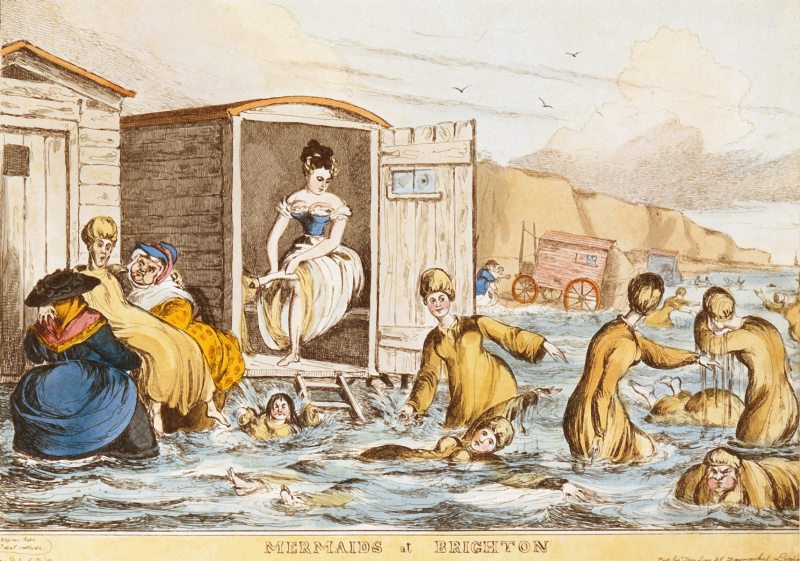
 "Mermaids at Brighton" by William Heath (1795 - 1840), c. 1829. Depicts women sea-bathing with bathing machines at Brighton.

“Mermaids at Brighton” by William Heath (1795 – 1840), c. 1829. Depicts women sea-bathing with bathing machines at Brighton.

I know it’s November, but I think now is the perfect time to talk about some of the eccentricities of beach etiquette in the Victorian era. Because you know that cozy outfit you’re wearing right now? Imagine wearing that on the beach. Summertime fun!

Bathing, whether by spa or by sea, began as a recreational activity in the mid-1800s. Prior to that, prolonged time in the water was assumed to cause instant death (something about water opening the pores so all the disease can get in). But by the mid 19th-century, many doctors began espousing the restorative and medicinal properties of a good soak or swim, and the middle-class began associating cleanliness with refinement, and dirtiness as a sign of disease and immorality. So all of a sudden, everyone wanted to go to the beach, and realized you couldn’t really do this in your everyday clothing.

Beaches have always been fun for men. They could bathe in their underwear, within full view of any delicate woman. But women had to hide their beach bodies and activities. According to Victoriana Magazine (why don’t I have a subscription to this), “Women typically dressed in black, knee-length, puffed-sleeve wool dresses, often featuring a sailor collar, and worn over bloomers trimmed with ribbons and bows. The bathing suit was typically accessorized with long black stockings, lace-up bathing slippers, and fancy caps.” This just goes to show you that even though we still argue about abortion and health care and intersectionality in feminism, things have changed. I am wearing a more revealing outfit right now, and I’m at work. Also I am a woman at work.

As you can imagine, these bathing outfits were not really easy to swim around in. In Extraordinary Origins of Everyday Things, Charles Panati mentions that there were a number of fatalities in Europe and America due to “waterlogged bathers caught in an undertow.” But, y’know, modesty.

Now, these outfits were only appropriate for the beach, so how did a woman get into them? Surely you couldn’t just hop in the car with a sarong around yourself. No, for this, we had bathing machines! These devices first showed up in England in the 1750s and lasted until the early 20th century. W.C. Oulton in The Traveller’s Guide; or, English Itinerary, Vol II describes them as “four-wheeled carriages, covered with canvas, and having at one end of them an umbrella of the same materials which is let down to the surface of the water, so that the bather descending from the machine by a few steps is concealed from the public view, whereby the most refined female is enabled to enjoy the advantages of the sea with the strictest delicacy.” Once in the water, a “modesty hood,” sort of like an awning,  hid her activities from male bathers.

As you may have expected, these were incredibly uncomfortable to use. Women would get in, change and store her street clothes in a little shelf up top so they wouldn’t get wet, and then get yanked into the water by horses. Sometimes other, stronger women would be hired to throw and retrieve the bathers to and from the sea, and if you couldn’t swim they’d tie a rope around your waist and let you bob there for a while, until a wave banged you around. (These “dippers” were also in charge of getting rid of male gawkers, and can we please get some erotic fiction going about them.) In The Hand-Book of Bathing, the author writes “if, therefore, the good effect of the bath is to be immediately counteracted by what must inevitably follow in a common bathing-machine, the patient had better totally refrain from sea-bathing.”

Like with most practices of modesty, we got over it, probably faster because of that whole drowning thing.

To The Man Who Upstreamed Me A Few Days Ago

To the man who upstreamed us in Queens a few nights ago:

I apologize that my fiance called you a “piece of shit asshole” when a cab pulled up to you before us, but let me explain. You see, despite your insistence that you wouldn’t/shouldn’t be paying attention to us, I must insist that in the future, you become more aware of those around you, especially when catching a cab.

Catching a cab in New York City is an art, and I could tell by your form that you were unpracticed and possibly new. You held your arm out for cabs that didn’t have their lights on, a telltale sign of a newbie. That’s ok. Everyone is new to hailing cabs at some point, but really, you should learn the rules before you attempt such a brazen move as an upstream.

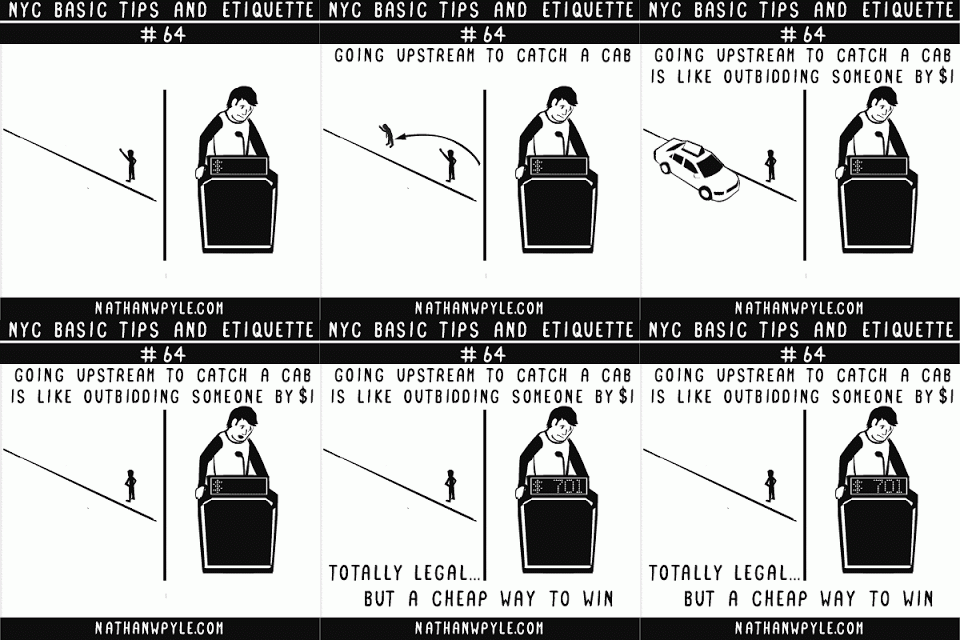
Nathan W. Pyle of the popular NYC Basic Tips & Etiquette gif series puts the practice thusly:

However, I would argue that upstreaming someone for a cab–which, by walking to the corner ahead of us after we had been standing there attempting to hail a cab for about 10 minutes, you most certainly did–is more than just a “cheap way to win.” It is a cheap way to live. It means you assert yourself as more important than your neighbors and community. It is why New Yorkers hate gentrification so much: you’re saying you’re here, but you don’t care.

I’m sorry if this comes off as too serious, but I have a long and uncomfortable relationship to upstreaming. Sometimes, as a child, I’d be late getting out the door for school, ensuring that a ride on the M15 bus would make me late. So, not wanting me to get to school late, or to hail a cab by myself, my parents would put me in a cab to school. They both lived at busy intersections, and it was often a time of morning when lots of other people would be late for work/school if they did not catch a cab. But that did not seem to bother my dad; getting his only child to school on time was important. So he’d walk against traffic, getting ahead of those who had been waiting longer, and as I’d pass them by again from the comfort of the backseat of a Crown Victoria I’d slink down in shame, knowing that the only reason I was there and they were not was because I decided to take their civility for granted.

But back to you.

There are a few other circumstances that made your move so frustrating. Firstly, we were in Queens, and though that corner was probably the best bet for cabs in the area, it’s hardly a hot spot. Secondly, it looks like you were coming off of work at a film shoot that was taking place, given that you were saying goodbye to a lot of people still inside the giant trailers parked everywhere. This city already has a tenuous relationship with film crews, who often block our streets and sidewalks and tell us where we can and cannot walk, and you’re doing nothing to help their reputation with your behavior.

So what should you have done?

Firstly, you should have looked around. You should have paid attention to us. We were at the opposite corner from you, clearly waiting for a cab to come in the same direction. Once you noticed us you should have either walked to a different block to try your luck there, or come over and waited behind us. Yes, I know it was late at night and yes, I know you were “just trying to get home like everyone else,” but “everyone else” includes us, who were waiting to get home before you.

Being a New Yorker (though, I’m presuming, a new one) you may be thinking “why should I care? New Yorkers are rude people, so I have the right to be rude! Plus, that guy just called me an asshole!” It’s true, New Yorkers have a certain–and in my opinion, false–reputation for being rude. But these rude outbursts are not just for the sake of being mean to strangers. Any time a New Yorker yells at you, it is punishment for disrupting the balance of the city, a place where the needs of millions must be sorted out in an incredibly confined space. In order for everyone not to go nuts, we’ve developed a dance. You keep to the right of stairwells, and don’t stop in the middle of moving traffic (yes, sidewalks count as moving traffic). You define your space on the subway in order to maximize your comfort, yet not encroach on the personal space of those around you. You’re constantly balancing your needs versus the needs of others, putting yourself first when it counts, and taking one for the team when someone else needs it. The whole idea is the foundation of good etiquette.

So, when my fiance yelled at you, it was not because he likes yelling, but because you were disrupting the balance and must learn, lest you spend the rest of your life pissing off every New Yorker you come in contact with. If we had the time to have a full conversation we would have, but let’s face it, we were all trying to get home. Yes, there are some who are rude for no reason, but you’ll find those people across the globe. Perhaps you were shocked that he would call you out, but really, consider it a favor. Hopefully, you’ll remember this the next time you attempt to grab a cab from someone who has been patiently waiting for longer than you have.

There may come a day where you legitimately need to upstream someone. One day your wife may be in labor, or you’re late for a job interview at a cutthroat firm, where being one minute late would guarantee that you’d lose the opportunity. Go forth and upstream then, knowing that it’s necessary. But if it’s a Wednesday night at 11 pm and you see two tired and slightly cold people waiting on a corner, leaning into the road to look for cabs, I implore you to cross the street and wait behind them.

Best,

Jaya

Not such a great idea now, huh hotshot?

Not such a great idea now, huh hotshot?