Let’s Eat These Foods With Our Fingers Like Monsters

We have a little etiquette secret for you. We know that your parents probably spent your entire childhood trying to get you to use a knife and fork properly, and to not just pick up food with your hands and mash it into your face like you’re a baby. But did you know there are foods you’re actually encouraged to eat with your fingers? Behold, the wonders of dining etiquette!

Anything served on a toothpick: This is pretty obvious, because what, you’re gonna pick the whole thing up with a fork and then get the toothpick in your mouth? No. Usually this is stuff like cheese cubes, olives, crudite, etc. Go ahead and use your hands.

Asparagus: Eating it with your fingers only applies if they are spears of asparagus and do not have sauce on them. In general, where there’s sauce, there are eating utensils.

Sushi: Usually Americans like to show off their chopstick skills at sushi restaurants, but sushi is really meant to be eaten with your hands. This is because many believe the delicate fish picks up the flavors of anything it touches, so metal cutlery is a big no-no.

Artichokes: I’d like to see anyone try to eat artichoke leaves with a fork. You’re supposed to rip each leaf off, dip in butter or any accompanying sauce, and then put it in your mouth and scrape the meat off with your top teeth. Charming.

Bacon: To eat bacon with your fingers, it must be crisp! If it’s soggy and limp, use a knife and fork. (ED: if it’s soggy and limp send it back to the kitchen to be cooked properly, yuck!)

Corn: Ok, so there is a way to eat corn on the cob with a knife and a fork, by sort of tilting the cob up on one end and scraping the kernels off but good lord that sounds like a recipe for sending your corn flying into the lap of the person next to you, and possibly taking out some fine china with it.  If you’re a host and you serve corn on the cob you best believe your guests should eat it with their fingers. Otherwise you’re just trying to torture them.

Pizza: Someone suggested that if pizza is heavy with toppings you are allowed to use your fork, but that just means you’re a quitter.

Tiny birds like quail, and frog’s legs: These can be picked up in the fingers, though you must avoid the appearance of gnawing.

Dinner Rolls: As we keep saying, these are broken apart with the fingers and each section is buttered individually and then eaten with the fingers.

Indian food: Lots of Indian food, especially of Northern cuisines, is served with bread, which you should use as your utensil by ripping of pieces and picking up food with it, like a little sandwich! Just make sure to use your right hand, because your left hand is reserved for…something else.

Drinking in the Office

If the President can drink on the job, so can you. via Wikimedia Commons

Dear Uncommon Courtesy,

My new company had an “afternoon tea” to welcome new associates and all they had was beer, which I felt weird about drinking since I just started and my boss was there and she wasn’t drinking. What do you do about office drinking situations, in general?

Sincerely,

Not The Office Drunk

OFFICIAL ETIQUETTE

Most of the etiquette regarding drinking at work seems to be about holiday parties and the advice is usually to not drink too much, so I assume that also goes for all other workplace drinking as well.

OUR TAKE

Victoria:  I am pro drinking in the office, and I think with this question, if it is offered, to take it at face value and not think they are trying to trick you.

Jaya:  Oh yes. A glass of wine on a friday afternoon boosts morale so much. I think it’d be strange if all they provided was beer and expected you not to drink any, right?

Victoria:  Right! Like, why would they do that? And if they are trying to trick you, maybe its a signal of much deeper problems.

Jaya:  Though I understand the anxiety about being new and not wanting to be too enthusiastic

Victoria:  Oh yeah, especially if you are new. Though i think if you are a long time employee, then you should show enthusiasm so that the newer people know it’s okay. And if you have temps and interns, or a receptionist who is chained to the front desk, make sure that they know it’s there and are welcome to have some. bring it to them if you have to. I have temped a lot in my life and it is so nice when people make you feel included and not like a space alien who is visiting earth for a few weeks.

Jaya:  Hahaha oh no! Yeah, if it’s there, it’s meant to be enjoyed. I’ve shown no remorse over having five cookies from a platter on some coworker’s birthday, and I wouldn’t be upset about having some wine on a similar occasion. Just don’t get wasted if it’s in the middle of the day and you have to get back to work.

Victoria:  Hahah, yes, that is a very good point. Oh and don’t pressure people to drink if they decline.

Jaya:  Absolutely. You don’t know why they’re not drinking. Though, it doesn’t matter. If they don’t want to they don’t want to, whether it’s because they’re an alcoholic or they’re just not in the mood

Thank Goodness We Don’t Have To Do That Anymore: Bathing Machines

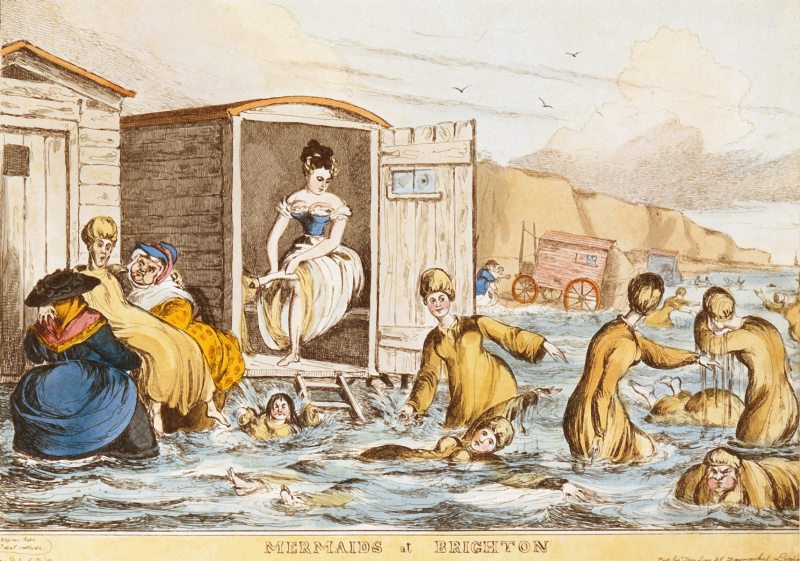
 "Mermaids at Brighton" by William Heath (1795 - 1840), c. 1829. Depicts women sea-bathing with bathing machines at Brighton.

“Mermaids at Brighton” by William Heath (1795 – 1840), c. 1829. Depicts women sea-bathing with bathing machines at Brighton.

I know it’s November, but I think now is the perfect time to talk about some of the eccentricities of beach etiquette in the Victorian era. Because you know that cozy outfit you’re wearing right now? Imagine wearing that on the beach. Summertime fun!

Bathing, whether by spa or by sea, began as a recreational activity in the mid-1800s. Prior to that, prolonged time in the water was assumed to cause instant death (something about water opening the pores so all the disease can get in). But by the mid 19th-century, many doctors began espousing the restorative and medicinal properties of a good soak or swim, and the middle-class began associating cleanliness with refinement, and dirtiness as a sign of disease and immorality. So all of a sudden, everyone wanted to go to the beach, and realized you couldn’t really do this in your everyday clothing.

Beaches have always been fun for men. They could bathe in their underwear, within full view of any delicate woman. But women had to hide their beach bodies and activities. According to Victoriana Magazine (why don’t I have a subscription to this), “Women typically dressed in black, knee-length, puffed-sleeve wool dresses, often featuring a sailor collar, and worn over bloomers trimmed with ribbons and bows. The bathing suit was typically accessorized with long black stockings, lace-up bathing slippers, and fancy caps.” This just goes to show you that even though we still argue about abortion and health care and intersectionality in feminism, things have changed. I am wearing a more revealing outfit right now, and I’m at work. Also I am a woman at work.

As you can imagine, these bathing outfits were not really easy to swim around in. In Extraordinary Origins of Everyday Things, Charles Panati mentions that there were a number of fatalities in Europe and America due to “waterlogged bathers caught in an undertow.” But, y’know, modesty.

Now, these outfits were only appropriate for the beach, so how did a woman get into them? Surely you couldn’t just hop in the car with a sarong around yourself. No, for this, we had bathing machines! These devices first showed up in England in the 1750s and lasted until the early 20th century. W.C. Oulton in The Traveller’s Guide; or, English Itinerary, Vol II describes them as “four-wheeled carriages, covered with canvas, and having at one end of them an umbrella of the same materials which is let down to the surface of the water, so that the bather descending from the machine by a few steps is concealed from the public view, whereby the most refined female is enabled to enjoy the advantages of the sea with the strictest delicacy.” Once in the water, a “modesty hood,” sort of like an awning,  hid her activities from male bathers.

As you may have expected, these were incredibly uncomfortable to use. Women would get in, change and store her street clothes in a little shelf up top so they wouldn’t get wet, and then get yanked into the water by horses. Sometimes other, stronger women would be hired to throw and retrieve the bathers to and from the sea, and if you couldn’t swim they’d tie a rope around your waist and let you bob there for a while, until a wave banged you around. (These “dippers” were also in charge of getting rid of male gawkers, and can we please get some erotic fiction going about them.) In The Hand-Book of Bathing, the author writes “if, therefore, the good effect of the bath is to be immediately counteracted by what must inevitably follow in a common bathing-machine, the patient had better totally refrain from sea-bathing.”

Like with most practices of modesty, we got over it, probably faster because of that whole drowning thing.